|
|
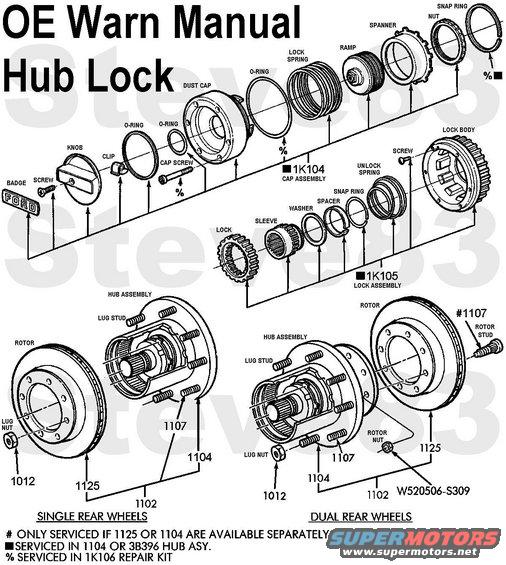
Stock (Warn) Manual Hub Locks
IF THE IMAGE IS TOO SMALL, click it.
This diagram has errors & omissions. The axle stub shaft retainer is not shown. For 1/2-ton (5-lug) trucks, the brake rotor attaches to the rear (inboard face) of the hub flange by the lug studs' splines.
Ford 8.8" axle uses 10 lug studs D6AZ-1107-A ('83-00)
Dana 44IFS uses 10 lug studs D6TZ-1107-A ('83-96)
Ford TIB axle uses 10 lug studs F4UZ-1107-A ('94-96)
Removal -- Manual Locking Hub:
1. Separate the cap assembly from the body assembly by removing six cap screws and remove the cap from the body.
2. Remove the snap ring that retains the axle shaft in the hub body assembly.
3. Remove the lock ring seated in the groove of the wheel hub.
4. Remove the body assembly from the hub. If the body is difficult to remove, install two cap screws and pull the body assembly out of the hub.
INSTALLATION
1. Insert the body assembly in the hub.
2. Install the lock ring in the groove to retain the body in the hub.
3. Install the snap ring that retains the axle shaft to the body.
4. Position the cap assembly on the body. Install the six cap screws and tighten to 4.0-6.0 Nm (35-53 lb-in).
NOTE: Do not pack the cap assembly with grease. Excessive grease can cause excessive dialing effort.
-----------------------------------------------------------
Today's free-running hubs are very simple to operate and feature seals that prevent the entry of dirt and moisture. Automatic locking hubs are used in many applications. They use the front axle shaft rotation to actuate a cam that locks and unlocks the hub.
There are two types of front hubs currently in use on Ford Trucks:
^ Manual (or free-running) that require the driver to get out of the cab to either lock or unlock them.
^ Automatic locking (they lock automatically when the axle shaft begins to turn).
The vehicle operator doesn't have to wait until the last minute (or when stuck) to lock the hubs. It makes sense to plan ahead and lock them at a convenient time. The hubs can be left in the locked position all the time if desired. For example, if the vehicle is constantly going from the highway to off the road conditions and back, it's not necessary to lock or unlock every time. If the vehicle is equipped with a manual shift transfer case and manual locking hubs, low range can be selected when the vehicle's front hubs are unlocked. This is useful for short distances if very low, creeper gearing (but not 4WD) is needed. For example, backing an empty boat trailer down a launching ramp is best accomplished in 2WD. Once the boat is loaded, 4L (low) can be selected to help pull the boat up the ramp. The hubs don't have to be locked for this purpose, and being in 2WD will prevent driveline windup while maneuvering in the boat ramp parking lot.
|