Ford 3G Alternator Output Curves - 95/130 Amp, Leece-Neville 165A, Mitsubishi 215A
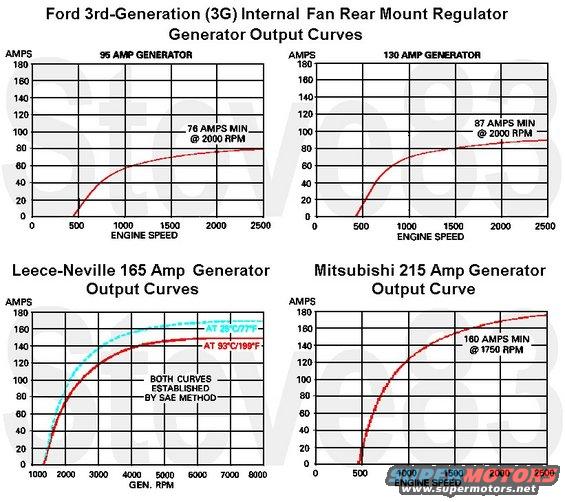
Alternator Output Curves for Ford 3G (95A & 130A), Leece-Neville 165A, and Mitsubishi 215A
Use an inductive meter rated for at least 200A DC around the heavy Bk/Or alternator output wire while a heavy load is applied to the battery, and the engine is near 2000 RPM.
Preliminary checks to the charging system should be made regardless of the fault condition. These checks include:
1. Check battery posts and cable terminals for clean and tight connections. Clean the posts and the cables to ensure good electrical contact.
2. Check for secure connections at the generator output, generator case, regulator, and engine ground. Also check the connection at the load distribution point (starter relay). .
.  .
.  .
. 
3. Check the generator belt and belt tension.
4. Check the fuses/fuse links and wiring to the generator to ensure that they are not burned or damaged. This condition, resulting in an open circuit or high resistance, can cause erratic or intermittent charging system concerns.
5. Check the battery voltage. If the voltage is less than 12.3 volts with the engine and all accessories off, charge battery before proceeding.
Is this accurate? Sign in to help verify it.
Frequently asked questions
- What is the minimum output for the Ford 3G 95 amp generator?
- The 95 amp generator should produce a minimum of 76 amps at 2000 engine RPM.
- What is the minimum output for the Ford 3G 130 amp generator?
- The 130 amp generator should produce a minimum of 87 amps at 2000 engine RPM.
- What is the minimum output spec for the Mitsubishi 215 amp generator?
- 160 amps minimum at 1750 engine RPM.
- How does temperature affect the Leece-Neville 165 amp generator's output?
- The chart shows two curves: output at 25°C/77°F is higher than output at 93°C/199°F across the RPM range. Both curves were established by the SAE method.
- Is the Leece-Neville chart plotted against engine speed or generator speed?
- It is plotted against generator RPM (1000–8000 RPM), unlike the other three charts which use engine speed (0–2500 RPM).
Comments
More from this build


No comments yet.