|
|
 TSB90-25-12VacCruise01.jpg | Hits: 1752 | Size: 5.5 KB | Posted on: 1/1/07 | Link to this image TSB90-25-12VacCruise01.jpg | Hits: 1752 | Size: 5.5 KB | Posted on: 1/1/07 | Link to this image
TSB 90-25-12 Vacuum Cruise System Diagnostics
ISSUE: Integrated Vehicle Speed Control (IVSC) was introduced on some 1986 units. The IVSC system uses the EEC IV processor as the control module. Before IVSC a Stand Alone Speed Control System was used on all applications. The Stand Alone Speed Control System uses a separate control amplifier.
ACTION: Refer to the following diagnostic information when servicing speed control concerns. Refer to the Speed Control System Application chart to determine which type of system is used for a specific model.
NOTE: THE DIAGNOSTIC INFORMATION ON THE FOLLOWING PAGES WILL APPLY TO THE STAND ALONE AND INTEGRATED VEHICLE SPEED CONTROL SYSTEMS UNLESS A SPECIFIC VEHICLE TYPE IS REFERENCED.
|
|
|
 TSB90-25-12VacCruise02SysID.jpg | Hits: 3225 | Size: 50.87 KB | Posted on: 1/1/07 | Link to this image TSB90-25-12VacCruise02SysID.jpg | Hits: 3225 | Size: 50.87 KB | Posted on: 1/1/07 | Link to this image
"TRICKS OF THE TRADE"
Many speed control concerns can be easily resolved by using the following "Tricks of the Trade" diagnostics. If a concern cannot be resolved, refer to the shop manual, Section 37-05 for additional component testing.
VERIFY CUSTOMER CONCERN
Before performing speed control diagnosis, the customer concern should be verfied. Occasionally, the customer does not completely understand operation of the speed control system. If this is the case, the customer should be referred to the Owner Guide for complete speed control operating instructions.
Most misunderstanding involves operation of the RESUME feature. RESUME should be used to return to a previously set speed after speed control operation has been interrupted. The RESUME feature will not operate if the vehicle speed has been lowered through use of the COAST button. The release of the COAST button sets the new lower speed into the control memory. Also, RESUMEwill not work if the vehicle speed is below the minimum speed control operating speed of about 30 mph (48 km/h).
The RESUME function for the Stand-Alone Speed Control System may not activate with a momentary tap of the RESUME button. The RESUME button must be held down for a short time to make sure of engagement.
Speed drops of more than 1 or 2 mph may occur while in speed control operation on grades or under other load conditions. This is especially true on vehicles that are equipped with automatic overdrive transmissions or with manual 5 speed transmissions. These speed drops are due to limited engine power available in the overdrive (or the highest gear of a manual transmission) mode of operation. Under heavy load conditions, such as hilly or mountainous areas or during trailer tow, the vehicle speed may drop even more. When speed drops of 10 - 13 mph (16 - 21 km/h) occur the speed control system will, by design, automatically disengage.
SYSTEMS
The speed control system obtains vehicle speed information from the vehicle speed sensor. In most cars and trucks the sensor is mounted on the transmission or in-line with the speedometer cable. The sensor is driven from gearing in the transmission. On 1986-90 Lincoln Town Car, Crown Victoria, Grand Marquis and Mark VII vehicles the speed signal comes from a speed sensor located in the Electronic Instrument Cluster. If the speedometer system is erratic or inoperative, it must be serviced before the speed control system is evaluated.
The speed control system also interacts with the brake system, and with the clutch system on manual transmission vehicles. Speed control requires electrical continuity through the stoplamps (and clutch switch on manual transmission vehicles) in order to operate. Proper stoplamp operation is required if the system is to disengage with brakes. Proper clutch switch operation is also required on manual transmission vehicles if the system is to disengage with clutch pedal actuation. Stoplamp and clutch switch circuit diagnosis is detailed in Section 37-05 of the appropriate Shop Manual.
NOTE: SPEED CONTROL WILL NOT DISENGAGE IF THE GEARS ARE SHIFTED ON A MANUAL TRANSMISSION VEHICLE WITHOUT DEPRESSING THE CLUTCH PEDAL.
VISUAL INSPECTION
Visual inspection is an important part of diagnosis. The visual inspection should be done to locate obvious reason for the customer concern.
When performing visual inspection, check all items for abnormal conditions. Look for items such as bare, broken or disconnected wires and damaged vacuum hoses.
For the speed control to function properly, it is necessary that the speedometer cables, if so equipped, be properly routed and securely attached. All vacuum hoses must be securely attached and routed with no sharp bends or kinks. The servo (throttle actuator) and throttle linkage should operate freely and smoothly.
Any concerns found by the visual inspection should be corrected before further tests of the speed control system are made. The following items should be inspected.
GENERAL
* Does the horn work? If not, check the horn circuit fuse, horn relay and horn circuit wiring.
* Do the stoplamps light when the brake pedal is depressed? If not, check the stop lamp circuit fuse, stoplamps, wiring and stop lamp switch.
AMPLIFIER
* Check for unseated connectors at the speed control amplifier. The amplifier location varies by carline. Refer to the appropriate Shop Manual, Section 37-05, for location.
* Look for loose or unseated connector pins.
* Check for broken wires at the connectors.
SERVO: Check for the following items.
* Disconnected or cut vacuum hose from the servo to the manifold source.
* Loose or disconnected electrical connector, or broken wire.
* Loose, or cracked plastic elbow at the servo.
* Disconnected, or loose, dump valve hose at the servo.
ACTUATOR CABLE
* Misadjusted Bowden cable/bead chain. If misadjustment is suspected due to set speed error or excessive speed drop, the cable or chain should be readjusted.
* Cable loose, or not connected to the engine bracket (screw loose or missing).
DUMP VALVE
* Hose pinched or not connected to the dump valve.
* Dump valve is not fully seated into the retaining clip in the brake pedal support bracket.
* Check the dump valve adjustment. Readjust the dump valve if the yellow plunger is extended more than 1/4" when the brake pedal is not depressed.
|
|
|
 TSB90-25-12VacCruise03CrctID.jpg | Hits: 2125 | Size: 48.16 KB | Posted on: 1/1/07 | Link to this image TSB90-25-12VacCruise03CrctID.jpg | Hits: 2125 | Size: 48.16 KB | Posted on: 1/1/07 | Link to this image
VOLTAGE/RESISTANCE TESTS
If a concern cannot be found with a visual inspection, it can usually be found with an inspection. It can usually be isolated by making voltage and resistance measurements at the amplifier connectors (Stand-Alone System) or at the EEC-IV connector (Integrated System). The connectors must be unplugged for the resistance checks.
The following tables summarize the circuits and wire color codes used for the speed control system. The proper voltage/resistance readings at the amplifier or EEC-IV connectors are also given. Typical circuit numbers apply to both car and truck applications. Refer to the appropriate Shop Manuals, Section 37-05, or to the Electrical/Vacuum Trouble-Shooting Manuals for the exact circuit number or color code.
|
|
|
 TSB90-25-12VacCruise04VoltM.jpg | Hits: 2011 | Size: 69.42 KB | Posted on: 1/1/07 | Link to this image TSB90-25-12VacCruise04VoltM.jpg | Hits: 2011 | Size: 69.42 KB | Posted on: 1/1/07 | Link to this image
VOLTAGE MEASUREMENTS
Connect the negative lead of the voltmeter to circuit 57 (ground) of the Stand Alone Amplifier 6 way connector, or to Pin 40 or 60 of the EEC-IV connector (EEC power ground). Measure the DC or AC voltage on the following circuits with the positive lead of the voltmeter.
|
|
|
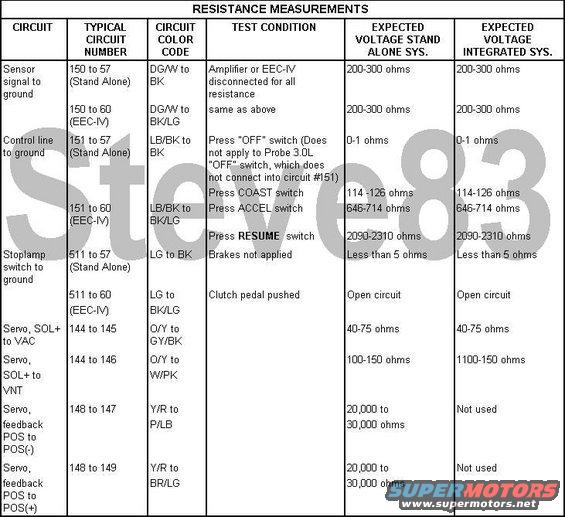 TSB90-25-12VacCruise05ResM.jpg | Hits: 1803 | Size: 66.06 KB | Posted on: 1/1/07 | Link to this image TSB90-25-12VacCruise05ResM.jpg | Hits: 1803 | Size: 66.06 KB | Posted on: 1/1/07 | Link to this image
RESISTANCE MEASUREMENTS
Connect an ohmmeter between the designed circuits and make the following resistance measurements with the ignition "OFF"
|
|
|
 TSB90-25-12VacCruise06Pinout.jpg | Hits: 1972 | Size: 31.01 KB | Posted on: 1/1/07 | Link to this image TSB90-25-12VacCruise06Pinout.jpg | Hits: 1972 | Size: 31.01 KB | Posted on: 1/1/07 | Link to this image
ABNORMAL OPERATION DURING "ACCEL" OR "COAST"
In 1986-88 models, the vehicle may exhibit hesitation while using the COAST mode, or hesitation and dropout while using the ACCELmode. This abnormal operation is caused by poor contact between the speed control brushes and the slip rings on the steering wheel. This poor contact is due to a buildup of contamination of the lubricating grease. The condition occurs more frequently when the temperature is hot and on vehicles with high mileage.
Correct the concern by removing the steering wheel and thoroughly cleaning the grease from the brushes and slip rings. Regrease using grease (E8AZ-19590-A). This new grease has been used in production since the beginning of the 1989 Model Year. Its use has resulted in a 90% reduction in the incidence of this concern.
SPEED CONTROL PERFORMANCE - AOD, AXOD AND MTX5
As noted in the Owner's Guide, it may be preferable to shift the AOD or AXOD to the "D" (overdrive lockout) or the MTX5 to 4th gear in mountainous areas or at high altitude to improve speed control performance.
On steep upgrades the vehicle may not be able to maintain speed while in overdrive, or 5th gear, resulting in a speed drop below the set speed. If the speed drop exceeds approximately 10-13 MPH, the speed control will automatically disengage and must be reset with the SET/ACCEL button. Performance will be improved by shifting to "D" (AOD or AXOD) or to 4th (MTX5).
If speed control performance is poor on moderate grades, the adjustment of the Bowden cable/bead chain should be checked and readjusted if necessary. The automatic transmission shift linkage should also be checked for proper adjustment.
STAND ALONE SPEED CONTROL VOLTAGE/RESISTANCE TEST CONNECTIONS
Refer to Figure 1 and locate Circuit 203 (orange/light blue). It is used ONLY on the 1991 Lincoln Town Car with electronic cluster. This circuit connects the speed control amplifier to a speed control "set" indicator which is located at the lower edge of the electronic cluster center section. The voltage at circuit 203 is normally 5.0V (speed control not set) and less than 1.0V when the speed control is set. Grounding circuit 203 pin will light the cluster display. The SPEED CONTROL display will light only when a set speed is being maintained and when using ACCEL or RESUME. The display will turn off when braking, using OFF or COAST, with the ignition off.
|
|
|
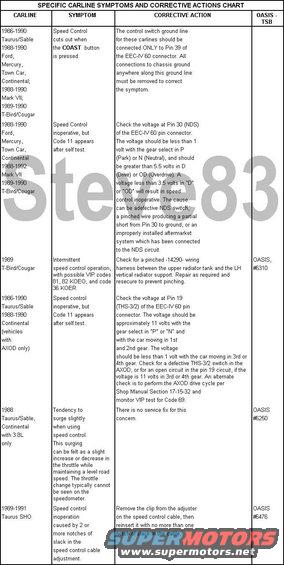 TSB90-25-12VacCruise07Symptoms.jpg | Hits: 1580 | Size: 37.62 KB | Posted on: 1/1/07 | Link to this image TSB90-25-12VacCruise07Symptoms.jpg | Hits: 1580 | Size: 37.62 KB | Posted on: 1/1/07 | Link to this image
SPECIFIC CARLINE SYMPTOMS AND CORRECTIVE ACTIONS
The following charts are a summary of speed control concern symptoms as reported. The corrective action for each is shown, as well as the TSB or OASIS number (if any) as a reference.
If a particular condition is found during any of the visual checks, it should be corrected and the system performance re-evaluated before Specific Carline Symptom and Corrective Action Charts are used.
OTHER APPLICABLE ARTICLES: 80-25-9
WARRANTY STATUS: INFORMATION ONLY
OASIS CODES: 205000
|
|
|
 TSB90-25-12VacCruise08Symptoms.jpg | Hits: 1597 | Size: 56.2 KB | Posted on: 1/1/07 | Link to this image TSB90-25-12VacCruise08Symptoms.jpg | Hits: 1597 | Size: 56.2 KB | Posted on: 1/1/07 | Link to this image
SPECIFIC CARLINE SYMPTOMS AND CORRECTIVE ACTIONS
The following charts are a summary of speed control concern symptoms as reported. The corrective action for each is shown, as well as the TSB or OASIS number (if any) as a reference.
If a particular condition is found during any of the visual checks, it should be corrected and the system performance re-evaluated before Specific Carline Symptom and Corrective Action Charts are used.
OTHER APPLICABLE ARTICLES: 80-25-9
WARRANTY STATUS: INFORMATION ONLY
OASIS CODES: 205000
|
|
|
 TSB90-25-12VacCruise09Symptoms.jpg | Hits: 1446 | Size: 56.27 KB | Posted on: 1/1/07 | Link to this image TSB90-25-12VacCruise09Symptoms.jpg | Hits: 1446 | Size: 56.27 KB | Posted on: 1/1/07 | Link to this image
SPECIFIC CARLINE SYMPTOMS AND CORRECTIVE ACTIONS
The following charts are a summary of speed control concern symptoms as reported. The corrective action for each is shown, as well as the TSB or OASIS number (if any) as a reference.
If a particular condition is found during any of the visual checks, it should be corrected and the system performance re-evaluated before Specific Carline Symptom and Corrective Action Charts are used.
OTHER APPLICABLE ARTICLES: 80-25-9
WARRANTY STATUS: INFORMATION ONLY
OASIS CODES: 205000
|
|
|
 TSB90-25-12VacCruise10Symptoms.jpg | Hits: 1509 | Size: 49 KB | Posted on: 1/1/07 | Link to this image TSB90-25-12VacCruise10Symptoms.jpg | Hits: 1509 | Size: 49 KB | Posted on: 1/1/07 | Link to this image
SPECIFIC CARLINE SYMPTOMS AND CORRECTIVE ACTIONS
The following charts are a summary of speed control concern symptoms as reported. The corrective action for each is shown, as well as the TSB or OASIS number (if any) as a reference.
If a particular condition is found during any of the visual checks, it should be corrected and the system performance re-evaluated before Specific Carline Symptom and Corrective Action Charts are used.
OTHER APPLICABLE ARTICLES: 80-25-9
WARRANTY STATUS: INFORMATION ONLY
OASIS CODES: 205000
|
|
|
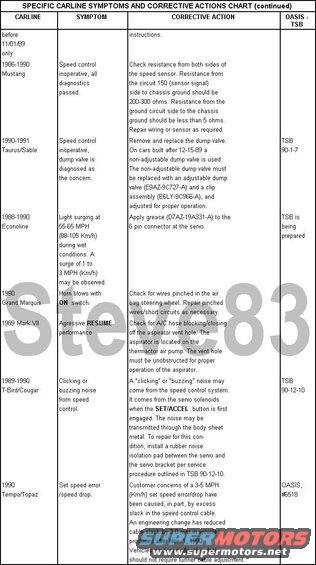 TSB90-25-12VacCruise11Symptoms.jpg | Hits: 1316 | Size: 42.56 KB | Posted on: 1/1/07 | Link to this image TSB90-25-12VacCruise11Symptoms.jpg | Hits: 1316 | Size: 42.56 KB | Posted on: 1/1/07 | Link to this image
SPECIFIC CARLINE SYMPTOMS AND CORRECTIVE ACTIONS
The following charts are a summary of speed control concern symptoms as reported. The corrective action for each is shown, as well as the TSB or OASIS number (if any) as a reference.
If a particular condition is found during any of the visual checks, it should be corrected and the system performance re-evaluated before Specific Carline Symptom and Corrective Action Charts are used.
OTHER APPLICABLE ARTICLES: 80-25-9
WARRANTY STATUS: INFORMATION ONLY
OASIS CODES: 205000
|
|
|




 90-25-12 Vacuum Cruise