The registry
Aprilia Registry: Models, Builds & Photos
Aprilia started in 1945 as a bicycle works founded by Alberto Beggio in Noale, Italy, and moved into motorcycles under his son Ivano Beggio in 1968. The company built its name on small-bore two-strokes and Grand Prix racing, winning dozens of 125 and 250 world titles. Aprilia bought Moto Guzzi and Laverda in 2000, hit financial trouble, and was absorbed by Piaggio in 2004, where it remains the group's sport brand today.
Pick your model
From Noale bicycles to Grand Prix wins
Alberto Beggio set up Aprilia in Noale, near Venice, in 1945 to build bicycles. His son Ivano took over and put the first Aprilia mopeds and small motorcycles on the road in 1968. Through the 1970s the firm did well in motocross, then pivoted hard to road bikes and roadracing in the 1980s. In that era Aprilia built few of its own engines. It bought two-strokes from Rotax in Austria and spent its money on chassis work, which is why the racing 125s and 250s handled the way they did. The 250 Grand Prix engine started as a Rotax design, with development moving in-house under engineer Jan Witteveen from 1994. That program produced world championships for Max Biaggi (1994-1996) and Valentino Rossi (1999), and the street-legal RS250 (1995-2002) carried a Suzuki RGV-derived V-twin two-stroke in an Aprilia frame.
Expansion, collapse, and Piaggio
The RSV Mille of 1998 was Aprilia's first big-bore superbike, using a Rotax-built 998cc 60-degree V-twin. In 2000 Aprilia bought Moto Guzzi and Laverda, overreached, and by the end of 2004 the whole group was sold to Piaggio. Piaggio kept the brand alive and funded the 65-degree V4 that debuted in the 2009 RSV4, which took World Superbike riders' titles with Max Biaggi in 2010 and 2012 and Sylvain Guintoli in 2014. The Piaggio era also produced the RS 660, a 659cc parallel twin introduced in 2020. Aprilia is still in production under Piaggio ownership.
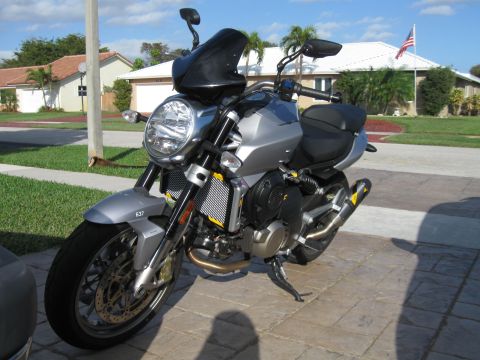
Mana 850 (2007-2016)
The Mana 850 is the odd one in the lineup and the one owners talk about most. It pairs an 839cc 90-degree V-twin with a CVT automatic transmission, the "Sportgear" system, that offers a full auto mode plus a 7-speed sequential manual mode worked by paddle or foot lever. The fuel tank is under the seat, and the conventional tank position is a lockable storage bin big enough for a helmet. A half-faired Mana 850 GT joined in 2008. Parts logic on these follows the Piaggio group, since the engine is shared with the Gilera GP800 family.
Ditech two-strokes (2000-2004)
Ditech was Aprilia's name for Orbital's air-assisted direct fuel injection fitted to its 50cc two-stroke scooters, mainly the SR50 Ditech and Scarabeo 50 Ditech, sold from roughly 2000 through 2004. Injecting fuel directly into the cylinder instead of the crankcase cut consumption sharply. Aprilia's period figures claimed about 40 percent less fuel on the ECE47 test cycle, up to 50 percent less at steady speeds, and about 60 percent less oil, 35 cc per 100 km against 85 cc for the catalyzed carbureted engine. The system needs its dedicated air compressor, injectors, and ECU kept healthy, and diagnosing a sick Ditech without the factory tooling is the main ownership hurdle today.
Asked all the time
Is Aprilia still in business?
Yes. Aprilia has been part of the Piaggio Group since the end of 2004 and still develops its motorcycles in Noale, Italy, with assembly at the nearby Scorze plant. The brand went through financial collapse in the early 2000s after buying Moto Guzzi and Laverda, but Piaggio kept it running as its sport marque.
What years was the Aprilia Mana 850 made, and what makes it different?
Aprilia built the Mana 850 from 2007 to 2016, with the half-faired GT version arriving in 2008. It uses an 839cc V-twin with a CVT automatic transmission that also offers a 7-speed manual-shift mode, and the fuel tank sits under the seat so the normal tank area is a storage compartment.
What does Ditech mean on an Aprilia scooter?
Ditech is Aprilia's branding for Orbital air-assisted direct fuel injection on its 50cc two-stroke scooters, chiefly the SR50 Ditech and Scarabeo 50 Ditech sold around 2000-2004. It injects fuel straight into the cylinder, and Aprilia claimed about 40 percent lower fuel use and 60 percent lower oil use than a comparable carbureted two-stroke, at the cost of a more complex compressor and ECU system to maintain.
Did Aprilia build its own engines?
Historically, mostly no. Aprilia's small two-strokes and the RSV Mille's 998cc V-twin came from Rotax in Austria, and the RS250 used a Suzuki-derived V-twin, though the racing engines saw heavy in-house development from the mid 1990s. Under Piaggio, Aprilia designed its own engines, most notably the 65-degree V4 introduced in the 2009 RSV4 and the 659cc parallel twin in the 2020 RS 660.
How hard is it to find parts for older Aprilias?
Piaggio group parts channels cover most Aprilia models from the late 1990s on, and shared platforms help; the Mana 850 engine family also appears in the Gilera GP800. The pain points are model-specific electronics, like Ditech injection components and factory diagnostic tooling, which are the usual sticking point on the 50cc direct-injection scooters.
The wall
The most-documented Aprilia vehicles in the registry, every photo by the owner.