The registry
Argo Registry: Models, Builds & Photos
Argo is the amphibious ATV line built by Ontario Drive & Gear (ODG), a gear and transmission maker founded in Kitchener, Ontario in 1962 that put its first Argo on the market in 1967 and has built them in New Hamburg, Ontario since 1969. Every Argo follows the same recipe: a one-piece polyethylene tub for a hull, six or eight low-pressure tires driven by chains from a central skid-steer transmission, so the machine floats and paddles across water on its own tires. Unlike nearly every other amphibious ATV maker from the 1960s boom, ODG is still building Argos today.
Pick your model
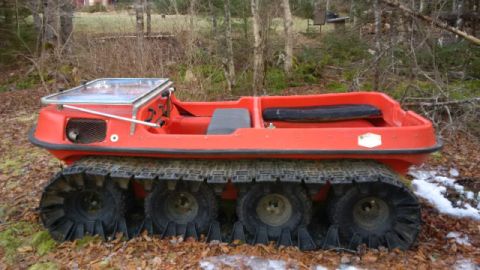
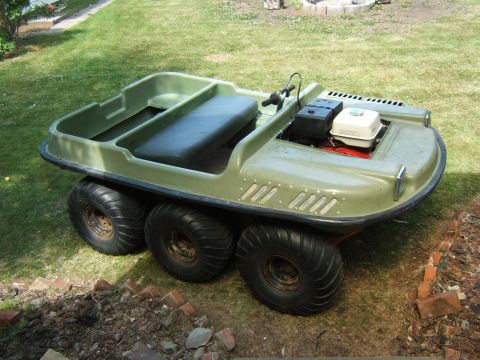
Where Argo Came From
Ontario Drive & Gear started in 1962 in Kitchener, Ontario building gearboxes and transmissions, and one of its early jobs was supplying the transmission for the Amphicat, a rival amphibious six-wheeler. In 1967 ODG applied that drivetrain know-how to the amphibious all-terrain vehicle boom and launched its own machine, named Argo after the ship of Greek myth. The company outgrew Kitchener and moved to a 10 acre site in New Hamburg, Ontario in 1969, where Argos are still built. The first 8x8 arrived in 1971, a stretched six-wheeler running a 440cc Kohler two-stroke. Dozens of AATV makers appeared in that era and almost all of them died by the mid 1970s. Argo survived because ODG built its own transmissions in-house and sold hard into working markets, utilities, surveying, trapping, and search and rescue, instead of chasing only recreation. The company later added factory track kits, opened a second plant in Thief River Falls, Minnesota in 2019, and began lunar rover prototype work with the Canadian Space Agency in 2008.
How an Argo Works
The formula has barely changed in nearly six decades. A molded plastic body doubles as the hull, high-density polyethylene since 1975. An industrial engine drives a skid-steer transmission, and roller chains carry power to each axle. Steering is by braking one side, the same as a tracked machine. The engines trace the company's history: Kohler two-strokes from 1967 to 1975, Tecumseh four-cycle engines from 1975, air-cooled Briggs & Stratton twins from 1989, and the first liquid-cooled engine, a Kawasaki FD620D, in the 1993 Conquest. On water the tire tread paddles the vehicle along at walking speed, and an outboard bracket was a common accessory for anyone who needed to actually get somewhere.
The Model Lines That Matter
- Vanguard: the volume 6x6 of the 1990s, with factory parts manuals dating from mid 1993 and the follow-on Vanguard 2 carrying the line into the mid 2000s. Power was the air-cooled Briggs & Stratton Vanguard 480cc V-twin, 16 hp in most years, and the model name matches the engine family, which trips up parts searches to this day. Ratings ran about 700 lb of payload on land and 350 lb on water.
- Response: the entry 8x8, introduced in 1995 as the lower-priced eight-wheeler below the liquid-cooled Conquest. It ran an air-cooled Briggs & Stratton 570cc V-twin making 18 hp through the standard Argo transmission and chain drive. Parts interchange across Response years is good because the platform changed slowly.
- Bigfoot: a flotation-focused 6x6 introduced in 1997 around 25 inch tires, giving lower ground pressure in muskeg and better freeboard in the water. It shared the 18 hp Briggs & Stratton 570cc twin with the Response.
Ownership Reality
Chains, bearings, and idler adjustment are the whole maintenance story on these machines. Tubs crack at the lower chassis bolt holes on hard-used examples and are repairable by plastic welding. Because ODG never went under, many wear parts for 1980s and 1990s machines can still be ordered new, which is rare in the amphibious ATV world.
Asked all the time
What years were Argo amphibious ATVs made?
Argo has been in continuous production since 1967, when Ontario Drive & Gear launched its first amphibious 6x6 in Kitchener, Ontario. Production moved to New Hamburg, Ontario in 1969 and continues there today. Argo is one of the only survivors of the 1960s amphibious ATV boom, so there is no cutoff year to worry about.
What is the difference between an Argo Response, Vanguard, and Bigfoot?
The Argo Vanguard was the mainstream 6x6 of the 1990s with a 16 hp Briggs & Stratton Vanguard 480cc V-twin. The Argo Response, introduced in 1995, was the lower-priced 8x8 with an 18 hp Briggs & Stratton 570cc V-twin. The Argo Bigfoot arrived in 1997 as a 6x6 on 25 inch tires for lower ground pressure and better flotation. All three share the same tub hull, chain drive, and skid-steer layout.
Can you still get parts for older Argos?
Yes, and this is the big advantage of an Argo over orphan amphibians like Attex or Hustler. Ontario Drive & Gear never went out of business, so chains, bearings, axles, and many body parts for 1980s and 1990s Argo machines can still be ordered new, and the Briggs & Stratton and Tecumseh engines are common industrial units with wide parts support.
Do Argos really float, and how fast are they in water?
A stock Argo floats on its sealed polyethylene tub and paddles with its tire tread at roughly walking speed, around 2 to 3 mph. Owners who need real water speed fit the factory outboard motor bracket. Load matters: an overloaded Argo rides low, so check the rated water capacity, which is roughly half the land rating on classic models like the Vanguard.
Why does searching for Argo Vanguard parts turn up engine parts?
Vanguard is also the name of a Briggs & Stratton engine family, and the Argo Vanguard 6x6 itself carried a Briggs Vanguard 480cc V-twin. A search needs to name the exact target: parts for the Argo Vanguard machine, or parts for the Briggs & Stratton Vanguard engine fitted to it and to other 1990s Argos.
The wall
The most-documented Argo vehicles in the registry, every photo by the owner.