The registry
DeTomaso Registry: Models, Builds & Photos
DeTomaso was founded in Modena, Italy in 1959 by Alejandro de Tomaso, an Argentine racing driver who built road cars around American Ford V8 power and Italian coachwork. Its best known product is the mid-engined Pantera, imported by Ford and sold through Lincoln-Mercury dealers from late 1971 until 1975, then built in Italy in small numbers into the early 1990s. The original company entered liquidation in 2004, a year after Alejandro's death.
Pick your model
Origins in Modena
Alejandro de Tomaso fled Argentina for Italy in 1955, raced OSCAs, and set up De Tomaso Automobili in Modena in 1959. Early work was racing chassis and Formula cars, but the pattern that defined the road cars appeared with the Vallelunga (1964-1967): a lightweight Italian chassis, in that case a pressed steel backbone, carrying a mass-produced Ford engine. Fewer than 60 Vallelungas were built, a handful of early aluminum cars by Fissore and roughly 50 fiberglass bodies by Ghia, all with the 1.5 liter Ford Kent four from the Cortina.
Mangusta, then Pantera
The Mangusta (1967-1971, 401 built) scaled the formula up. Giorgetto Giugiaro shaped the body at Ghia, and a Ford small-block V8 sat midships on a backbone frame, the 289 in the first European cars and the 302 for most of the run. It was beautiful and fast but flexed under power and carried most of its weight on the rear axle.
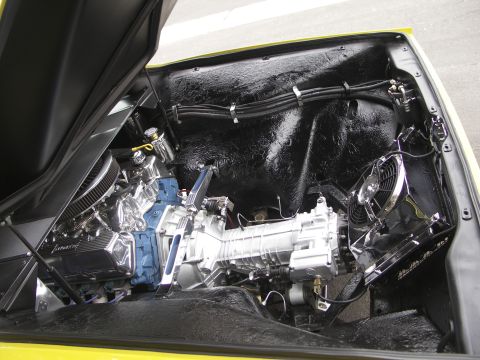
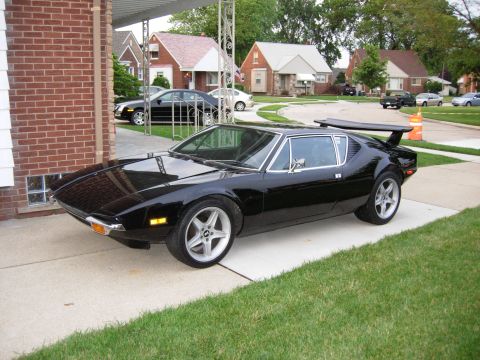
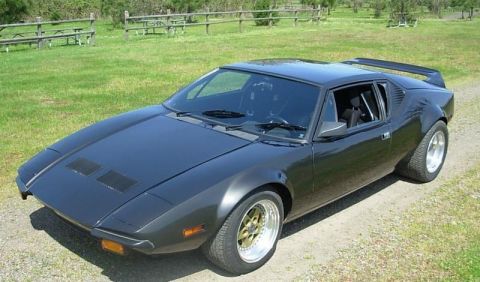
The Pantera fixed that. Introduced in 1971 with a steel monocoque instead of a backbone, it paired the Ford 351 Cleveland V8 with a ZF 5-speed transaxle, the same ZF 5DS-25 family used in the Ford GT40. Ford took an 84 percent stake in De Tomaso in 1971 and imported the Pantera for its Lincoln-Mercury dealers starting late that year. Imports ended in 1975 after roughly 5,500 cars (Lincoln-Mercury claimed just over 6,000), and Ford had already sold its stake back in 1974. Early cars had real teething problems (overheating, rust, electrics), but DeTomaso kept building Panteras in Italy in GTS, GT5, GT5-S, and finally fuel-injected Si form, with production ending in 1992 and the last Si cars completed in 1993. Total production came to about 7,260, the large majority of them the 1971-1975 US-market push-button and L models.
The rest of the range
- Deauville (1971-1985): a four-door sedan with the 351 Cleveland, 244 built.
- Longchamp (1972-1989): a two-door coupe on a shortened Deauville platform, 409 built; the same platform sat under the Maserati Kyalami and Quattroporte III.
- Guara (1993-2004): the last original-era car, about 52 built, with a BMW 4.0 V8 through 1998 and a Ford 4.6 32-valve V8 after that.
Corporate fate
De Tomaso bought Maserati out of collapse in 1975 with Italian government assistance and ran it until the sale to Fiat was completed in 1993; he also controlled Innocenti, Moto Guzzi, and Benelli, plus the Ghia and Vignale coachbuilding houses. Alejandro suffered a stroke in 1993 and died in May 2003, and the company entered liquidation in 2004. The trademark was bought in 2014 by a Hong Kong investment group, which showed the P72 at the 2019 Goodwood Festival of Speed, but that operation has no continuity with the Modena original.
Asked all the time
What years was the DeTomaso Pantera made?
The DeTomaso Pantera ran from 1971 to the early 1990s. The high-volume years were late 1971 through 1975, when Ford imported it for the US and sold it through Lincoln-Mercury dealers. After Ford pulled out, DeTomaso kept building the car in Italy in small numbers as the GTS, GT5, GT5-S, and Si. Production ended in 1992, with the last Pantera Si cars completed in 1993.
What engine does a DeTomaso Pantera have?
US-market DeTomaso Panteras use the Ford 351 Cleveland V8 mated to a ZF 5-speed transaxle. After American Cleveland production ended, DeTomaso sourced Australian-built 351 Clevelands, switched to the 351 Windsor when that supply ran out in late 1986, and fitted the final Pantera Si with a fuel-injected Ford 5.0 and catalytic converters. The pushrod Ford V8 is the main reason Panteras are far cheaper to keep running than other Italian exotics.
Are DeTomaso parts hard to find?
Split the answer in two. DeTomaso drivetrain parts are easy, since the engine is a pushrod Ford V8 and speed-shop support is endless. Body panels, glass, trim, and suspension pieces are the hard part, though several dedicated Pantera vendors in the US reproduce most of what wears out, and the owner club network (POCA and others) is active.
What is the difference between early and late DeTomaso Panteras?
The 1971-1975 US DeTomaso Panteras (push-button, then L and GTS trims) are the Ford-era cars, with federal bumpers arriving on the L. After Ford stopped importing them, the Italian-built cars for other markets gained wider bodywork, flares, and wings through the GTS, GT5, and GT5-S, and the final Si of 1990-1993 added fuel injection. Early cars are more original in shape; late cars are rarer and wilder.
Does DeTomaso still exist?
The original DeTomaso company went into liquidation in 2004, following Alejandro de Tomaso's death in 2003. The trademark was bought in 2014 by a Hong Kong investment group, which unveiled the P72 supercar in 2019, but that firm shares only the name with the Modena company that built the Pantera.
The wall
The most-documented DeTomaso vehicles in the registry, every photo by the owner.