The registry
Geo Registry: Models, Builds & Photos
Geo was a General Motors brand sold through Chevrolet dealers from the 1989 model year through 1997, created to compete head-on with small Japanese imports by selling rebadged Japanese designs. Nothing under a Geo badge was engineered by GM: the Metro and Tracker were Suzuki designs, largely built at the CAMI joint-venture plant in Ingersoll, Ontario; the Prizm was a Toyota, built at the GM-Toyota NUMMI plant in Fremont, California; and the Storm and Spectrum were Isuzus, imported from Japan. GM folded the brand after 1997, and the surviving models (Metro, Prizm, Tracker) carried Chevrolet badges from 1998 onward.
Pick your model
Why Geo existed
By the late 1980s GM was losing entry-level buyers to Toyota, Honda, and Nissan, and the corporate answer was to sell the imports itself. Geo launched for the 1989 model year as a sub-brand inside Chevrolet showrooms with the Metro, Spectrum, and Tracker; the Prizm and Storm followed for 1990. There was never a Geo factory or a Geo engineering center; each model was a captive import or joint-venture product wearing a Geo badge. Sales peaked in 1991 at just under 310,000 units, slipped every year after, and by 1997 volume was down around 224,000, so GM retired the name and moved the survivors into the Chevrolet lineup. The Metro lasted through 2001, the Prizm through 2002, and the Tracker through 2004. The Metro and Tracker carried over unchanged across the badge swap, so parts interchange freely across those years.
Metro (1989-1997 as a Geo, 1998-2001 as a Chevrolet)
The Metro was a rebadged Suzuki Cultus, replacing the Chevrolet Sprint. The base engine was the 1.0 liter G10 three cylinder, rated 55 hp, and the 49 hp XFi economy variant used a milder cam and leaner calibration to earn original EPA ratings of 53 city and 58 highway. The second generation arrived for 1995 with a sedan body style and a 70 hp 1.3 liter four, standard in the sedan and optional in the LSi hatchback, the same engine the Suzuki Swift had been running for years. The first 1989 cars came from Japan; from 1990 on, North American Metros were built at the CAMI plant in Ontario alongside the Suzuki Swift, which shares nearly everything mechanical. Owners cross-shop Suzuki part numbers constantly; that is the main survival skill with these cars. Curb weight around 1,620 lb on early hatchbacks means brakes, tires, and suspension parts are cheap and the drivetrain is barely stressed.
Storm (1990-1993)
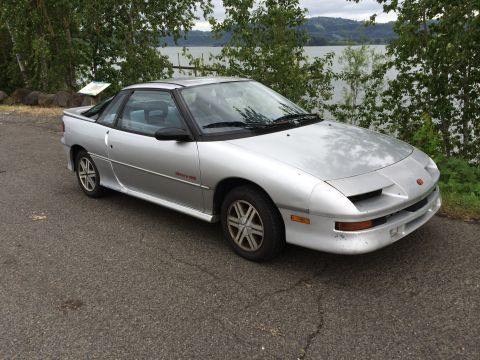
The Storm was a rebadged Isuzu, built at Isuzu's plant in Fujisawa, Japan on the second generation Impulse platform. Base cars ran a 95 hp 1.6 liter SOHC Isuzu four; the GSi got a DOHC 16 valve version making 130 hp, replaced for 1992-1993 by a 140 hp 1.8 liter DOHC. The Storm was the Impulse stripped of its costlier hardware: the Lotus-tuned suspension, optional turbocharger, and all-wheel drive stayed on the Isuzu side of the showroom. Isuzu quit building passenger cars in 1993, which killed the Storm and is why body and trim parts are the hard find today. Mechanical parts often cross to the Isuzu Impulse and Stylus.
The rest of the lineup
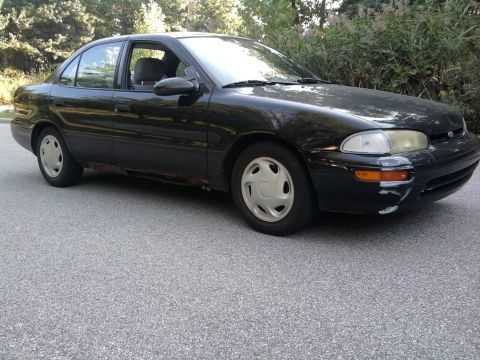
- Prizm (1990-1997 as a Geo, introduced in early 1989): a Toyota Sprinter twin, mechanically a Corolla, built at NUMMI. Base cars ran the 102 hp 1.6 liter 4A-FE; the early GSi got the 130 hp 4A-GE with four wheel discs.
- Tracker (1989-1997 as a Geo): a Suzuki Sidekick twin with an 80 hp 1.6 liter four, one of the few Geos with real off-pavement credibility. Nearly all 1989 units were built in Japan while CAMI production ramped up.
- Spectrum (1989 only as a Geo): an Isuzu Gemini derivative carried over from the 1985-1988 Chevrolet Spectrum, dropped after one year and replaced by the Storm.
Asked all the time
What years was Geo sold?
Geo ran from the 1989 model year through 1997 in the United States. GM retired the Geo name after 1997, and the remaining models were sold as Chevrolets from 1998 on: the Metro through 2001, the Prizm through 2002, and the Tracker through 2004.
Who actually built Geo vehicles?
No Geo was an in-house GM design. The Geo Metro and Tracker were Suzuki designs, mostly built at the CAMI joint-venture plant in Ontario (early examples came from Japan). The Geo Prizm was a Toyota built at NUMMI in California. The Geo Storm and the one-year Spectrum were Isuzu products built in Japan.
Are Geo Metro parts still easy to get?
Yes, because the Geo Metro is mechanically a Suzuki Swift/Cultus and continued as the Chevrolet Metro through 2001. Cross-referencing Suzuki and Chevrolet part numbers opens up most of the supply. Body panels and interior trim for early three-cylinder hatchbacks are the thinner end of the market.
What made the Geo Storm GSi quick for its class?
The Geo Storm GSi used Isuzu's DOHC 16-valve 1.6 liter four rated at 130 hp, upgraded to a 140 hp 1.8 liter for 1992-1993, in a light front-drive coupe. Mechanical parts often interchange with the Isuzu Impulse and Stylus, which matters since the Storm ended after 1993.
Why did GM kill the Geo brand?
Geo sales peaked in 1991 at just under 310,000 units and fell every year afterward, and GM concluded the standalone brand no longer justified its marketing cost. After 1997 the surviving models were rebadged as Chevrolets. The Metro and Tracker carried over mechanically unchanged for 1998; the Prizm was redesigned that same year alongside the new Toyota Corolla.
The wall
The most-documented Geo vehicles in the registry, every photo by the owner.