The registry
Hyundai Registry: Models, Builds & Photos
Hyundai Motor Company was founded in 1967 in Seoul by Chung Ju-yung and built its first car, a licensed Ford Cortina, in 1968. The 1975 Pony was the first car developed and mass-produced in South Korea, and Hyundai entered the US market in 1986 with the Excel. The company took a controlling stake in Kia in 1998 and backed its quality push that same year with a 10 year, 100,000 mile powertrain warranty in the US. The rear-drive Genesis sedan and coupe of 2008-2016 marked the point where Hyundai started building cars people modify on purpose.
Pick your model
From licensed Cortinas to in-house engineering
Hyundai Motor Company started in 1967 as an arm of Chung Ju-yung's Hyundai construction empire, assembling Ford Cortinas under license in Ulsan from 1968. The 1975 Pony, styled by Giorgetto Giugiaro and running Mitsubishi-sourced engines, was Korea's first domestically developed car. Hyundai leaned on Mitsubishi drivetrains and platforms through the 1980s and early 1990s, then moved to its own engine families, starting with the Alpha four in 1991. The 1986 Excel launch in the US sold on price, and the reputation hit that followed is why the 1998 10 year, 100,000 mile warranty existed. Hyundai bought control of Kia out of the 1997 Asian financial crisis, and the two have shared platforms and engines ever since.
Genesis, 2008-2016
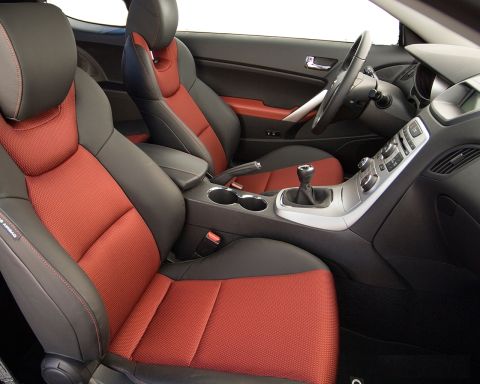
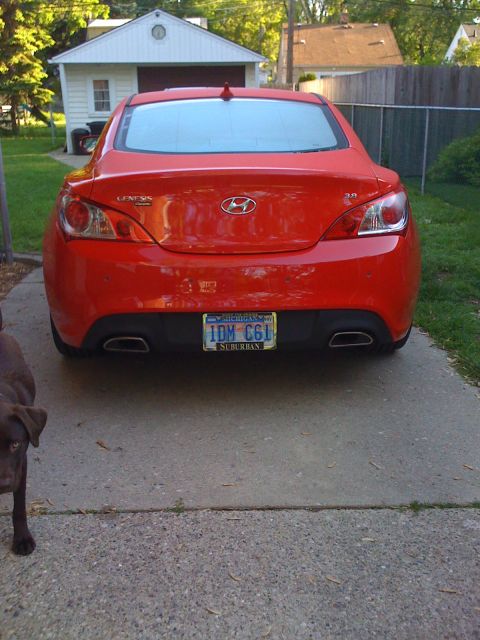
The Genesis sedan (2009 model year) was Hyundai's first rear-drive luxury platform, offered with the 3.8L Lambda V6 or the 4.6L Tau V8, Hyundai's first production V8 for the US. The Genesis Coupe (2010-2016) put a turbocharged 2.0L four or the 3.8 V6 in a rear-drive chassis with an available limited-slip differential, which made it the default Korean drift and track platform. Genesis was spun off as a standalone brand for 2017.
The volume lines
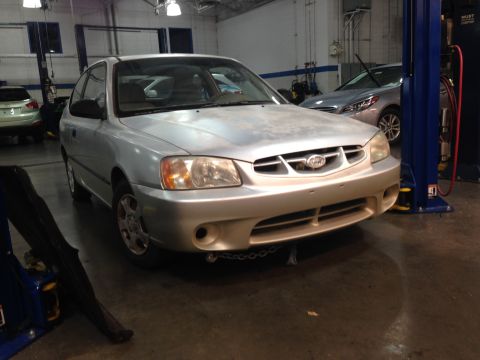
- Accent (1995-2022 in the US): replaced the Excel and was the first subcompact fully engineered by Hyundai, on its own Alpha engines. Simple timing-belt fours and cheap parts keep high-mileage examples on the road. Hyundai dropped it from the US lineup after the 2022 model year.
- Tiburon (1997-2008): front-drive sport coupe on Elantra underpinnings. Second-generation cars (2003-2008) offered the 2.7L Delta V6 with an available six-speed manual in the GT.
- Sonata (1985-present, US sales from 1989): the midsize workhorse. The 2011 redesign dropped the V6 entirely for the 2.4L direct-injected Theta II four, an engine family later covered by large recall and warranty-extension campaigns for rod-bearing failure. Check that history on any 2011-2014 car.
- Elantra (1990-present, US sales from the 1992 model year): first generation used a Mitsubishi-derived 1.6, and the line moved to Hyundai's own Beta fours in the mid 1990s. It became the brand's compact backbone worldwide.
- Santa Fe (2001-present): Hyundai's first SUV, built unibody from the start. The 2007-2012 second generation ran 2.7L and 3.3L V6s through 2009, then switched to a 2.4L four and a 3.5L V6 with the 2010 refresh.
Asked all the time
When did Hyundai start selling cars in the United States?
Hyundai entered the US market in 1986 with the Excel subcompact, which sold over 168,000 units in its first year on price alone. Hyundai's modern US lineup dates from the mid 1990s, when the Accent and Elantra moved onto Hyundai's own engines and platforms.
Is the Hyundai Genesis the same as the Genesis brand?
From 2008 to 2016 the Genesis sedan and Genesis Coupe were sold as Hyundais, badge and all. Hyundai spun Genesis off as a standalone luxury brand for the 2017 model year. Parts for the Hyundai-badged cars still route through Hyundai dealers, and the coupe never carried over to the new brand.
Which Hyundai engines have known problems I should check for?
The Theta II 2.0 and 2.4 direct-injection fours used in the 2011-2014 Sonata and related Hyundai models are the big one, with rod-bearing failures that led to recalls and an extended warranty. Verify whether the recall work and the knock-sensor software update were done before buying.
What distinguishes the eras of Hyundai ownership?
Pre-1995 Hyundais lean heavily on Mitsubishi engines and parts. Most mid-1990s through mid-2000s cars run Hyundai's own Alpha, Beta, and Delta engines and are cheap to keep alive. From 2008 the rear-drive Genesis platform and direct-injection engines mark the modern era, with better chassis and more aftermarket support.
Are parts easy to get for older Hyundais like the Tiburon?
Mechanical parts for the Tiburon, Accent, and Elantra remain cheap and available because Hyundai shared engines and suspension across those lines for years. Trim and body pieces for the 1997-2008 Tiburon are the hard part, so owners lean on donor cars and the used market.
The wall
The most-documented Hyundai vehicles in the registry, every photo by the owner.