The registry
Kenworth Registry: Models, Builds & Photos
Kenworth has built heavy trucks in the Pacific Northwest since 1923, when Seattle's Gersix Motor Company was reorganized and renamed for stockholders Harry Kent and Edgar Worthington. Pacific Car and Foundry (now PACCAR) bought the company in January 1945, and Kenworth remains PACCAR's flagship Class 8 nameplate alongside Peterbilt. The trucks that matter most to owners are the long-hood W900 conventionals, in production in one form or another since 1961, and the T800 vocational conventional introduced in 1986. In January 2025 Kenworth announced the end of the line for both: W900, T800W, and C500 production wraps up in 2026.
Pick your model
From Gersix to PACCAR
Kenworth traces to the Gersix Motor Company, a Seattle builder of six-cylinder trucks. In 1923 the firm was reorganized and renamed Kenworth after two of its principals, Harry Kent and Edgar Worthington. The company built its name on trucks specced for Western work, logging, long grades, and heavy loads, and it put diesel power into production before anyone else in the American industry: in 1933 Kenworth factory-installed the 100 hp Cummins HA-4, adding vertical exhaust stacks behind the cab while it was at it. Pacific Car and Foundry acquired Kenworth in January 1945. That parent became PACCAR in 1972, and Kenworth has operated as a PACCAR division ever since, headquartered in Kirkland, Washington, with US assembly plants in Renton, Washington and Chillicothe, Ohio.
W900 and W900A
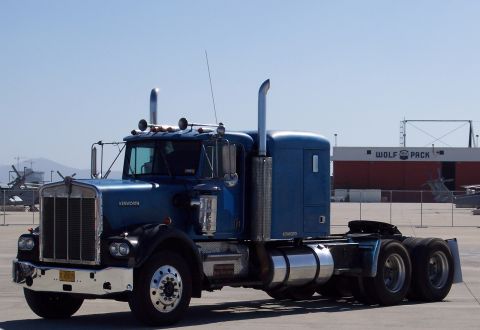
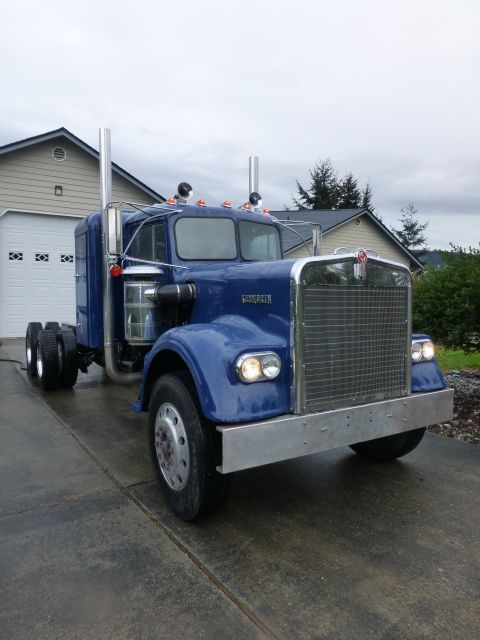
The W900 conventional arrived in 1961 as the long-hood half of a model renumbering that also produced the K-series cabover, first badged K900 and soon renamed K100. The letters stand for Worthington and Kent. The W900A designation covers roughly 1967 to 1982, when the W900B took over with a taller hood and rectangular headlights. The A model is the truck most people picture when they think of a classic Kenworth: steel butterfly-opening hood on early trucks, fiberglass tilt hood later, and a bolted aluminum cab shared in concept across decades of production. Kenworth introduced the Aerodyne raised-roof sleeper in 1976, the first factory raised-roof walk-in sleeper in the industry with seven feet of standing headroom, and it showed up on plenty of late W900As. Power in the A era was classic big-bore territory, Cummins, Caterpillar, and Detroit Diesel in a wide range of ratings, matched to Fuller and Spicer transmissions. Owners restoring trucks from before the 1967 A designation will find the earlier W900s share most of their architecture, which keeps the parts situation workable across the whole 1961-1982 span.
T800
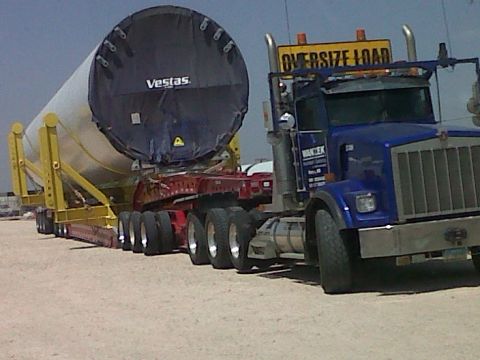
The T800 launched in 1986, a year after the aerodynamic T600 proved buyers would accept a sloped hood and set-back front axle. The T800 kept the set-back steer axle but built the platform for vocational and heavy-haul work: better curb-to-curb turning, more weight over the front axle for dump, mixer, and logging bodies, and frame rails and front-end ratings that supported everything from single-axle tractors to multi-axle heavy haulers. The T880, introduced in March 2013, took over most of that work, but the wide-hood T800W stayed in production for heavy-haul, oilfield, and logging duty right up to the announced 2026 end, a run of roughly four decades.
End of the long hoods
Kenworth is still an active manufacturer, but the traditional trucks are finished. In January 2025 the company announced that the W900, the wide-hood T800W, and the C500 would end production in 2026, pushed out by emissions regulations and component constraints. A limited run of 1,000 W900 Legacy Edition trucks closes out a nameplate that stayed in the catalog for some 65 years. The aerodynamic T680 and the vocational T880 carry the on-highway and vocational lines forward under PACCAR MX and Cummins power.
Asked all the time
What years was the Kenworth W900A built?
The Kenworth W900A designation covers roughly 1967 to 1982, though some records place the wide-hood A's start as early as 1965. It refined the original W900 introduced in 1961, and in late 1982 the W900B replaced it with a taller hood and rectangular headlights. Sheet metal and cab structure changed less than the model letters suggest, which helps with parts sourcing.
How do I tell a Kenworth W900A from a W900B?
The quickest tells on a Kenworth are the hood and headlights. The W900A has a lower hoodline with round headlights, while the 1982-on W900B runs a taller hood, a larger grille, and rectangular lamps (round stayed on the option sheet). VIN and data plate confirm it, but most owners can call it from thirty feet.
What engines came in classic Kenworth trucks?
Kenworth was an assembler in the traditional sense, so W900A-era trucks came with the buyer's choice of Cummins, Caterpillar, or Detroit Diesel power in many ratings, usually behind Fuller or Spicer transmissions. Matching numbers matters less in this world than a correct-type engine in good health.
What was the Kenworth T800 designed for?
Kenworth introduced the T800 in 1986 as a vocational and heavy-haul conventional with a set-back front axle, which tightens the turning circle and puts more legal weight on the steer axle. It served dump, mixer, logging, oilfield, and heavy-tractor duty for nearly four decades. The T880, launched in 2013, took over most of that work, and the last wide-hood T800W trucks are built in 2026.
Is the Kenworth W900 still in production?
Not for long. In January 2025 Kenworth announced that the W900, T800W, and C500 would end production in 2026, driven by emissions regulations and component constraints. A final run of 1,000 W900 Legacy Edition trucks closes out a line that started in 1961. Dealer parts support through PACCAR continues.
Is parts support still good for older Kenworth trucks?
Yes. Kenworth is still in business under PACCAR, dealers stock or can order a surprising amount for older conventionals, and the long production runs mean aftermarket and salvage support for W900-family trucks is strong. Cab and hood hardware carried over for years at a stretch, so donor trucks are a realistic source.
The wall
The most-documented Kenworth vehicles in the registry, every photo by the owner.