The registry
Kubota Registry: Models, Builds & Photos
Kubota Corporation started in Osaka, Japan in 1890 as a one-room casting shop opened by Gonshiro Ohde, a 19-year-old foundryman who later took the Kubota name from the family that adopted him. The company cracked domestic production of cast iron water pipe in 1897, built its first engine in the 1920s, entered the tractor business in Japan in 1960, and set up Kubota Tractor Corporation in the United States in 1972, where its compact diesel tractors filled a size class the domestic makers had mostly ignored. Kubota remains an independent, publicly traded Japanese maker of tractors, diesel engines, construction equipment, and the RTV line of diesel utility vehicles.
Pick your model
From foundry to diesel builder
Gonshiro Ohde was 19 when he opened a small casting shop in Osaka in 1890, making weights and everyday hardware. Japan was importing the iron pipe for its new municipal water systems, and after years of failed attempts across the industry, Ohde worked out a workable casting method for water pipe in 1897. The pipe business made the company, and it changed the man's name too. A benefactor named Toshiro Kubota adopted him, and the firm became Kubota Iron Works. Engines came later. Kubota entered the engine business in 1922 and released its first one in 1923, the Type A, a 3 horsepower kerosene engine built to drive irrigation pumps and rice hullers. Small diesels followed, and that engine business is the spine of everything the company sells now. Kubota diesels also power equipment from plenty of other brands, Bobcat and Jacobsen machines among them, so parts and know-how for the engines circulate well beyond Kubota's own dealer network.
The North American push
Kubota began selling tractors in the United States in 1969, starting with the 21 horsepower L200, and formalized the operation as Kubota Tractor Corporation in Torrance, California in 1972. The pitch was simple, a small, cheap, dead-reliable diesel tractor in a size class American makers had walked away from while they chased bigger iron. The L-series compacts and the smaller B-series (the B6000, a 12.5 horsepower two-cylinder diesel, arrived in the early 1970s) built the reputation. The BX sub-compact line, new for the 2001 model year, pushed the same formula down into lawn-tractor territory with a real diesel and a real three-point hitch. US manufacturing started in Gainesville, Georgia in 1988, first with implements like front loaders and backhoes, and the Georgia plants have gone on to build tractors, mowers, and utility vehicles.
RTV900
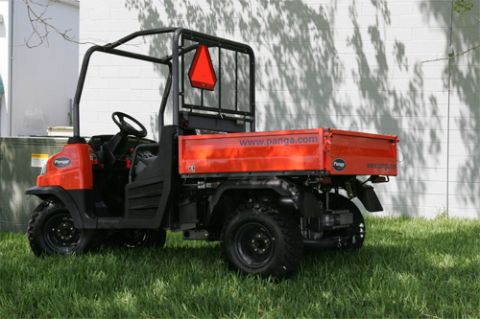
The RTV900 is the model that brought most utility-vehicle owners to the brand. Kubota introduced it in 2004 as its first side-by-side, and it went straight after the work end of the market rather than the sport end. Power is Kubota's own D902 three-cylinder diesel, 898 cc and 21.6 horsepower, the same basic engine family used across Kubota's small equipment. The drivetrain is the unusual part, a VHT variable hydrostatic transmission instead of the belt-drive CVT nearly every competitor uses. No belt to slip or burn, and genuine engine braking on descents, at the cost of some top speed (about 25 mph). Steel frame, optional hydraulic dump bed, and selectable four-wheel drive round it out. The RTV900 ran from 2004 through 2013, when Kubota announced the updated RTV-X900 for the 2014 model year, and clean used ones still work for a living. Common owner attention points are the fuel system's dislike of stale diesel, front CV boots, and keeping the hydro fluid and filters on schedule, since the transmission shares its appetite for clean fluid with a tractor hydrostat.
Where the company stands
Kubota is not defunct and never merged away. It remains headquartered in Osaka, builds equipment on several continents, and has expanded through acquisitions such as the Norwegian implement maker Kverneland in 2012 and Great Plains Manufacturing of Salina, Kansas, bought for about 430 million dollars in 2016.
Asked all the time
What years was the Kubota RTV900 made?
Kubota built the RTV900 from 2004 through 2013. The updated RTV-X900, announced in late 2013, replaced it for the 2014 model year. The RTV900 was Kubota's first side-by-side utility vehicle, powered by the 898 cc D902 three-cylinder diesel.
What makes the Kubota RTV900 different from other side-by-sides?
The Kubota RTV900 uses a VHT variable hydrostatic transmission instead of the belt-drive CVT most competitors use. There is no drive belt to slip or burn, and the hydrostat gives real engine braking on hills, though top speed is limited to about 25 mph.
Is Kubota still in business?
Yes. Kubota Corporation, founded in Osaka in 1890, is still an independent, publicly traded Japanese company. It builds tractors, engines, construction equipment, and utility vehicles worldwide, with US manufacturing in Gainesville, Georgia since 1988.
Are parts easy to get for older Kubota equipment?
Generally yes. Kubota's dealer network stocks parts deep into older model lines, and because Kubota diesels power equipment from many other brands, engine parts (filters, injectors, gaskets) are widely available from aftermarket suppliers as well.
When did Kubota start selling tractors in the United States?
Kubota tractors first arrived in the US in 1969 with the 21 horsepower L200, and Kubota Tractor Corporation was formally established in Torrance, California in 1972. The early L-series and B-series compact diesels built the brand's American reputation.
The wall
The most-documented Kubota vehicles in the registry, every photo by the owner.