The registry
Lotus Registry: Models, Builds & Photos
Lotus goes back to 1948, when Colin Chapman built his first competition special in Hornsey, North London; he incorporated the Lotus Engineering Company in 1952. The firm built its name on one principle: low weight beats big power. It won seven Formula One constructors' championships between 1963 and 1978 while selling road cars like the Elite, Elan, and Esprit that applied the same thinking. Lotus survived Chapman's death in 1982 through a string of owners, including General Motors from 1986 to 1993, and has been majority owned by China's Geely since 2017. It still builds cars in Hethel, Norfolk, on the former airfield site the company has occupied since 1966.
Pick your model
Chapman's company
Colin Chapman built his first trials special, an Austin 7 rebuild, in 1948 behind his father's pub in Hornsey, and incorporated the Lotus Engineering Company on 1 January 1952. The early business ran on kit cars, mainly the Lotus Seven (introduced 1957), which kept the lights on while Chapman chased racing. The race program paid off: Team Lotus took Formula One constructors' titles in 1963, 1965, 1968, 1970, 1972, and 1973, plus 1978 with the ground-effect Type 79. Chapman died of a heart attack in December 1982 at age 54, and the company nearly went under. General Motors bought Lotus in 1986, sold it to Bugatti's Romano Artioli in 1993, Malaysia's Proton took over in 1996, and Geely bought a 51 percent stake in 2017. Road car production has been at Hethel, Norfolk since 1966.
Esprit (1976-2004)
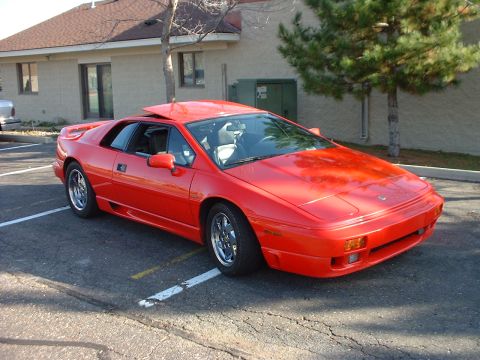
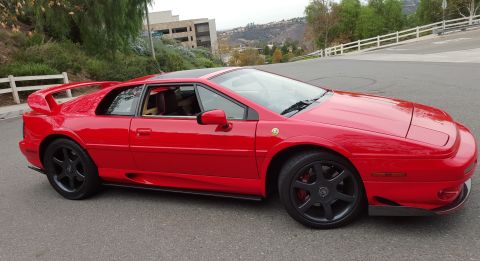
The Esprit is the longest-running Lotus road car, in production for 28 years with a steel backbone chassis and fiberglass body over the whole run. The Giugiaro-designed original carried the 2.0L Lotus 907 four; the Turbo Esprit arrived in 1980 with the 2.2L 910 engine. Peter Stevens reskinned the car for 1988, and the cars most owners on this side of the Atlantic deal with are the 1989-1996 four-cylinder turbos (264 hp in the SE and S4, 285 hp in the S4s) and the 1996-2004 V8. That car used Lotus's own twin-turbo 3.5L flat-plane V8, held to 350 hp from a potential 500 or so because the gearbox could not take more. Transaxles split by era: 1976-1987 cars use the Citroen C35 five-speed shared with the Citroen SM and Maserati Merak, while the 1988 restyle brought in the Renault UN1, which sat behind every later four-cylinder and the V8. Known service items include the timing belt on the four-cylinder cars (short interval, bent valves if it lets go), thin parts support for the Citroen box, and the UN1's torque ceiling behind the V8.
Elite (1957-1963)
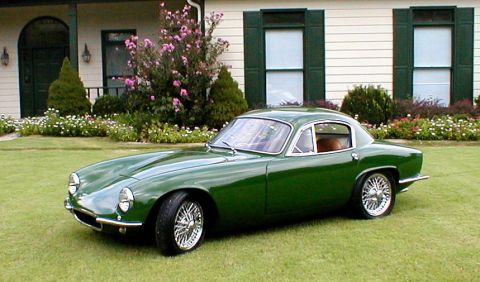
The original Elite (Type 14) was the world's first production car with a fiberglass monocoque, no steel chassis at all, just bonded-in metal reinforcements at load points. Around 1,030 were built. Power came from a 1,216 cc Coventry Climax FWE all-aluminum four, and the car weighed roughly 1,450 lb, light enough to take class wins at Le Mans six years running (1959-1964). The monocoque cracked around the suspension and differential mounts in service, and Chapman reportedly lost money on every car. A second, unrelated Elite (Type 75, a four-seat shooting brake) ran 1974-1982.
Other lines worth knowing
- Seven (1957-1972 at Lotus): rights sold to Caterham in 1973, still in production there.
- Elan (1962-1973): introduced the steel backbone chassis Lotus used for decades.
- Elise (1996-2021): bonded-aluminum extrusion chassis, spawned the Exige and the Tesla Roadster's platform.
- Evora (2009-2021) and Emira (2022-present): the current combustion line, alongside Geely-era EVs built in China.
Asked all the time
What years was the Lotus Esprit made?
Lotus built the Esprit from 1976 to 2004. Major breakpoints are the 1980 Turbo Esprit, the 1988 Peter Stevens restyle, the 1993-on S4 four-cylinder turbos, and the 1996-2004 twin-turbo V8. All of them share the steel backbone chassis and fiberglass body.
What made the original Lotus Elite special?
The 1957-1963 Lotus Elite (Type 14) was the first production car with a full fiberglass monocoque, no separate frame. With a 1,216 cc Coventry Climax engine and a curb weight around 1,450 lb, Lotus Elites took six straight class wins at Le Mans from 1959 to 1964. About 1,030 were built.
Is Lotus still in business?
Yes. Lotus never went defunct, though it came close after Colin Chapman died in 1982. Ownership passed through General Motors (1986-1993), Romano Artioli, and Proton (1996-2017) before Geely took a 51 percent stake in 2017. Sports cars are still built at Hethel, England.
Are parts hard to find for older Lotus cars?
Mixed. Lotus borrowed heavily from mass-market suppliers, so Esprit switchgear, lights, and the Renault UN1 transaxle have donor-car sources, and specialists like SJ Sportscars and JAE support the Esprit well. The pre-1988 Citroen transaxle is thinner on parts, and original Elite bits are harder still; the Coventry Climax engine and monocoque repairs need marque specialists.
What is the difference between four-cylinder and V8 Lotus Esprits?
1976-1999 four-cylinder Lotus Esprits use the 2.0L or 2.2L Lotus 900-series engine, turbocharged from 1980, reaching 264 hp in the SE and S4 and 285 hp in the S4s. The 1996-2004 Esprit V8 uses Lotus's own 3.5L twin-turbo flat-plane V8 at 350 hp. Cars built before 1988 use a Citroen transaxle shared with the Citroen SM and Maserati Merak; later four-cylinders and every V8 use the Renault UN1, whose torque limit is why the V8 was held to 350 hp.
The wall
The most-documented Lotus vehicles in the registry, every photo by the owner.