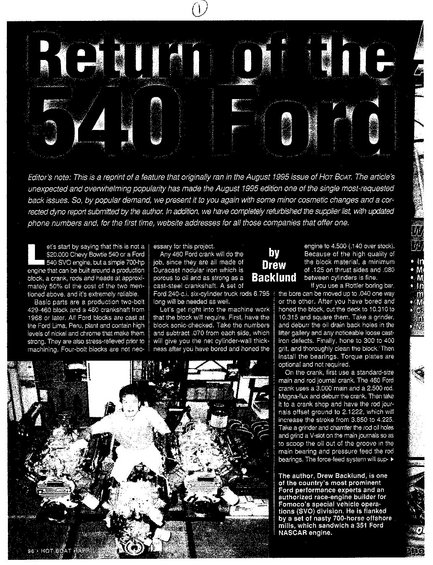
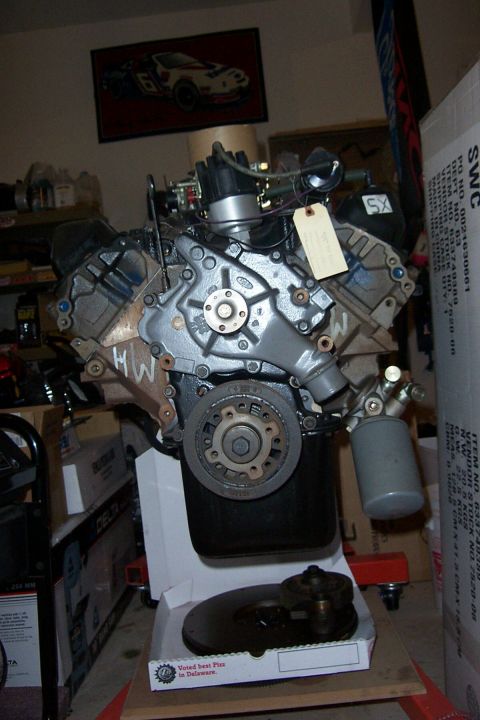
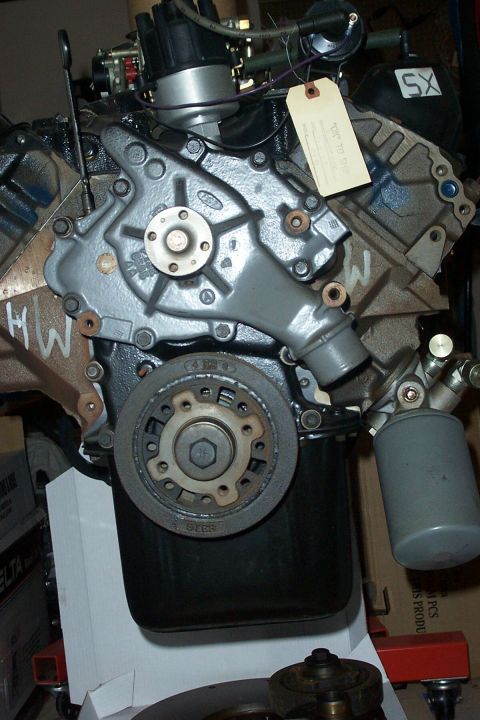
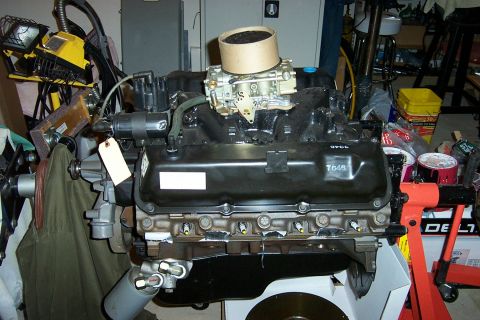
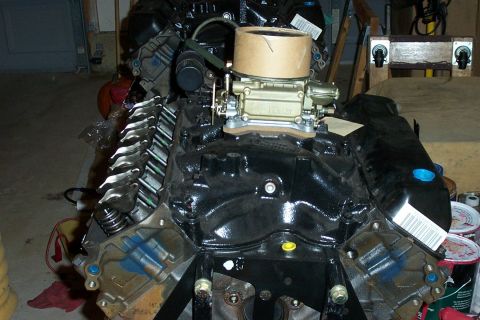
Article discusses engine building and parts, with a person posing between engines.
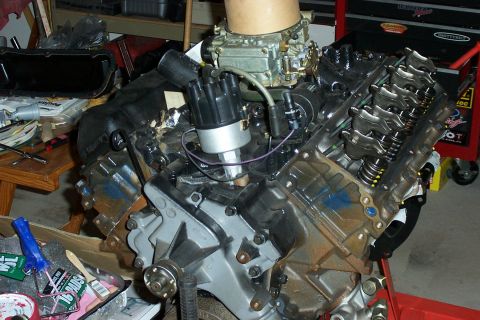
Editors note: This is a reprint of a feature that originally ran in the August 1995 issue of HOT BOAT, The article's unexpected and overwhelming popularity has made the August 1995 edition one of the single mosrrequested back issues. So, by popular demand, we present it to you again with some minor cosmetic changes and a cor- rected dyno report submitted by the author in addition, we have Completely refurbished the supplier list, with updated phone numbers and. for the first time, website addresses for all those companies that offer one. ets start by saying that this is not a I 820.000 Chevy Bowtie 540 or a Ford 540 SVO engine. but a simple 700hp engine that can be built around a production block, a crank, rods and heads at approxi- mately 50% of the cost of the two men- tioned above. and it's extremely reliable. Basic parts are a production two-bolt 4297460 block and a 60 crankshalt item 1968 or later. All Ford blocks are cast at the Ford Lima, Peru, plant and contain high levels oi nickel and chrome that make them strong. They are also stress-relieved prior to l l l l machining. Fourbolt blocks are not nec i essary for this prcyect, Any 460 Ford crank will do the job. since they are all made of Duracast nodular iron which is porous to oil and as strong as a cashsteel crankshaft. A set of Ford 240~c.i. slxcylindertruok rods 6 795 . long will be needed as well. Let's get right into the machine work that the block will require. First, have the block soniochecked. Take the numbers and subtract .070 from each side, which will give you the net cylinder-wail thick- ness alter you have bored and honed the by Drew Backlund engine to 4.500 (.140 over stocki. Because at the high quality at the block material, a minimum at .125 on thrust sides and .080 between cylinders is line. It you use a Rottler boring bar the bore can be moved up to .040 one way . or the other. Alter you have bored and honed the block, out the deck to 10.3w to toms and square them. Take a grinder. and deburr the oil drain back holes in the litter gallery and any noticeable loose cast- iron defects. Finally. hone to 300 to 400 grit, and thoroughly clean the block Then install the bearings. Torque plates are . optional and not required. On the crank, lirst use a standard-size main and rod journal crank. The 460 Ford crank uses a 3.000 main and a 2.500 rod. Magna-llux and deburr the crank. Then take it to a crank shop and have the rod lour- rials offset ground to 21222, which wrll increase the stroke from 3.850 10 4.225. Take a grinder and chamfer the rod oil holes and grind a V-slot on the main iournals so as - to scoop the oil out of the groove in the . main bearing and pressure teed the rod 3 bearings. The lorceieed system will sup > The author, Drew Backlund, is one of the country's most prominent Ford performance experts and an authorized race-engine builder for Fomocos special vehicle opera- tions (SVO) division. He is flanked by a set of nasty 700-horse offshore mills, which sandwich a 351 Ford NASCAR engine.
Comments
More from this build
No comments yet.