The registry
Morgan Registry: Models, Builds & Photos
Morgan Motor Company has been building cars in Malvern Link, Worcestershire since H.F.S. Morgan founded it in 1910, and it is still doing so from the same Pickersleigh Road works it moved into in 1919. The firm made its name on lightweight three-wheelers before the four-wheeled 4-4 arrived in 1936, and that car's descendants stayed in production into the 2010s with the same basic formula: steel chassis, ash-framed body, sliding-pillar front suspension. Morgan remained family-owned for over a century until Italian investment group Investindustrial bought a majority stake in 2019. It is one of the very few pre-WWI British marques still building cars.
Pick your model
Founding and the three-wheeler years
Henry Frederick Stanley Morgan built his first single-seat three-wheeler runabout in 1909 and formed the Morgan Motor Company in 1910 in Malvern, Worcestershire. The early cars carried V-twin engines from JAP, Matchless and others out front, drove the single rear wheel, and used the sliding-pillar independent front suspension H.F.S. designed at the start. That suspension stayed on Morgan's traditional chassis for more than a hundred years. Three-wheelers were the whole business into the mid 1930s, helped along by British tax law that classed them as motorcycles. Production of the original trikes ended in 1952, and Morgan revived the idea with the S&S V-twin powered 3 Wheeler, shown in 2011 and built from 2012 to 2021.
The 4/4, the car that never left
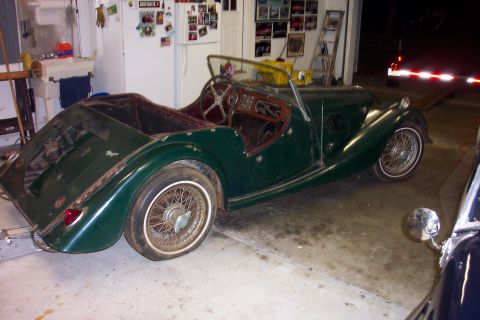
The 4-4 (four wheels, four cylinders) launched in 1936 as Morgan's first four-wheeled car, with a 1,122 cc Coventry Climax engine. Renamed 4/4, it stayed in production until 2018, pausing only for WWII and from March 1951 to September 1955 while the Plus 4 carried the range, one of the longest production runs of any car nameplate. Engines rotated through Standard, Ford sidevalve and Kent units, Fiat twin cams, and in the final years Ford Duratec and Sigma fours. Every one used the ladder chassis, Z-section frame rails, and an ash wood body frame skinned in steel or aluminum. A 1960s 4/4 and a 2010s 4/4 share running-gear geometry closely enough that the parts and setup knowledge transfer.
Plus 4, Plus 8, and the Roadster
The Plus 4 arrived in 1950 with the 2.1 liter Standard Vanguard engine, then Triumph TR2 through TR4 power, and it took a class win at Le Mans in 1962. The Plus 8 (1968-2004) dropped the all-aluminum Rover 3.5 V8 into the traditional chassis, giving a roughly 1,900 lb car serious thrust, and displacement grew to 4.6 liters before Rover V8 supply ended. The Roadster replaced it in 2004, running Ford V6 engines (the 3.0 Duratec, later the 3.7) until 2019 in the same steel-chassis, ash-framed body. Morgan also brought the Plus 8 name back from 2012 to 2018 on the bonded-aluminum Aero platform with a 4.8 liter BMW V8, a very different car under the familiar shape.
The modern company
Morgan is not defunct. The bonded-aluminum Aero 8, unveiled in 2000 and built in two runs that ended in 2018, broke from the steel chassis and pointed at what came next. The CX-Generation platform arrived under the Plus Six in 2019 and the Plus Four in 2020, and those cars finally retired the sliding-pillar suspension in favor of wishbones. The Plus Six ended production in 2025, replaced that March by the Supersport on the updated CXV platform. The Morgan family sold majority control to Investindustrial in March 2019, ending 109 years of family ownership, and the works still hand-builds bodies over ash frames.
Asked all the time
What years was the Morgan 4/4 made?
Morgan built the 4/4 from 1936 to 2018, with pauses for WWII and from March 1951 to September 1955 while the Plus 4 carried the range, making it one of the longest production runs of any car nameplate. Engines changed constantly (Coventry Climax, Standard, several Fords, Fiat), but the chassis and ash-framed body construction stayed recognizably the same throughout.
Is Morgan still in business?
Yes. Morgan Motor Company still builds cars at Pickersleigh Road in Malvern Link, where it has been since 1919. The Morgan family sold a majority stake to Investindustrial in 2019, and current production centers on the Plus Four, the Supersport that replaced the Plus Six in 2025, and the Super 3 three-wheeler.
Are Morgan bodies really made of wood?
Partly. A Morgan has a steel (traditional) or bonded-aluminum (modern) chassis, and the body panels hang on a hand-built ash wood frame. The wood is structural for the body, not the chassis. Rotten ash frames are a known issue on older cars, and the factory and specialists still supply frame sections.
What is the difference between a Morgan Plus 8 and a Morgan Roadster?
The original Plus 8 (1968-2004) used the aluminum Rover 3.5 to 4.6 liter V8 on the traditional steel chassis with sliding-pillar front suspension. When Rover V8 production ended, Morgan replaced it with the Roadster (2004-2019), which ran Ford V6 engines, first the 3.0 Duratec and later the 3.7, on that same chassis. Morgan later revived the Plus 8 name from 2012 to 2018 with a 4.8 liter BMW V8 on the bonded-aluminum Aero platform.
How hard is it to get parts for an older Morgan?
Easier than the production numbers suggest. Morgan changed its traditional cars so little that many mechanical parts interchange across decades, engines are common Ford, Triumph, or Rover units with strong aftermarket support, and the factory plus UK specialists still supply chassis and ash frame parts. The owner club network is small but active and technically deep.
The wall
The most-documented Morgan vehicles in the registry, every photo by the owner.