The registry
Motomarina Registry: Models, Builds & Photos
Motomarina was an American trade name, created by importer Marina Mobili Inc of Moonachie, New Jersey, for 49cc mopeds built in Italy by Moto Meteora of Monteveglio, near Bologna. The best-known model, the Sebring, sold in the U.S. through the mid and late 1980s, most titled between 1985 and 1989, with either a Minarelli V1 or a Franco Morini M1 two-stroke. Those proven engines are the main reason survivors are still practical to keep running, long after the badge left the market at the end of the 1980s.
Pick your model
Where Motomarina fits
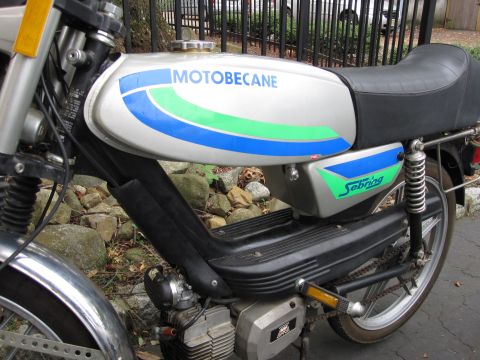
Motomarina was not an Italian factory. It was a badge invented by Marina Mobili Inc (MMI), an importer in Moonachie, New Jersey, and the machines wearing it were built by Moto Meteora, a firm Angelo Zanasi founded in Monteveglio, outside Bologna, in 1953. Meteora started with small four-strokes, spent decades building 50cc through 125cc lightweights with Franco Morini and NSU power, and in 1975 signed on to build export machines for Motobecane. That deal is how the Sebring first reached America: the 1979-80 version sold here wore Motobecane badges and carried Morini MO1 and MO2 engines. After 1980 Meteora quit selling under its own name and built machines for other brands, including the Motomarina line for MMI.
The timing is the odd part of the story. U.S. moped sales climbed from about 25,000 in 1975 to 150,000 in 1977, roughly doubled again in 1978, then fell hard after 1980 as gas prices eased and cheap economy cars arrived. Motomarina showed up in force after that collapse, selling Italian-built mopeds through the mid and late 1980s when most importers had already packed up. MMI even picked up the General trademark around 1984 and folded that brand's leftover models into its own catalog.
Sebring (1985-1989)
The Sebring is the Motomarina most owners actually encounter, typically titled between 1985 and 1989. It is a 49cc pedal-start two-stroke that came with one of two engines: the Minarelli V1 single-speed automatic on most bikes, or the Franco Morini M1 on the rest, and the factory owner's manual covers both. Late Sebrings used the case-reed V1-L variant, fed by a Dellorto SHA 14.12 carburetor mounted sideways into the crankcase. Either engine is a good draw today. The V1 in particular is one of the best-supported vintage moped powerplants, with pistons, clutches, crank seals, and a deep aftermarket of performance cylinders and exhausts still in circulation. One detail sets the chassis apart: 17-inch wheels, where nearly every other Italian moped of the era ran 16-inch.
Raven and Tri-Power
The Sebring was not the whole line. The Raven, documented as a 1987 model, is a step-thru with a piston-port Minarelli V1 and 16-inch Bernardi cast aluminum wheels; it had earlier been sold as the General TE before MMI took over that trademark. The Tri-Power was a late-1980s three-wheeler built on an electric-start Minarelli V1 drivetrain, with the trike rear conversion done by Pryer Motorcraft of Ada, Ohio.
Ownership realities
Running a Motomarina today means identifying the engine first and treating the badge second.
- Confirm which engine you have before ordering anything. Minarelli V1 and Morini M1 parts do not interchange, and both turned up in Sebrings.
- Engine parts are easy either way. V1 pieces cross over from Cimatti, Motron, General, and a dozen other brands that used the same powerplant, and the Morini M1 has similar cross-brand support.
- Body and trim parts are the hard part. Tanks, side covers, badges, and Sebring-specific plastics have no reproduction support, so donor bikes and patience are the usual answer.
- Documentation is workable. Sebring owner's manuals circulate as free scans, and generic Minarelli and Morini service literature covers the drivetrain completely.
Values track the broader vintage moped market: complete, running Sebrings trade modestly, and buyers care more about a healthy engine and a clean title than about originality.
Asked all the time
What years were Motomarina mopeds sold in the United States?
Motomarina-badged mopeds sold mainly in the mid and late 1980s, with most Sebrings titled between 1985 and 1989. The same basic bike reached the U.S. earlier as the Motobecane Sebring in 1979-80, before the Motomarina name existed on it.
Who actually built Motomarina mopeds?
Moto Meteora of Monteveglio, near Bologna, Italy, built them for Marina Mobili Inc, the New Jersey importer that owned the Motomarina name. Meteora dated to 1953 and had already built the Sebring for Motobecane's export program in 1979-80.
What engine does the Motomarina Sebring use?
Sebrings came with either the Minarelli V1, a 49cc single-speed automatic two-stroke, or the Franco Morini M1. Most carry the V1, and late bikes use the case-reed V1-L variant, so check your engine cases before ordering parts.
Are parts still available for a Motomarina moped?
Drivetrain parts are widely available because both the Minarelli V1 and Morini M1 were shared across many brands, and the V1 remains one of the best-supported vintage moped engines. Body panels, tanks, badges, and other Motomarina-specific trim have no reproduction support, so those pieces come from donor bikes.
Is a Motomarina Sebring a good first vintage moped?
A running Sebring is a reasonable entry point because both of its possible engines are simple, well documented, and cheap to rebuild. The main risks are missing brand-specific trim and incomplete bikes, so buy the most complete example you can find.
Is Motomarina still in business?
No. The Motomarina name faded from the American market at the end of the 1980s along with the last of the U.S. moped trade. Moto Meteora, the Italian builder behind the bikes, stopped producing complete machines of its own and later did assembly work for other manufacturers.
The wall
The most-documented Motomarina vehicles in the registry, every photo by the owner.