The registry
Peterbilt Registry: Models, Builds & Photos
Peterbilt Motors Company dates to 1939, when Tacoma plywood maker T.A. Peterman bought the failed Fageol Motors plant in Oakland, California to build the logging trucks he could not buy. Pacific Car and Foundry, now PACCAR, acquired the company in 1958 and still owns it, with production centered in Denton, Texas since 1980. The trucks that anchor its reputation with owners are the long-hood conventionals: the 351 built from 1954 to 1976, the 359 built from 1967 to 1987, and the 379 built from 1987 to 2007.
Pick your model
Founding and corporate history
T.A. Peterman was a Tacoma plywood man who needed better log trucks than he could buy. In 1939 he purchased the failed Fageol Motors plant in Oakland, California for $50,000 and started building trucks under his own name; the first Peterbilts, the chain-drive Model 260 and shaft-drive Model 334, went on sale that April. Peterman died in 1944. His widow Ida sold the company to seven of its managers in 1947 for $450,000 but kept the Oakland land, and when she moved in 1958 to redevelop the property as a shopping center, the owners sold the company to Pacific Car and Foundry, now PACCAR, rather than finance a new plant. PACCAR has run Peterbilt ever since as a sister division to Kenworth, with separate dealer networks and brand identities. Production moved from Oakland to Newark, California in 1960. The Denton, Texas plant opened in 1980, and by 1993 Denton had taken over manufacturing, engineering, and the head office from Newark.
The 351
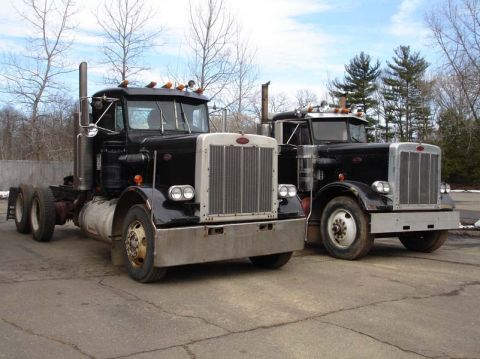
The 351 conventional ran from 1954 to 1976, one of the longest production runs of any Peterbilt model. It carried the narrow needle-nose look of the 1950s West Coast truck, with butterfly hood panels that opened from the center and an aluminum cab that kept weight down for loggers and haulers paying by the pound. The 352 cabover and later the 359 took over highway tractor duty, but the 351 stayed in production as a vocational truck for logging, dump, and heavy-haul work. The riveted aluminum construction does not rust the way steel does, which is a big part of why so many survived to be restored.
The 359
The 359 took over as the flagship long hood in 1967 and ran through 1987. It kept the riveted aluminum cab and, on most trucks, the dual round headlights on brackets. Early trucks used the metal butterfly hood, and after 1973 Peterbilt offered the fiberglass tilt hood that most surviving 359s wear. Production closed with a numbered run of 359 Classics, announced in July 1986 and built as 1987 models, loaded long-hood trucks whose factory numbers still matter at resale. Peterbilt built 8,844 359s in that final year. Owner trucks on the road today cluster in the 1970-1984 span, mostly Cummins, Caterpillar, or Detroit powered with Fuller transmissions.
The 379
The 379 took over the flagship slot in 1987 and ran through 2007, and it is the Peterbilt most working owner-operators know first hand. It kept the 359 formula: a set-forward steer axle, a riveted aluminum cab, and a long aluminum hood, sold in 119 inch and 127 inch bumper-to-back-of-cab configurations. The factory 379 hood was aluminum; its lower-priced stablemate, the 378, got the fiberglass hood. The electrical system and interior were updated over the years, and trucks from the mid 1990s onward carry the improved dash and HVAC. Anything built with pre-EGR power is in demand, because the 2004 federal emissions standards were pulled ahead to October 2002 by consent decree, and that date, not 2004, is where the pre-emissions cutoff owners talk about actually sits. Peterbilt closed out the model in 2007 by designating the final 1,000 trucks as Legacy Class 379s, then replaced it with the 389.
Asked all the time
What years was the Peterbilt 379 made?
Peterbilt built the 379 from 1987 through 2007, when the 389 replaced it. The final 1,000 trucks were designated Legacy Class 379s. Owners hunt hardest for mid 1990s to early 2000s trucks, late enough for the updated dash and HVAC but built before the October 2002 emissions pull-ahead brought cooled-EGR engines.
How is a Peterbilt 359 different from a 379?
The Peterbilt 359 (1967-1987) is the earlier flagship, with early trucks wearing a metal butterfly hood before the fiberglass tilt hood became available after 1973. The 379 (1987-2007) kept the long-hood, riveted-aluminum-cab formula but used an aluminum hood, offered an extended configuration stretching bumper to back of cab to 127 inches, and carried revised electrical systems and a more modern dash. Parts interchange is real but not total between the two.
Who owns Peterbilt, and is it still in business?
Peterbilt is very much alive. Pacific Car and Foundry, now PACCAR, bought the company in 1958 and still owns it, alongside Kenworth. Trucks are built primarily in Denton, Texas, where the main plant opened in 1980.
Are parts still available for older Peterbilts like the 351 and 359?
Yes, better than for most trucks their age. Peterbilt dealers still stock or can source many cab and hood parts, and the aftermarket for 359 and 379 pieces (hoods, brackets, stainless, interiors) is deep because so many trucks are still working or being restored. Drivetrain parts are easy since these trucks used common Cummins, Caterpillar, and Detroit engines with Fuller transmissions rather than proprietary powertrains.
Why do Peterbilt cabs hold up so well?
Peterbilt built its traditional conventional cabs from riveted aluminum, a practice going back to the lightweight West Coast trucks of the 1940s and 1950s. Aluminum does not rust the way steel cabs do, so a 1959 Peterbilt 351 or a 1975 359 can survive decades of work with the cab structure intact, which is a big reason so many old Peterbilts are still on the road. The rivets can work loose on a rough-ridden truck, but the structure itself outlasts steel.
The wall
The most-documented Peterbilt vehicles in the registry, every photo by the owner.