The registry
Saleen Registry: Models, Builds & Photos
Saleen is a low-volume American manufacturer and Mustang tuner founded by racer Steve Saleen in California in 1983, building its first three modified Fox-body Mustangs in 1984. Every Saleen Mustang carries a sequential production number on a chassis badge in addition to its Ford VIN, and Saleen is a registered manufacturer in its own right, with its own VIN code used on the S7. Alongside thousands of serialized Mustangs, Saleen built its own mid-engine supercar, the S7, unveiled in 2000 and produced in small numbers into the late 2000s, and painted and performed final assembly of the Ford GT under contract for Ford from 2004 to 2006. The original company went through an investor takeover and restructuring in the late 2000s; Steve Saleen returned with Saleen Automotive, which continues limited production today.
Pick your model
How Saleen started
Steve Saleen raced SCCA Formula Atlantic in the late 1970s, finishing third in the 1980 championship standings, then moved to Trans-Am in 1982 before starting Saleen Autosport in 1983. The first cars, three 1984 Fox-body hatchbacks in white, copper, and black, were mostly suspension, wheel, and aero packages over the stock 175 hp 5.0L HO. That formula, complete cars built on new Mustangs and sold through Ford dealers with a Saleen serial number, is what separated the company from mail-order tuners. Saleen backed the road cars with racing and won the 1987 SCCA Escort Endurance Championship, taking the driver, team, and manufacturer titles with the Mustang.
S-351 and the S-281 era
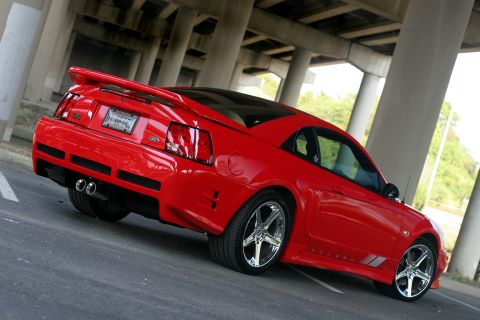
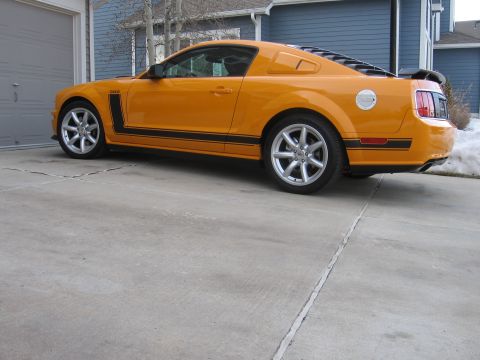
The S-351, built 1994 to 1999, was the deep-modification car: Saleen pulled the factory engine and installed its own 351 cubic inch pushrod V8, supercharged in the final 1999 cars to 495 hp. When the SN95 Mustang got the 4.6L modular V8 in 1996, Saleen named its base car the S-281 for the engine's 281 cubic inches, rated 220 hp that first year. New Edge S-281s from 1999 to 2004 ran 285 hp naturally aspirated, and the S-281SC added a supercharger for a 350 hp rating; by 2003 Saleen was fitting its own Series IV twin-screw supercharger system, built around a Lysholm screw unit. The cars used Racecraft suspension (springs, struts, sway bars, chassis brace) and body panels actually molded by Saleen, not stick-on kits. On the 2005-2009 S197 platform the S-281 ran 335 hp naturally aspirated and 465 hp supercharged.
The S7
The S7 was Saleen's clean-sheet mid-engine supercar, unveiled in 2000 and built in small numbers into the late 2000s. It used a 4130 steel spaceframe with aluminum honeycomb composite panels, a carbon fiber body, and an all-aluminum 427 cubic inch (7.0L) pushrod V8 rated at 550 hp; the Twin Turbo introduced for 2005 raised that to 750 hp. Total production was roughly 78 cars including the S7R racers. The S7R won its class at the 2001 Sebring 12 Hours and, run by Larbre Competition, won the GT1 class at the 2010 24 Hours of Le Mans, beating the factory-backed Corvettes.
Ford GT work and the modern company
Ford contracted Saleen Special Vehicles in Troy, Michigan to paint and perform final assembly of the 2005-2006 Ford GT. Bodies came in from Mayflower Vehicle Systems in Ohio, and the Troy line ran from June 2004 to September 2006, covering about 4,000 cars. During the same period, outside investors took a majority stake in Saleen, Inc., and Steve Saleen resigned in May 2007. The company's assets passed to MJ Acquisitions in early 2009 amid bankruptcy-era restructuring. Steve Saleen started SMS Supercars in 2008, regained the Saleen name after litigation, and now builds the Coyote-powered 302 line under Saleen Automotive: the naturally aspirated White Label at 510 hp and the supercharged Yellow Label and Black Label, the latter rated 850 hp on the current car. The marque is not defunct, but cars built before 2008 and after the early 2010s come from legally different companies, which matters for records and warranty support.
Asked all the time
What years were Saleen Mustangs built?
Saleen has serialized Mustangs since 1984. The main eras are Fox-body cars (1984-1993), the S-351 and early S-281 SN95 cars (1994-1998), New Edge S-281 and S-281SC (1999-2004), S197 S-281 and Extreme (2005-2009), and Coyote-powered 302 cars from the early 2010s on under Steve Saleen's revived operation, sold today by Saleen Automotive.
How do I verify a real Saleen?
Every genuine Saleen carries a sequential Saleen serial number on a dash or door-jamb badge and in company production records, in addition to the Ford VIN. Clones built from body kits are common, so verify the serial against Saleen production records or an owner club such as the Saleen Owners and Enthusiasts Club before paying Saleen money.
What made the Saleen S-281SC different from a stock Mustang GT?
The 1999-2004 Saleen S-281SC added a supercharger (by 2003, Saleen's own Series IV twin-screw system), Racecraft suspension with unique springs, struts, and sway bars, Saleen-molded body panels, and specific wheels and interior trim. It was rated 350 hp versus 260 for a stock New Edge GT.
Is Saleen still in business?
Yes, but with a break in continuity. Outside investors took control of the original Saleen, Inc., Steve Saleen resigned in May 2007, and the assets passed to MJ Acquisitions in 2009. Steve Saleen came back through SMS Supercars, regained the brand after litigation, and Saleen Automotive builds today's 302 Mustangs. Parts and records support differs depending on which company built your car.
How rare is the Saleen S7?
Roughly 78 S7s were built in total, including S7R race cars, from the car's 2000 debut into the late 2000s. The Twin Turbo cars introduced for 2005 (750 hp) are the most valuable; every S7 uses an all-aluminum 427 cubic inch V8 in a steel spaceframe with carbon fiber bodywork.
The wall
The most-documented Saleen vehicles in the registry, every photo by the owner.