The registry
Sand Rail Registry: Models, Builds & Photos
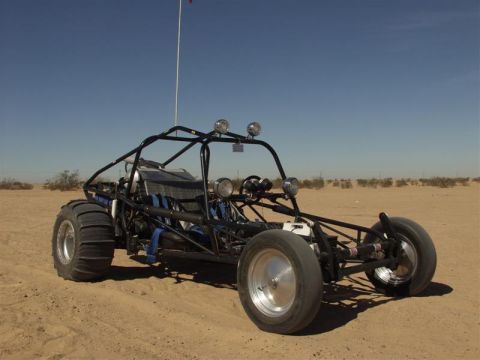
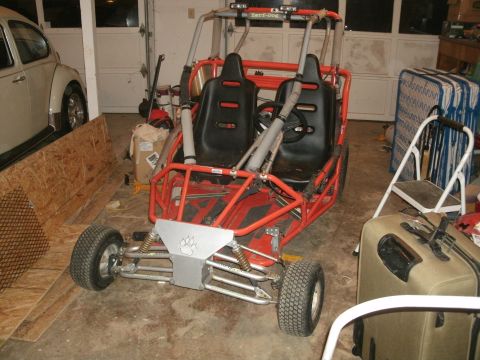
Sand Rail describes a class of purpose-built tube-frame dune machines rather than a single factory marque, a type that grew out of Southern California's stripped-down Volkswagen dune buggies in the 1960s. Builders welded open space frames around the rear-engine VW Type 1 drivetrain and skipped bodywork entirely to keep weight down and planted over the paddle tires. Chassis lines such as High Jumper sold frames and turnkey cars through the 1970s and 1980s, and the format is still built new today with everything from air-cooled flat fours to Subaru and V8 power.
Pick your model
Where the sand rail came from
The sand rail grew out of the same Southern California dune scene that produced the fiberglass buggy boom of the mid 1960s. Once drivers at Pismo and Glamis figured out that the shortened floorpan buggy still carried too much weight and flex, fabricators started throwing the pan away entirely and welding a tube frame around the running gear. The Volkswagen Type 1 drivetrain made the whole thing possible: a light air-cooled flat four bolted to a transaxle, hung behind the rear axle line, with torsion-bar front beams up front. A bare rail could come in under 1,000 pounds, and weight over the drive wheels is exactly what paddle tires want.
The builders
Sand rails were never a Detroit product. The market has always been dozens of regional chassis shops, some lasting decades and some lasting a few seasons. Frames were sold as weld-it-yourself kits, rolling chassis, or turnkey cars, which is why two rails from the same era can differ in wheelbase, tube diameter, and suspension design. Common threads across the classic era: VW link-pin or ball-joint front beams, swing-axle or IRS Type 1 transaxles, and engines ranging from stock 1600cc VW to stroked Type 4 and turbocharged combinations. From the 1990s on, builders moved toward long-travel A-arm front ends, mid-engine layouts, and water-cooled power, with Subaru flat fours becoming the most common swap over the air-cooled VW.
High Jumper
High Jumper, often badged Hi-Jumper, was one of the higher-volume Southern California chassis lines of the classic era. Dealers were selling the cars by the mid 1970s, and the best-known chassis, the two-seat Ascot and single-seat RS lines, ran from about 1976 into the mid 1980s before being replaced by updated 3-series versions of the same frames. The cars follow the classic formula: rear-mounted VW-pattern drivetrain in a welded tube frame with VW-derived front suspension. Because frames were sold bare and finished by buyers, sometimes years after they were welded, titles often carry the year of the donor pan or the year of first registration rather than the year the chassis was built. Identifying a specific car usually means measuring wheelbase and reading the frame details rather than looking for a VIN plate.
Owning one now
Parts support is strong because so much of a classic rail is off-the-shelf VW. Transaxles, brakes, front beam components, and complete engines are all still in production or rebuilt in volume. The fabricated parts, frame repairs, mounts, and cages, are standard work for any competent tube chassis shop. Registration for street use varies widely by state, so check title status before buying.
Asked all the time
What years were Sand Rails made?
Sand Rails have been built continuously since the late 1960s, when Southern California fabricators started replacing shortened VW floorpans with welded tube frames. There is no single production run because Sand Rails come from many independent chassis shops, and new ones are still built today. Individual chassis lines had their own windows; High Jumper, for example, sold its best-known frames from the mid 1970s into the mid 1980s.
What engine does a Sand Rail use?
The classic Sand Rail runs an air-cooled Volkswagen Type 1 flat four bolted to a VW transaxle behind the rear axle line, anywhere from a stock 1600cc up to big-bore stroker and turbo builds. Modern Sand Rails commonly swap in water-cooled Subaru flat fours, and long-travel cars run everything up to V8 power.
What is a High Jumper Sand Rail?
High Jumper, often badged Hi-Jumper, was a Southern California chassis line whose cars were sold through dealers by the mid 1970s, with its two-seat Ascot and single-seat RS frames built from about 1976 into the mid 1980s. They follow the standard formula, VW-pattern rear drivetrain in a welded tube frame with VW-derived front suspension, sold as frames, rolling chassis, and finished cars, so individual examples vary in wheelbase, seating, and engine spec, and title years often reflect the donor pan rather than the frame.
Are Sand Rails street legal?
It depends entirely on the state. Some states will title and register a Sand Rail as a specially constructed vehicle with lights, mirrors, and a horn added; others restrict them to OHV areas. Before buying a Sand Rail, confirm whether it has a title or OHV registration, because a no-paperwork frame can be difficult to make road legal.
Are parts still available for older Sand Rails?
Yes. Most of a classic Sand Rail is standard air-cooled VW hardware, and that supply chain is still healthy: transaxles, front beam parts, brakes, and complete engines are available new or rebuilt. Chassis-specific pieces are fabricated items, so frame repairs and mounts go to a tube chassis shop rather than a parts counter.
The wall
The most-documented Sand Rail vehicles in the registry, every photo by the owner.