The registry
Sea-Doo Registry: Models, Builds & Photos
Sea-Doo is the personal watercraft brand Bombardier first sold in 1968 as the original mass-produced sit-down jet watercraft, shelved after 1970, then relaunched in 1988 on its way to becoming the best-selling PWC line in the world. Every Sea-Doo has run a Rotax engine, from the Austrian engine maker Bombardier bought in 1970. Since 2003 both the brand and Rotax have belonged to BRP (Bombardier Recreational Products), the powersports company spun off from Bombardier Inc. that year. Sea-Doo watercraft are still in production, and from 1993 to 2012 the brand also covered the Sea-Doo Sport Boats jet boat line.
Pick your model
Bombardier origins and the 1988 relaunch
Bombardier put the first Sea-Doo on the water in 1968, a sit-down machine built under patents licensed from Clayton Jacobson II, the same inventor whose stand-up design later became the Kawasaki Jet Ski. Sales were thin, early engines overheated, and the program was dropped after the 1970 season. Bombardier came back in 1988 with the SP, powered by a 580cc Rotax two-stroke twin making 56 hp, right as the PWC market took off. That relaunch stuck. In 2003 Bombardier spun its powersports division off as BRP, which owns Sea-Doo and Rotax today.
Two-stroke era: XP, GTi, GTX
The 1990s Sea-Doo lineup was built around Rotax two-strokes in 580, 650, 720, 787, and 951cc displacements. The XP (1991-2004) was the performance runabout, and the 1995 XP with the dual-carb 720 Rotax carried a carbureted simplicity that owners still like to wrench on. The GTi three-seater served as the durable family hull, with the 720 Rotax in late-1990s versions like the 1998 GTi. The GTX was the full-size three-seat flagship. In 1998 the GTX RFI became the first fuel-injected Sea-Doo, running semi-direct RFI injection on the 787 two-stroke; it sold through 2001, and the GTi RFI and GTi LE RFI carried the same 110 hp engine from 2003 through 2005. RFI cut fuel consumption and emissions but added injector and fuel-pressure systems that carb-era owners never had to think about. The two-stroke GTI family ended after 2005, and the 3D, the convertible stand-up model, carried the last Sea-Doo two-strokes through 2007.
Four-stroke era and the RXP
The 1503 Rotax 4-TEC four-stroke three-cylinder arrived in 2002 in the GTX 4-TEC at 155 hp. Sea-Doo supercharged it for 2003 in the 185 hp GTX 4-TEC SC, then added an intercooler for 2004 and launched the RXP, a two-passenger musclecraft rated at 215 hp, at the time the most powerful production PWC sold. Early supercharged 4-TECs are known for ceramic supercharger clutch washers that fail and send debris through the engine; on 2004-2007 machines the steel-washer rebuild is considered mandatory maintenance, and a 2003 GTX 4-TEC SC deserves the same check.
Sea-Doo Sport Boats
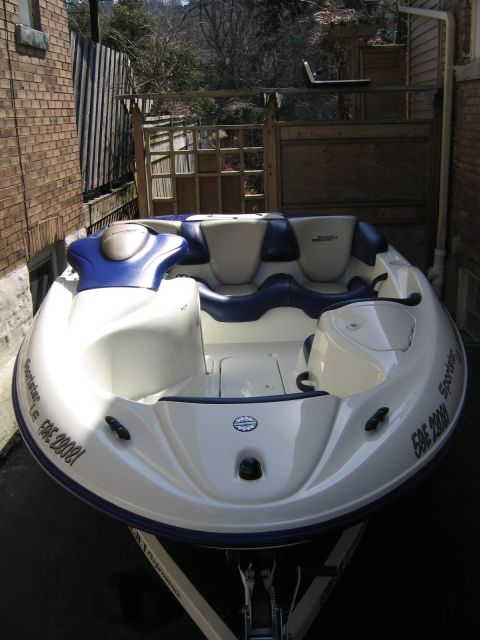
Bombardier also sold Sea-Doo branded boats from 1993 to 2012. The first was the odd 1993 Explorer, a jet-powered rigid inflatable running the 587 Rotax. The Speedster followed in 1994 as a 14-foot twin-engine sport boat with two Rotax 657 two-strokes making a combined 160 hp. The Speedster Wake variant of the mid-2000s added a factory tower with board racks, ballast, and speed control. The 230 Wake, introduced for 2007, was a 23-foot wake-specific boat with factory ballast and a lighted tower, running twin supercharged Rotax 4-TECs at 430 hp standard. BRP announced the end of the Sea-Doo boat line in September 2012 to concentrate on watercraft; the boats have no direct successor.
Asked all the time
What years has Sea-Doo been in production?
Sea-Doo ran a short first production span from 1968 to 1970, then relaunched in 1988 and has been in continuous production since. Sea-Doo watercraft are still built today by BRP. The Sea-Doo boat line ran separately from 1993 to 2012.
When did Sea-Doo switch from two-stroke to four-stroke engines?
Sea-Doo introduced the 1503 Rotax 4-TEC four-stroke in the 2002 GTX 4-TEC. Two-strokes were phased out over the next few years. The two-stroke GTI family, including the GTi RFI, ended after 2005, and the 3D carried the final two-stroke engines through 2007, after which the lineup was all four-stroke.
What does RFI mean on a Sea-Doo?
RFI is Rotax Fuel Injection, a semi-direct injection system first fitted to the 787cc two-stroke in the 1998 GTX RFI, the first fuel-injected Sea-Doo. The GTX RFI sold through 2001 and the GTi RFI ran from 2003 to 2005. RFI improved fuel economy and emissions over carburetors, but the injection and fuel-pressure components add failure points that carbureted Sea-Doos do not have.
Are parts still available for 1990s two-stroke Sea-Doo models?
Yes. The 580, 720, 787, and 951 Rotax two-strokes were built in huge numbers, so pistons, crank rebuilds, carbs, and wear rings for 1990s Sea-Doo models like the XP and GTi are well supported by the aftermarket, and the owner community for these hulls is one of the most active in vintage PWC.
What should I check before buying a supercharged Sea-Doo like a 2004-2007 RXP?
Confirm the supercharger has been rebuilt with the updated steel clutch washers. Supercharged Sea-Doo 4-TEC engines from 2004 through at least 2007 used ceramic washers that can shatter and feed debris into the engine, and the 2003 GTX 4-TEC SC shares the risk. A documented supercharger rebuild is the single most important service record on those years.
The wall
The most-documented Sea-Doo vehicles in the registry, every photo by the owner.