The registry
Tomos Registry: Models, Builds & Photos
Tomos built 49cc two-stroke mopeds in Koper, Slovenia from the mid-1950s until the company went bankrupt on January 3, 2019. The name is an acronym for Tovarna motornih koles Sežana, "motorcycle factory Sežana," after the town where the plant was first planned before it was built in Koper instead. The firm started out assembling Austrian Puch designs under license, then developed its own A3, A35, and A55 engine families, and the two-speed automatic transmission those engines drive is the single feature most owners associate with the make.
Pick your model
Origins in Koper
Tomos was founded in July 1954 on the coast of what was then Yugoslavia and is now Slovenia. The factory was originally planned for Sežana, which is where the acronym comes from, but construction started in Koper in October 1954. Production began in temporary facilities in 1955, and Tito formally opened the finished plant in 1959. The early product line was built under license from Puch of Austria, starting with the Puch SG 250, which gave Tomos proven small two-stroke designs to build on. The company opened a second moped factory in Epe, in the Netherlands, in 1966, and entered the US market through distributors in 1976. Tomos also built outboard motors, and from 1959 assembled Citroen cars under license, work that became the Cimos joint venture with Iskra and Citroen in 1972 and lasted until Citroen stopped delivering parts by 1985. Over the company's life more than 2.5 million machines left the lines across some 70 models, with exports to more than 80 countries and peak production between 1979 and 1989.
The engine families
Three engine generations define the make for anyone wrenching on one today. The A3 is the old points-ignition unit with a cast iron cylinder and piston-controlled intake, found on US models from the brand's arrival through 1991. The A35 replaced it for 1992 with a reed-valve intake, bigger fins, and stronger gears and clutches; early A35s kept points, and CDI ignition phased in around 1994 to 1996. The A55 dropped the reed valve and went back to a piston-controlled intake, this time on an all-aluminum cylinder with four transfer ports, developed to meet US and Swiss emissions rules. In the US it appeared first on the 2004 Revival TS and was under every Tomos by 2007. All three engines are 49cc two-strokes driving a two-speed automatic transmission, which is two centrifugal clutches running in an oil bath. First gear engages as revs come up, then the second clutch grabs at higher rpm, and that second ratio is why a Tomos pulls away harder than most single-speed mopeds. Depending on model and year the engines use oil injection or premix, and the oil pump on injected bikes is a known service item.
The Targa and its siblings
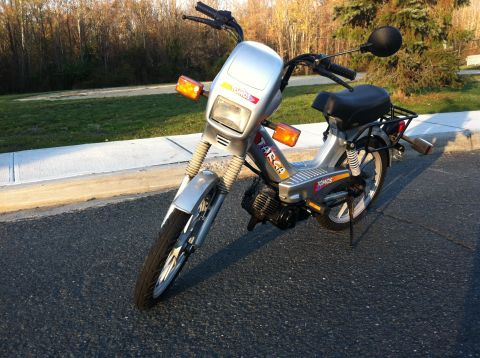
The Targa is the model most North American owners know. It arrived for 1994 alongside the Targa LX, replacing the Golden Bullet and Golden Bullet TTLX, and it carried the A35 engine through its run. The Targa name left the US lineup after about 2002, when the model names shifted to LX and ST. Stock top speed is in the 25 to 30 mph range depending on the restriction fitted for the state it was sold in, and the aftermarket for cylinder kits, pipes, and clutch work is deep because the A35 and A55 stayed in production so long. Earlier US models include the Bullet and Silver Bullet from late 1979, the Golden Bullet from 1985, the Bullet TT of 1987 (the first top-tank Tomos in the US), and the Sprint from late 1993. Later came the Revival in 2002 and the Streetmate in 2005, both on the same drivetrain.
The end of the company
Tomos was privatized in 1998 and sold to Hidria, a Slovenian industrial group, then struggled through the 2010s as European moped demand shrank. In the US, 2013 was the last model year for a while; a new importer brought the brand back in 2017. Workers filed for receivership in November 2018 after going unpaid, and the Koper District Court declared the company bankrupt on January 3, 2019. Parts supply for the A35 and A55 remains reasonable because so many were sold and because aftermarket suppliers still stock consumables, gaskets, and performance parts.
Asked all the time
What years was the Tomos Targa made?
The Targa and Targa LX arrived in the US for the 1994 model year, replacing the Golden Bullet and Golden Bullet TTLX. The Targa name ran through about 2002, after which the lineup shifted to names like LX and ST. US Targas carry the A35 engine, so a 1999 Targa is an A35 machine.
What is the difference between the Tomos A35 and A55 engines?
Both are 49cc two-strokes with the two-speed automatic transmission, but the intake systems are opposite to what many people assume. The A35 uses a reed-valve intake on a cast iron cylinder. The A55 went back to a piston-controlled intake on an all-aluminum cylinder with four transfer ports, designed for emissions compliance. In the US the A55 appeared on the 2004 Revival TS first and was in every model by 2007. Cylinder kits and pipes usually fit one engine or the other, so identify yours before ordering parts.
How fast is a stock Tomos moped?
A stock Tomos runs about 25 to 30 mph depending on model year and the restriction fitted for the state or country it was sold in. The two-speed automatic, two centrifugal clutches in an oil bath, gives it a stronger launch than single-speed mopeds, and common upgrades (70cc kit, exhaust, carb) push a Tomos well past 40 mph at the cost of engine life.
Are parts still available now that Tomos is out of business?
Yes. Tomos went bankrupt in January 2019, but the A35 and A55 engines were built in such volume and stayed in production so long that gaskets, pistons, clutches, and a large performance aftermarket remain easy to find through moped specialty suppliers. Body plastics and model-specific trim are the harder items.
Where were Tomos mopeds built?
The main factory was in Koper, Slovenia (part of Yugoslavia until 1991), running from the mid-1950s until the January 2019 bankruptcy. Tomos also operated a moped plant in Epe, in the Netherlands, from 1966. The company started out producing Puch designs under license before developing its own A-series engines, and US-market bikes arrived through importers beginning in 1976.
The wall
The most-documented Tomos vehicles in the registry, every photo by the owner.