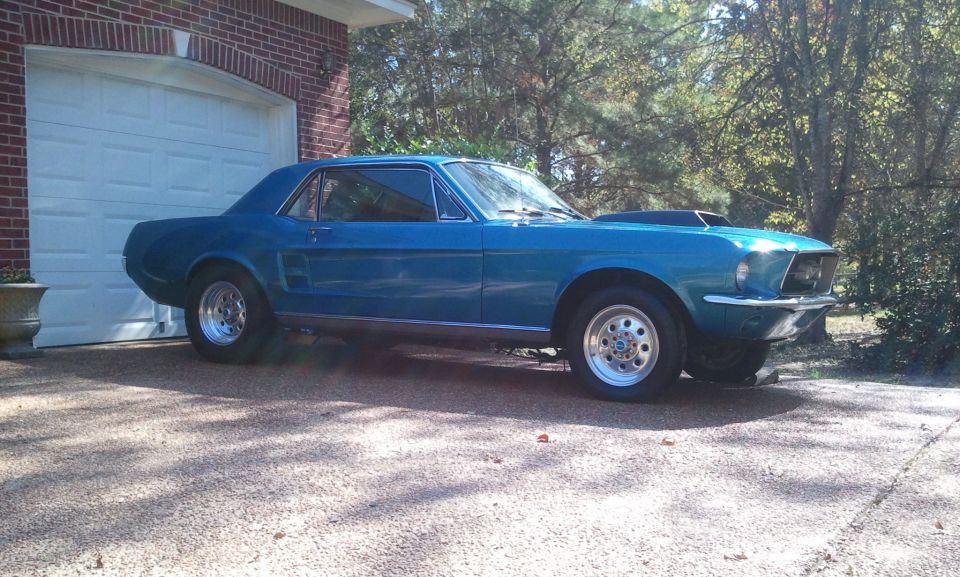
The first-generation Ford Mustang ran from the 1965 model year through 1973 on a chassis derived from the Ford Falcon compact. Ford unveiled the car on April 17, 1964 at the New York World's Fair, and the early "1964½" cars were all stamped and titled as 1965 models. The line launched with a 170 cu in (2.8L) Thriftpower inline-six and a 260 cu in (4.3L) Windsor V8, then quickly standardized the 200 cu in (3.3L) six and the 289 cu in (4.7L) Windsor. A 1967 restyle widened the engine bay for the 390 cu in (6.4L) FE big-block, and 1968 brought the 302 cu in (5.0L) Windsor and the 428 Cobra Jet. The 1969 restyle introduced the Mach 1, the Trans-Am Boss 302, the NASCAR-homologation Boss 429, and the Grande luxury hardtop. Bodies grew through 1971-1973, the final first-generation years. Body styles were the hardtop coupe, the 2+2 fastback, and the convertible. All horsepower figures for this era are SAE gross.
Other Ford Mustang generations
At a glance
- Years: 1964½-1973 (first generation; the April 17, 1964 debut cars were titled as 1965 models)
- Platform: Ford Falcon compact unibody, rear-wheel drive
- Body styles: hardtop coupe, fastback (2+2), convertible
- Engines: 170, 200, then 250 cu in inline-six; 260, 289, 302 cu in Windsor V8; 351 Windsor then 351 Cleveland V8; 390 and 428 cu in FE big-block V8; 429 cu in V8 (1971)
- Performance models: K-code HiPo 289, GT, Mach 1 (from 1969), Boss 302, Boss 429, Shelby GT350 and GT500
- Rear axle: Ford 8-inch and 9-inch, by engine
- Horsepower basis: SAE gross through 1971; SAE net for 1972-1973
Year-by-year specifications
| Year | Engines | Drivetrain & brakes | Notable changes |
|---|---|---|---|
| 1965 | 170 cu in (2.8L) and 200 cu in (3.3L) Thriftpower I6; 260 cu in (4.3L) and 289 cu in (4.7L) Windsor V8; K-code HiPo 289 rated 271 hp gross | 3-speed and 4-speed manual or Cruise-O-Matic; Ford 8-inch or 9-inch rear axle; front drum brakes standard, front discs optional | The 1965 Mustang absorbed the "1964½" launch cars titled as 1965s. GT Equipment Group introduced; 2+2 fastback added during the year. |
| 1966 | 200 cu in (3.3L) I6; 289 cu in (4.7L) Windsor V8 incl. the 271 hp gross K-code HiPo | 3-speed/4-speed manual or Cruise-O-Matic; 8-inch or 9-inch rear axle; front drums standard, front discs optional | The 1966 Mustang carried minor trim revisions over 1965 with a restyled grille and side ornamentation; it was the highest-volume single year of the early Mustang. |
| 1967 | 200 cu in (3.3L) I6; 289 cu in (4.7L) Windsor V8; new 390 cu in (6.4L) FE big-block V8 | 3-speed/4-speed manual or Cruise-O-Matic; 8-inch or 9-inch rear axle; front disc brakes optional | The 1967 Mustang received the first restyle with a wider body and engine bay, which opened room for the 390 FE big-block. |
| 1968 | 200 cu in (3.3L) I6; 289 (4.7L) and new 302 cu in (5.0L) Windsor V8; 390 (6.4L) FE; 428 Cobra Jet FE big-block from April 1968 | 3-speed/4-speed manual or C4/C6 automatic; 8-inch or 9-inch rear axle; front discs optional | The 1968 Mustang added the 302 Windsor and, mid-year in April 1968, the 428 Cobra Jet, which became the headline drag-strip engine. |
| 1969 | 200 (3.3L) and 250 cu in I6; 302 (5.0L) Windsor; 351 cu in Windsor; 390 (6.4L) FE; 428 Cobra Jet; Boss 302 rated 290 hp gross; Boss 429 rated 375 hp gross | 3-speed/4-speed manual or C4/C6 automatic; 9-inch rear axle on performance models; front discs widely available | The 1969 Mustang was fully restyled with quad headlamps and a longer body. New models: Mach 1, Grande luxury hardtop, Trans-Am Boss 302, and NASCAR-homologation Boss 429 semi-hemi. |
| 1970 | 200/250 I6; 302 (5.0L) Windsor; 351 cu in Windsor then 351 Cleveland; 428 Cobra Jet; Boss 302 (290 hp gross); Boss 429 (375 hp gross) | 3-speed/4-speed manual or C4/C6 automatic; 9-inch rear axle on big-blocks; front disc brakes | The 1970 Mustang returned to single headlamps within the grille opening and phased in the 351 Cleveland alongside the 351 Windsor; final year for the Boss 302 and Boss 429. |
| 1971 | 250 I6; 302 (5.0L) Windsor; 351 Cleveland incl. 351 Cobra Jet/HO; 429 Cobra Jet and 429 Super Cobra Jet (this year only) | 3-speed/4-speed manual or C6 automatic; 9-inch rear axle on big-blocks; front disc brakes | The 1971 Mustang grew to the largest first-generation body with a near-horizontal fastback roofline. The 429 Cobra Jet and Super Cobra Jet were offered for 1971 only. |
| 1972 | 250 I6; 302 (5.0L) Windsor; 351 Cleveland incl. 351 HO; figures now quoted as SAE net | 3-speed/4-speed manual or C6 automatic; 8-inch rear axle on 302 cars, 9-inch on 351s; front disc brakes | The 1972 Mustang dropped the big-blocks; the industry-wide switch to SAE net ratings and lower compression for unleaded fuel reduced quoted output across the range. |
| 1973 | 250 I6; 302 (5.0L) Windsor; 351 Cleveland; SAE net ratings | 3-speed/4-speed manual or C6 automatic; 8-inch rear axle on 302 cars, 9-inch on 351s; front disc brakes | The 1973 Mustang was the final first-generation car, with a revised front bumper meeting new federal 5 mph impact rules ahead of the 1974 Mustang II. |
Platform and how the first-generation Mustang grew
The first-generation Ford Mustang shared its underpinnings with the Ford Falcon compact: the unibody, front suspension, and Thriftpower inline-six family. The 1965 Mustang launched with a 170 cu in (2.8L) six and a 260 cu in (4.3L) Windsor V8, and within months standardized on the 200 cu in (3.3L) six and the 289 cu in (4.7L) Windsor. The top early V8 was the K-code "HiPo" 289, rated 271 hp gross with a solid-lifter cam and free-flow exhaust. The 1967 Mustang was the first restyle, widening the body and engine bay to accept the 390 cu in (6.4L) FE big-block. The 1968 Mustang added the 302 cu in (5.0L) Windsor and, from April 1968, the 428 Cobra Jet FE big-block.
The 1969 restyle and the performance Mustangs
The 1969 Ford Mustang received a major restyle, gaining length and quad headlamps for 1969, with the inboard pair in the grille and the outboard pair in the fender extensions. For 1970 the Mustang returned to two headlamps set within the grille, the former outboard openings becoming simulated intakes. It introduced four models. The 1969 Mach 1 was the performance fastback offered with V8s up to the 428 Cobra Jet. The 1969 Boss 302 was built to homologate the 302 Windsor for SCCA Trans-Am racing and was rated 290 hp gross. The 1969 Boss 429 was built to homologate its semi-hemi 429 big-block for NASCAR, rated 375 hp gross. The 1969 Grande was a luxury hardtop with added sound insulation and upscale trim. The 351 Windsor V8 joined for 1969, and the 351 Cleveland followed for 1970.
The 1971-1973 big-body cars
The 1971 Ford Mustang grew to the largest body of the first generation, with a near-flat "SportsRoof" fastback roofline. The 1971 range offered the 351 Cleveland, including the 351 Cobra Jet and 351 HO, plus the 429 Cobra Jet and 429 Super Cobra Jet big-blocks, both offered for 1971 only. The 1972 Ford Mustang dropped the big-blocks, lowered compression for unleaded fuel, and quoted power as SAE net, which read lower than the gross figures used through 1971. The 1973 Ford Mustang was the final first-generation car and added a federal 5 mph front bumper before the Pinto-based Mustang II replaced it for 1974.
Shelby Mustangs (1965-1970)
Carroll Shelby's operation built high-performance Mustang variants from 1965 through 1970. The 1965-1966 Shelby GT350 used the 289 cu in (4.7L) Windsor V8 in a fastback prepared for road racing. The Shelby GT500 arrived for 1967 with FE big-block power. The 1968 Shelby GT500KR ("King of the Road") used the 428 Cobra Jet FE big-block. From 1968 the Shelby cars were built under Ford supervision, and production ended after the 1970 model year.
Known characteristics and weak points
The first-generation Ford Mustang used a unibody prone to rust in the floor pans, torque boxes, frame rails, and rear quarter panels. Early 1965-1966 cars came with front drum brakes as standard and front discs optional, so disc-brake cars are preferred for performance use. Big-block 1967-1971 cars carry more weight over the front axle than small-block cars, which changes handling balance.
Frequently asked questions
When did the first-generation Ford Mustang debut, and what is a "1964½"?
The first-generation Ford Mustang debuted on April 17, 1964 at the New York World's Fair. Cars built before the formal 1965 model-year start are nicknamed "1964½" by enthusiasts, but Ford VIN-stamped and titled all of them as 1965 models, so there is no official 1964 Mustang.
What platform is the first-generation Ford Mustang built on?
The first-generation Ford Mustang (1965-1973) is built on the Ford Falcon compact platform, sharing its unibody structure, front suspension design, and the Thriftpower inline-six engine family.
What was the K-code HiPo 289 in the early Mustang?
The K-code "HiPo" (High Performance) 289 was the top engine in the 1965-1966 Ford Mustang, a 289 cu in (4.7L) Windsor V8 rated 271 hp gross with a solid-lifter cam and free-flow exhaust. The same 289 also powered the 1965-1966 Shelby GT350.
What is the difference between the 1969 Boss 302 and Boss 429 Mustang?
The 1969 Ford Mustang Boss 302 was built to homologate the 302 Windsor V8 for SCCA Trans-Am road racing and was rated 290 hp gross. The 1969 Ford Mustang Boss 429 was built to homologate its semi-hemi 429 big-block for NASCAR and was rated 375 hp gross.
Why does a 1972 Mustang V8 look weaker than a 1971 one?
The 1972 Ford Mustang quoted SAE net horsepower rather than the SAE gross figures used through 1971, and compression was lowered for unleaded fuel. A 1972-1973 engine therefore reads lower on paper even when it is mechanically close to a 1971 unit.
Sources
- Ford factory model-year sales brochures and shop manuals (1965-1973)
- Ford VIN and data-plate decoding references for engine and axle codes
- Marque-club registries and reference works on the early Mustang, Boss, Mach 1, and Shelby variants
- Period road tests reporting SAE gross ratings (pre-1972) and SAE net ratings (1972 onward)
Asked all the time
When did the first-generation Ford Mustang debut, and what is a "1964½"?
The first-generation Ford Mustang debuted on April 17, 1964 at the New York World's Fair. Cars built before the formal 1965 model-year start are nicknamed "1964½" by enthusiasts, but Ford VIN-stamped and titled all of them as 1965 models, so there is no official 1964 Mustang.
What platform is the first-generation Ford Mustang built on?
The first-generation Ford Mustang (1965-1973) is built on the Ford Falcon compact platform, sharing its unibody structure, front suspension design, and the Thriftpower inline-six engine family.
What was the K-code HiPo 289 in the early Mustang?
The K-code "HiPo" (High Performance) 289 was the top engine in the 1965-1966 Ford Mustang, a 289 cu in (4.7L) Windsor V8 rated 271 hp gross with a solid-lifter cam and free-flow exhaust. The same 289 also powered the 1965-1966 Shelby GT350.
What is the difference between the 1969 Boss 302 and Boss 429 Mustang?
The 1969 Ford Mustang Boss 302 was built to homologate the 302 Windsor V8 for SCCA Trans-Am road racing and was rated 290 hp gross. The 1969 Ford Mustang Boss 429 was built to homologate its semi-hemi 429 big-block for NASCAR and was rated 375 hp gross.
Why does a 1972 Mustang V8 look weaker than a 1971 one?
The 1972 Ford Mustang quoted SAE net horsepower rather than the SAE gross figures used through 1971, and compression was lowered for unleaded fuel. A 1972-1973 engine therefore reads lower on paper even when it is mechanically close to a 1971 unit.
Technical Reference
Member-uploaded diagrams & documents for this generation. AI-classified; community-verified where badged.
Schematics (5)
- Ford DOHC Competition Engine Longitudinal Cross Section Diagram - Figure 21This document is a single page from a Ford technical/reference publication, headed "MAINTENANCE" in large orange lettering. The page consists almost entirely of a detailed cutaway technical illustration, captioned…
- Inline 4-Cylinder Engine Cutaway Illustration - Four Carburetors, Cam & Crank ViewThis document is a color technical cutaway illustration, printed on a blue background, showing the internal construction of an inline four-cylinder gasoline engine in longitudinal cross-section. The top of the engine…
- Hand-Drawn Cooling Schematic - Modified Radiator with Inline 190° ThermostatsThis document is a hand-drawn schematic sketch showing a modified engine cooling system layout. At the top of the drawing is a component labeled "Modified Radiator," depicted with a filler cap and two lower outlets…
- Ford V8 Firing Order 1-5-4-2-6-3-7-8 Diagram - Cylinder & Distributor LayoutThis document is a firing order / cylinder numbering schematic for a Ford V8 engine, watermarked www.mre-books.com. It shows the engine as viewed from above with two cylinder banks: one bank numbered 1 through 4 (front…
- Ford V8 Cylinder Numbering & Distributor Cap Firing Order DiagramThis document is a simple black-and-white schematic showing the cylinder numbering and distributor cap terminal arrangement for a Ford V8 engine. The engine is drawn as two banks of four cylinders each: one bank…
Manual Pages (16)
- Ford 427 SOHC & GT Engine Induction System Development - Cylinder Head DesignThis is a two-page spread (pages 12-13) from a Ford engineering/performance publication describing the development of Ford's high-performance 427 engine induction systems. Page 12 covers the dual four-venturi intake…
- Ford 427 Medium-Riser Induction System & 4V Intake Manifold DevelopmentThis is a two-page spread (pages 8-9) from a Ford engineering publication describing the design and development of the medium-riser induction system for the 427 engine. Page 8 contains three photographs: Figure 14…
- Ford 351 V8 Engine Design Features - Cylinder Block vs 302, Main Bearing CapsThis two-page spread (pages 8-9) from a Ford engineering reference booklet describes the design features of the cylinder block for the then-new Ford 351 cubic inch V8 engine, comparing it to the current production 302…
- Ford Engine Plant Manufacturing - Carousel Hot Test & Machining Processes, Page 7This is page 7 of a Ford engineering/manufacturing publication describing production processes at a new Ford engine plant. The page explains a "lift and carry" transfer system that replaced suspended "C" hook…
- Ford Mustang I Concept & Design - Mid-Engine Prototype Specs, Frame & DrivelineThis two-page spread, titled "Concept and Design," is from an engineering paper describing the original Ford Mustang two-seat sports car concept (the mid-engine Mustang I prototype). It explains the initial design…
- Ford V8 Engine Cutaway Illustrations - Figures 34 & 35, Book Pages 20-21This scan shows a two-page spread (pages 20 and 21) from a printed automotive book or technical publication, containing two full-page color cutaway illustrations labeled Figure 34 and Figure 35. Figure 34 (page 20) is…
- Ford Experimental Aluminum V8 Cylinder Head Gasket Design - O-Ring Seal, Fig 23-24This is page 15 of a Ford engineering/technical publication describing an experimental engine's cylinder head gasket design. The large illustration (Figure 23) shows a cutaway of the head-to-block sealing arrangement…
- Indianapolis Track Survey Figure 10 - Southwest Corner Banking & Watson Indy DataThis is page 8 of a printed technical publication describing a survey of the Indianapolis Motor Speedway, headlined 'Indianapolis Track Survey' (Figure 10). The large diagram details the Southwest Corner of the track…
- 1968 Shelby GT500 & Ford 427 Tunnel Port Article - Speed & Supercar p.67This is page 67 of Speed & Supercar magazine (1968), containing continuations of several feature articles plus a full advertisement. The first column concludes a Ford tunnel-port engine discussion, covering 12.5-to-1…
- Ford Tractor 9N 2N 8N 1939-1952 Assembly Manual & Service Parts Catalog CoverThis is the front cover of a reproduction assembly manual and service parts catalog for Ford tractors, specifically covering the Ford 9N, 2N, and 8N models produced from 1939 to 1952. The cover features a photograph of…
- SAE Paper 670067: Ford Mark II 427 GT Engine Induction System (1967) CoverThis image shows the front cover of a Society of Automotive Engineers (SAE) technical paper titled "Mark II: 427 GT Engine Induction System," authored by A. O. Rominsky of Ford Motor Company. The paper was presented at…
- SAE Paper 670065: The Ford GT Sports Car by R. C. Lunn, Ford Motor Co. (1967)This is the cover page of a Society of Automotive Engineers (SAE) technical paper booklet titled "The Ford GT Sports Car," authored by R. C. Lunn of Ford Motor Company. The cover shows the SAE triangular logo and the…
- SAE Paper 700080: Ford's Second Generation New 351 4-V Engine (1970) CoverThis image shows the cover page of a Society of Automotive Engineers (SAE) technical paper, number 700080, titled "Ford's Second Generation New 351 4-V Engine." The paper was written by F. J. Miller and J. J. Van Deun…
- SAE Paper 611F (1963): The Mustang - Ford's Experimental Sports Car by R.C. LunnThis image shows the front cover of a Society of Automotive Engineers (SAE) technical paper titled "The Mustang: Ford's Experimental Sports Car," authored by R. C. Lunn of Ford Motor Company. The paper carries the SAE…
- SAE Paper 818A: A Ford Engine for Indianapolis Competition (1964) - W.H. GayThis is the cover page of a Society of Automotive Engineers (SAE) technical paper, number 818A, titled "A Ford Engine for Indianapolis Competition," authored by William H. Gay, Executive Engineer of the Engine and…
- Vintage Mustang Forum April Fools 2008 Shutdown Message ScreenshotThis document is not an automotive reference page but a screenshot of the Vintage Mustang Forum (VMF) website, viewed in Microsoft Internet Explorer at forums.vintage-mustang.com. The page displays a 'Forum Message'…
Brochures & Literature (36)
- American Autowire Classic Update Wiring Kit Unboxing - 1968 Ford MustangThis is a photograph (not a scanned reference document) showing an unboxing of an American Autowire wiring harness kit shipped from Summit Racing Equipment. The white product box prominently displays the American…
- Bill Stroppe Baja Bronco Order Form - Ford Bronco U15 Package & PricingThis document is an original order form from Bill Stroppe & Associates of Long Beach, California, for purchasing a Ford Bronco with the Stroppe Baja Bronco Package. It lists the mailing address (P.O. Box 1891 / 2180…
- 1968 Shelby Cobra GT-500 427 Road Test Specs - Speed & Supercar Magazine p.62This is page 62 from Speed & Supercar magazine, part of a road test article titled "Shelby's Sophisticated Supercar" covering the 1968 Shelby Cobra GT-500. The page contains an "S&S Test Specs" panel listing full test…
- Save Johnson Valley Fun Ride Flyer - Dec 13-14 2008, Cougar Buttes OHV EventThis document is a promotional event flyer (not an automotive reference document) for the "Save Johnson Valley Fun Ride," held December 13-14, 2008 at Cougar Buttes. Sponsored by BRP (Billet Racing Products) and AMA…
- Coyote Wash 200 Night Race Drawing Party Flyer - ORW Escondido, June 7thThis document is a promotional event flyer, not a technical reference. It advertises a "Driver Starting Position Drawing Party" hosted at ORW (Off Road Warehouse, offroadwarehouse.com) for the Coyote Wash 200 Night…
- 1968 Mercury Cougar 390 GT Muscle Machines Drive Report - Specs & HistoryThis is a photograph of a framed magazine feature from Muscle Machines ("The Ultimate All-American Performance Car Magazine"), a Drive Report on a 1968 Mercury Cougar, written by George Mattar and Jeff Koch. The spread…
- Robby Gordon Angry Over 2008 Dakar Rally Cancellation - USA TODAY ArticleThis is a scanned USA TODAY newspaper article by Nate Ryan titled "Cancellation angers Gordon," reporting from Daytona Beach, Fla. Off-road and NASCAR driver Robby Gordon expresses anger over the cancellation of the…
- 2007 Baja 1000 Drawing Festival Flyer - 40th SCORE Baja 1000, Lake ElsinoreThis document is a promotional event flyer (not a technical automotive reference) for the 2007 3rd Annual Baja 1000 Drawing Festival, held at the Lake Elsinore Casino, September 21-23, 2007, in celebration of the 40th…
- 1968 Ford Mustang 428 Cobra Jet - Hubert Platt SS/E Winternationals ArticleThis is page 41 of S/S & FX magazine, an article titled "Hubie Tells It Like It Is!" by Alex Walordy. It profiles Ford drag racer Hubert Platt and his 428 Cobra Jet Mustang, which won its SS/E (Super Stock/E) class at…
- 2003 45 mph Catamaran Boat Sales Flyer - Twin Volvo 4.3 GXI, Factory Direct YachtsThis document is a dealer sales flyer from Factory Direct Yachts of Newport Beach, CA, advertising a 2003 model 45 mph Catamaran powerboat. The flyer lists key specifications: 27-foot length, 9-foot beam, 7,250 lb…
- Chrysler Turbine Car 'Bronze Blowtorch' Exhibit Sign - Jet-Car Engine FactsThis is a photograph of a promotional/informational display placard titled "Chrysler's Bronze Blowtorch, the Turbine," apparently a museum or exhibit sign about the Chrysler Turbine car. Under the heading "Imagine a…
- Chrysler Turbine Car "Bronze Blowtorch" Museum Display Sign - Jet-Car FactsThis is a photograph of a museum-style display placard titled "Chrysler's Bronze Blowtorch, the turbine," promoting the Chrysler Turbine car. The sign, headed "Imagine a car that...", lists five bullet-point advantages…
- Only in America: Cigar Fire Insurance Claim & Arson Story - Global Village ClippingThis document is not an automotive reference at all. It is a scanned clipping from a column titled "global village, a weekly posting from cyberspace," under the heading "Only in America." It relates a well-known…
- 1957 Chevrolet Bel Air 2-Door Sedan For Sale - Buyers Guide & NADA ValuesThis photograph shows two documents taped inside the driver's window of a heavily patinated 1957 Chevrolet Bel Air 2-door sedan offered for sale. The first document is a standard FTC Buyers Guide filled out for a…
- 1957 Chevrolet Bel Air 2-Door Sedan For Sale - Buyers Guide & NADA ValuesThis photograph shows two paper documents taped inside the driver's-side window of a heavily weathered/patina'd two-door sedan offered for sale. The left document is a standard FTC Buyers Guide window form filled out…
- 1966 Plymouth Belvedere Satellite Convertible - Buyers Guide & NADA ValuesThis photo shows two documents taped inside the window of a used car for sale. The left document is a completed FTC Buyers Guide window sticker identifying the vehicle as a 1966 Plymouth Belvedere with VIN…
- 2014 Tecate SCORE Baja 1000 Course Map - Ensenada to La Paz, 47th Annual RaceThis document is the official projected course map poster for the 47th Tecate SCORE Baja 1000, held November 12-16, 2014, running point-to-point from Ensenada, Baja California, to La Paz, Baja California Sur…
- 2014 SCORE Imperial Valley 250 Off-Road Race Course Map & Spectator AreasThis document is the official course map for the SCORE International Imperial Valley 250 off-road race, held April 23-27, 2014, near Ocotillo, California (website WWW.IVSCORE250.COM). The map shows the full race course…
- Carson Trailer 2014 Price List - CC California Car Hauler Specs & OptionsThis document is page 8 of the Carson Trailer, Inc. 2014 Price List covering the CC - California Car Hauler trailer. It lists the trailer's standard specifications: 7000# GVWR, two 3500# axles, equalizer/leaf spring…
- Carson Trailer 2014 Price List - CC California Car Hauler Specs & OptionsThis document is a single page (page 8) from the Carson Trailer, Inc. 2014 Price List, dated September 2013 (Rev R1.0). It covers the "CC - California Car Hauler" trailer model. The top section lists the trailer's…
- Carson Trailer 2014 Price List: DC Deluxe Car Hauler Specs, Prices & OptionsThis document is page 7 of the Carson Trailer, Inc. 2014 Price List, dated September 2013 (Rev R3.0), covering the DC, Deluxe Car Hauler trailer line. It lists the standard specifications: 7000# GVWR, two 3500# axles…
- Carson Trailer 2014 Price List: SC Standard Car Hauler Specs & Option PricesThis is page 6 of the Carson Trailer, Inc. 2014 Price List, dated September 2013 (Rev R5.0), covering the SC, Standard Car Hauler trailer. The page lists the standard specifications: 7000# GVWR, two 3500# axles, 2000#…
- 45th Tecate SCORE Baja 500 (2013) Official Course Map & Race RouteThis document is the official course map for the 45th Tecate SCORE Baja 500 off-road race, held May 31, June 2, 2013, with an approximate race mileage of 500 miles. The start/finish line is at the Riviera Convention…
- Glendale Elks Lodge #1289 16th Annual Car Show Flyer - March 20, 2011, Glendale CAThis document is a promotional flyer for the Glendale Elks (Lodge #1289) 16th Annual Car Show, held Sunday, March 20, 2011, from 9:00 am to 8:30 pm at 120 E. Colorado St., Glendale, CA. All proceeds went to the…
- 2011 Burbank Kiwanis 12th Annual Car Show Flyer - Johnny Carson Park, April 17This document is a promotional flyer (printed on pink paper) for the 12th Annual Car Show presented by the Burbank Kiwanis For Fun Foundation, Inc. The event was held Sunday, April 17, 2011, from 9:00 a.m. to 3:30 p.m…
- 2008 Baja Legacy Party Poster - SCORE Baja 500 40th Anniversary, EnsenadaThis document is a promotional event poster for the 2008 Baja Legacy Party, presented by Monster Energy and held Thursday, May 29th, 2008, from 6-10 PM at Horsepower Ranch in Ensenada, Mexico. The event celebrated the…
- Mercury Capri Turbo RS Dealer Posters - Motorsport & Free Options Promo AdsThis is a photograph taken at a car show showing two framed vintage Mercury Capri dealership promotional posters displayed in front of a Fox-body Mercury Capri with its hood raised, alongside a 'Reserved Capri Parking…
- 2000 Ford Mustang Cobra R Show Placard - Specs, Features & Sticker PriceThis document is a car show display placard from a "Fabulous Fords Forever" event, describing a 2000 Ford Mustang Cobra 'R'. It lists the car's factory special features: a 5.4 liter DOHC 385 hp engine, large capacity…
- 1966 Ford Mustang Shelby GT350-H Convertible Re-Creation - Show Board & SpecsThis is a car-show display board photographed at an event, describing a 1966 Ford Mustang Shelby GT350-H Convertible re-creation. The History section explains that in 1966 Ford and Carol Shelby proposed a deal to Hertz…
- 2008 Ford Shelby GT500 Super Snake Road & Track Spec Sheet - Full Test DataThis is a Road & Track magazine specification and road-test data sheet for the 2008 Ford Shelby GT500 Super Snake, produced by Shelby Automobiles, Inc. of Las Vegas, Nevada, displayed as a poster at a car show. It…
- 2008 Tecate SCORE San Felipe 250 Official Course Map - Checkpoints & Race MilesThis document is the official course map poster for the 2008 Tecate SCORE San Felipe 250 off-road race, held March 14-15, 2008, in Baja California, Mexico. The course is 232.0 miles long with a 10-hour time limit, and…
- 1968 Shelby GT500-KR Road Test & Specs - Hot Rod Magazine November 1968This is page 41 of the November 1968 issue of Hot Rod magazine, part of a road test of the 1968 Shelby GT500-KR Mustang, tested in both fastback (4-speed manual) and convertible (Selecto-O-Matic 3-speed automatic)…
- 1988 Ford Bronco II Specs Sheet - FAB Fords 2006 Feature Vehicle InfoThis document is a car show feature vehicle information sheet from the FAB Fords 2006 show, dated April 9, 2006, presenting a 1988 Ford Bronco II Sport Utility Wagon as a Bronco feature vehicle. The sheet includes a…
- 1979 Ford Bronco Feature Vehicle Sheet - Fab Fords 2006 Show Specs & HistoryThis document is a vehicle feature sheet from the Fab Fords 2006 car show (April 9, 2006), highlighting a 1979 Ford Bronco wagon as the Bronco Feature Vehicle. It lists factory specifications: 400 cubic-inch engine…
- Hot Rod Dec 2007 'Street Cup': Rick Stanton Ford Talladega NASCAR Street CarThis image is a photograph of a two-page opening spread from Hot Rod magazine (December 2007 issue, pages 40-41), laid open across the engine bay of a car whose valve cover/air cleaner area shows a 'BOSS 429' badge…
- 1965 Shelby Cobra 427 Competition CSX-3016 - Racing History Display SignThis document is a photographed display placard titled "YES, IT'S REAL!" describing an original Shelby Cobra 427, chassis number CSX-3016. According to the placard, the car is one of the rarest 427 Cobras and one of…
Wiring Diagrams (9)
- Electric Heat Air Handler Wiring Diagram B17576-02 - 208/230V Schematic & NotesThis document is a factory wiring diagram label (drawing number B17576-02, dated 3-91) for an electric-heat air handler / HVAC unit operating on 208/230 volts, not an automotive diagram. The schematic shows up to four…
- Electric Heat Air Handler Wiring Diagram - HTR, BTDR, EHR, 60A BreakersThis document is a schematic wiring diagram for an electric-heat air handler / evaporator unit (HVAC equipment), not an automotive wiring diagram. It shows a low-voltage field connection box with a thermostat terminal…
- Ford Mustang Fuel Gauge Sender & Anti-Slosh Module Wiring Diagram - Wire ColorsThis is a hand-traced color wiring diagram showing the fuel gauge sender and related instrument cluster circuits for a Ford Mustang. At the top, a Red/Yellow wire feeds the Low Fluid Module. Inside the dashed box…
- Ford Mustang Ignition Switch Connector Wiring Diagram - Wire Colors & CircuitsThis document is a color-coded wiring diagram of the ignition switch connector for a Ford vehicle, showing each wire leaving the ignition switch by circuit number, color, and gauge. It maps circuit 977 Pink/White 20ga…
- Ford Mustang 5.0 EEC Wiring Diagram - Fuel Pump, Alternator, Fuse Links, A/CThis is a hand-drawn/computer-drawn wiring diagram (credited to "tmoss") covering the fuel pump, alternator/charging, fusible links, ignition switch power distribution, and A/C circuits on a Ford EEC-equipped vehicle…
- 1991-93 Ford Mustang 5.0 EEC-IV Pinout & Wiring Diagram - ECU Pin ColorsThis document is a color-coded wiring/pinout diagram titled "91-93 EEC Pinout" (credited to "tmoss") for the Ford EEC-IV engine control system, commonly used on 1991-1993 5.0L Mustangs. It shows the EEC control module…
- 1988-1991 Ford Mustang 5.0 EEC-IV Wiring Diagram - 60-Pin ECU Pinout & ColorsThis document is a Ford EEC-IV engine control wiring diagram labeled "88-91 EEC Wiring Diagram" (credited to "tmoss"). It maps the 60-pin EEC processor connector to all major engine-management circuits, listing each…
- 1988-1991 Ford Mustang 5.0 EEC-IV Wiring Diagram - 60-Pin ECU Pinout & ColorsThis document is a color-coded EEC-IV engine control wiring diagram labeled "88-91 EEC Wiring Diagram" by 'tmoss', covering the Ford EEC-IV computer harness (commonly used on 1988-1991 5.0L Mustangs). It shows the…
- 1968 Ford Mustang Ignition, Starting & Charging Wiring Diagram + Color CodesThis document is a scanned factory-style wiring diagram titled "1968 Mustang Ignition, Starting and Charging." It illustrates the complete ignition, starting, and charging circuits for the 1968 Ford Mustang, showing…
Exploded Parts (4)
- Ford H.E.G.O. O2 Sensor Harness Diagram M-12071-D302/H302: Connectors & WiresThis document is an illustrated parts/wiring reference for a Ford H.E.G.O. (Heated Exhaust Gas Oxygen) sensor harness, part M-12071-D302/H302. The line drawing shows the physical routing of the convoluted (loomed)…
- Ford M-12071-E302/H302 5.0 EFI Engine Harness Diagram - Connector & Wire ColorsThis document is a labeled diagram and connector chart for the Ford engine wiring harness, part numbers M-12071-E302 and M-12071-H302 (Ford Racing/Motorsport EFI 302 engine harnesses). The top of the page shows an…
- 1971-1973 Ford Mustang Clutch & Clutch Pedal Assembly Exploded Parts DiagramThis document is an exploded parts diagram from an automotive reference book showing the clutch and clutch pedal assembly for the 1971-1973 Ford Mustang. The illustration depicts the complete clutch system with Ford…
- Holley Dominator Carburetor Parts Kit - Compartment Labels & Reorder Part NumbersThis is a photograph of the lid of a Holley DOMINATOR Parts Kit, a compartmented plastic organizer box for Holley Dominator carburetor service and tuning parts. The inside of the lid is printed with a labeled grid…
Fuse & Relay Charts (1)
- Ford Mustang Fox Body Fuse Box Diagram - Fuse Panel Layout & Fusible LinksThis document is a fuse box (fuse panel) diagram and legend for a Ford Mustang, showing the physical layout of 18 fuse positions plus the round Hazard Warning Flasher mounted at the top right of the panel. Each fuse…
Vacuum Routing (2)
- Ford Mustang 5.0 Vacuum Line Routing Diagram - EGR, Thermactor & EVAP HosesThis document is a labeled vacuum routing diagram for a Ford engine, showing the layout and interconnection of vacuum lines among emissions and accessory components. Depicted components include the vacuum reservoir…
- 1988 Ford Mustang GT 5.0 Emissions & Vacuum Line Routing DiagramThis document is a hand-drawn schematic titled "88 GT Emissions/Vacuum Lines" by TMoss, showing the emissions and vacuum line routing for a 1988 Ford Mustang GT 5.0. It diagrams the vacuum reserve (VRESER), the EGR…
Blueprints (11)
- 1973 Mustang Trans-Am Upper A-Arm Limiter Blueprint - Maier Racing (1979)This document is a hand-drawn fabrication blueprint on graph paper, dated 3-6-79 and drawn by "W.G.A.", for an "Upper A-Arm Limiter" for a '73 T/A (Trans-Am) Mustang, attributed to Maier Racing Ent. The drawing shows a…
- Homemade Mandrel Tube Bender Plans - DIY Pipe Bending Blueprint & Parts ListThis document is a hand-drawn blueprint titled 'Mandrel Bender Plans' showing how to fabricate a homemade mandrel-style tube/pipe bender. It contains two views, a PLAN (top) view showing a large circular bending hub…
- Home Garage Workshop Floor Plan Blueprint - Shop Tool & Equipment LayoutThis document is a CAD-style architectural floor plan (blueprint) of a home workshop/garage area rather than an automotive service document. The drawing shows a shop room with labeled equipment locations: a 200A…
- Home Garage Workshop Floor Plan - 200A Panel, Air Compressor & Tool LayoutThis document is a CAD-drawn architectural floor plan (blueprint style) of a residential garage/workshop and the adjoining rooms of a house. The plan shows the large GARAGE bay with dashed outlines indicating vehicle…
- Ogive Rafter Reinforcement Sketch - Garage Roof Framing on Cinder Block WallsThis document is a hand-drawn structural sketch (blueprint-style) showing a cross-section of a building, likely a garage or workshop, with a gabled (pointed-arch/ogive) roof. The drawing depicts two vertical cinder…
- AutoCAD 2008 Staircase Design Drawing - Elevation & Plan with DimensionsThis document is a screenshot of AutoCAD 2008 (file "Drawing1.dwg") showing a two-view architectural drawing of a staircase design, not an automotive document. The upper view is a side elevation showing a straight-run…
- Shop/Garage Floor Plan in AutoCAD 2008 - Kitchenette, Bathroom, 16x14 OH DoorThis document is a screenshot of AutoCAD 2008 displaying a drawing file named shop.dwg (path T:\Larry\shop.dwg). It shows a floor plan for a shop/garage building rather than any automotive wiring or fuse diagram. The…
- Home Auto Shop Floor Plan (AutoCAD) - Paint Booth, Welding & Garage LayoutThis document is a screenshot of AutoCAD 2008 displaying a drawing file named shop.dwg (path T:\Larry\shop.dwg). It shows a floor plan / blueprint of a personal automotive workshop or garage rather than a…
- Driveshaft U-Joint Working Angle Diagram - 2° & 3° Driveline Angles (CAD)This document is a screenshot of AutoCAD 2006 (file "Drawing2.dwg") showing a CAD blueprint of a two-piece driveshaft assembly, uploaded as "DS angle.JPG" to illustrate driveline/driveshaft working angles. The drawing…
- Roll Cage Construction Diagram - Gussets, Diagonal & Rear Braces (.125"x3"x3")This document is a scanned line-art blueprint/diagram of a tubular roll cage structure, apparently taken from a printed reference or rulebook page. The illustration shows a complete roll cage assembly with the main…
- Shop Blueprint: Hinged-Door Enclosure/Safe CAD Drawing (Plan View, No Dimensions)This document is an untitled, unannotated CAD-style blueprint drawing, apparently a plan (top-down) or sectional view of an enclosure with a hinged door. Given the upload filename "safe.jpg" and companion files in the…
Data/Spec Plates (8)
- 2007 Ford Shelby GT500 Certificate of Authenticity - VIN, Build #1370 of 8152This document is a photographed certificate of authenticity for a limited-edition 2007 Ford Shelby GT500. Issued jointly by the Ford Performance Group and Ford Special Vehicle Team (SVT), the certificate states that…
- 1969 Ford Mustang Stamped VIN 9F02Q - Body Panel Serial Number PhotoThis image is a close-up photograph (not a printed document) of a stamped identification number on a blue-painted metal surface, uploaded as a data/spec plate record for a 1969 Ford Mustang. The photo is significantly…
- 1970 Ford Torino Fastback Buyers Guide & NADA Price Report - $28,995 As-IsThis photograph shows two dealer window documents for a 1970 Ford Torino 2 Door Hardtop Fastback offered for sale by a dealer (Vehicle Liquidation / BadAssRidez.com, est. 2001). The left document is the federally…
- 1936 Riley Lynx Show Card - United Scottish Society British Car DisplayThis is a photograph of a car show display placard placed in the windshield of a vehicle at the United Scottish Society's Scottish Festival British Car Display. The pre-printed form, bearing the logo of the United…
- 1961 Aston Martin DB4 - Scottish Festival British Car Display Show CardThis document is a handwritten car show display card photographed behind the windshield of a vehicle. The card is a pre-printed form from the United Scottish Society for its Scottish Festival British Car Display…
- 1974 Morgan +8 Rover V8 - Scottish Festival British Car Display PlacardThis document is not a technical specification or wiring reference; it is a car show display placard from the United Scottish Society's Scottish Festival British Car Display. The pre-printed form, bearing the United…
- 1960 Austin-Healey Sprite AN5 Car Show Display Card - Scottish FestivalThis document is a car show display placard photographed in the window of a vehicle at the United Scottish Society's Scottish Festival British Car Display. It is a preprinted form with handwritten entries identifying…
- SuperFlow WinDyn Dyno Chart: STP Power & Torque vs Acceleration RateThis document is a dynamometer test chart generated by SuperFlow WinDyn software (©2002), dated 12/28/07 at 15:52:16. Titled "STP Power And Torque Variations with Different Acceleration Rates," it overlays three dyno…
Service Procedures (2)
- Ford Racing Engine Manual p.24 - Oil Pump & Oil Filter Maintenance, LubricationThis is page 24 of a maintenance manual, covering the Lubrication System, specifically oil pumps and the oil filter of an engine with pressure and scavenge (dry-sump style) oil pumps. It states factory flow-test…
- Ford Boss 302 Engine Safety Wiring Procedure - Oil Pump, Main Cap & Pan BaffleThis is a single page from a vintage engine maintenance manual, headed "MAINTENANCE," covering the topic of safety wiring on engine fasteners. The text instructs that whenever safety wiring is removed it must be…
The wall · registered 1964-1973 Mustangs
Sorted by depth of documentation. Click any vehicle to open its permanent record.