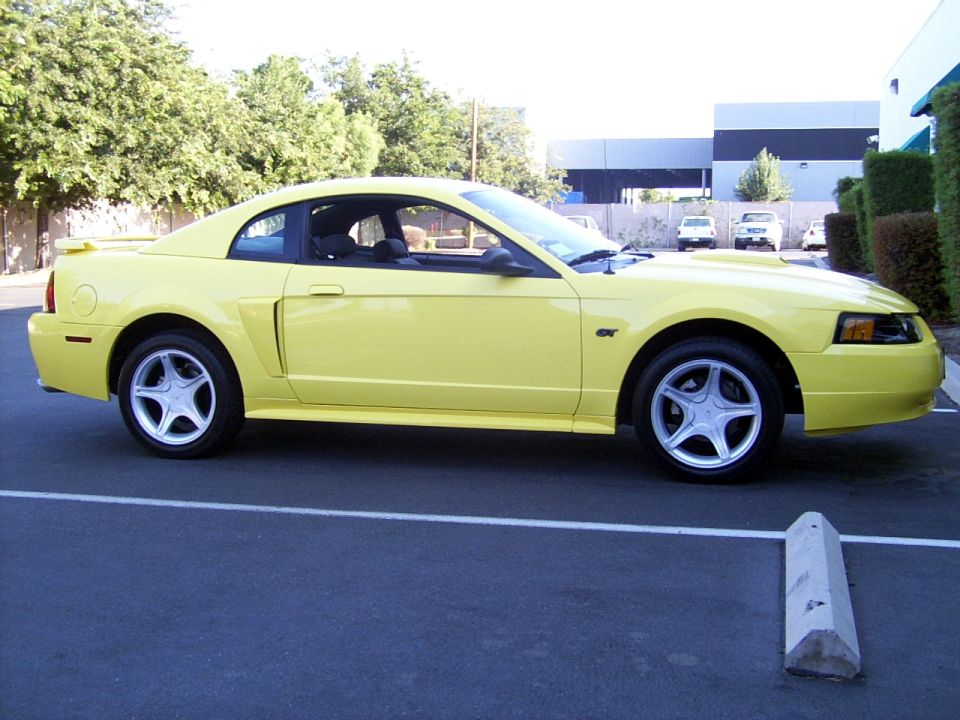
The 1999 Ford Mustang carried the New Edge restyle, applying sharper character lines and larger wheel openings to the SN95 platform that had launched in 1994. The base engine remained the 3.8L (232 cu in) Essex V6, and the GT used the single-overhead-cam modular 4.6L (281 cu in) V8, revised to 260 hp net for 1999. The 1999 SVT Cobra gained an independent rear suspension, the first Mustang ever fitted with IRS from the factory, with its DOHC 4.6L rated at 320 hp net. The New Edge years produced a run of memorable special models: the 2000 Cobra R with a 5.4L DOHC V8, the 2001 Bullitt GT, and for 2003-2004 the supercharged Terminator SVT Cobra alongside the revived Mach 1. The 2004 model year closed the generation and coincided with Mustang's 40th anniversary. The 2004 Mustang was the last SN95/New Edge year, but it was not the last solid-axle Mustang generation; the 2005-2014 S197 that followed kept a live rear axle.
At a glance
- Years: 1999-2004 (fourth generation, New Edge styling)
- Platform: Ford SN95 with the New Edge restyle; rear-wheel drive
- Body styles: coupe (notchback) and convertible
- Engines: 3.8L (232 cu in) Essex V6; 4.6L modular SOHC V8 (GT); 4.6L modular DOHC V8 (SVT Cobra, Mach 1); 5.4L DOHC V8 (2000 Cobra R)
- Performance models: GT, SVT Cobra, 2000 Cobra R, 2001 Bullitt, 2003-2004 Mach 1, and the supercharged 2003-2004 Terminator Cobra
- Rear axle: Ford 8.8-inch live rear axle on V6 and GT; independent rear suspension on the SVT Cobra from 1999
- Horsepower basis: SAE net
Year-by-year changes
| Year | Engines | Drivetrain & brakes | Notable changes |
|---|---|---|---|
| 1999 | 3.8L V6; GT 4.6L SOHC (260 hp net); SVT Cobra 4.6L DOHC (320 hp net) | 8.8-inch live axle on V6/GT; independent rear suspension on the Cobra; four-wheel discs on V8 | New Edge restyle; SVT Cobra becomes the first IRS Mustang; early Cobras reflashed for a documented power shortfall |
| 2000 | 3.8L V6; GT 4.6L SOHC (260 hp net); Cobra R 5.4L (330) DOHC (385 hp net) | Cobra R: Tremec T-56 six-speed, IRS, fixed rear wing, big brakes | Limited-run Cobra R; no standard SVT Cobra sold for 2000 |
| 2001 | 3.8L V6; Bullitt GT 4.6L SOHC (265 hp net); SVT Cobra 4.6L DOHC (320 hp net) | 8.8-inch live axle on V6/GT; IRS on the Cobra; Bullitt with PBR front calipers | Bullitt GT styling and chassis package; SVT Cobra returns at 320 hp net |
| 2002 | 3.8L V6; GT 4.6L SOHC (260 hp net) | 8.8-inch live rear axle; five-speed manual or automatic | V6 and GT only; no SVT Cobra produced for the 2002 model year |
| 2003 | 3.8L V6; GT 4.6L SOHC (260 hp net); Mach 1 4.6L DOHC (305 hp net); Terminator Cobra 4.6L DOHC supercharged (390 hp net) | IRS and Tremec T-56 six-speed on the Cobra; shaker hood on the Mach 1 | Supercharged Terminator SVT Cobra arrives; Mach 1 revived with the naturally aspirated DOHC 4.6L |
| 2004 | 3.8L V6; GT 4.6L SOHC (260 hp net); Mach 1 4.6L DOHC (305 hp net); Terminator Cobra supercharged (390 hp net) | IRS and Tremec T-56 six-speed on the Cobra; 8.8-inch live axle on V6/GT | Final SN95/New Edge year, coinciding with Mustang's 40th anniversary; 40th Anniversary appearance package |
New Edge styling and the first IRS Mustang, 1999
The 1999 Mustang received the New Edge restyle, with creased sheetmetal, sharper character lines, and larger wheel openings over the carryover SN95 platform that had launched in 1994. The 1999 GT's modular 4.6L SOHC V8 was revised to 260 hp net. The 1999 SVT Cobra gained an independent rear suspension (IRS), the first Mustang ever fitted with IRS from the factory, and its DOHC four-valve 4.6L was rated at 320 hp net. Early 1999 Cobras were found to make less power than advertised; Ford acknowledged the shortfall and ran a service campaign to reflash the cars and restore the rated output. The volume V6 and GT cars kept the Ford 8.8-inch live rear axle.
The 2000 Cobra R and the 2001 Bullitt
The 2000 model year brought the limited-run Cobra R, using a 5.4L (330 cu in) DOHC V8 rated at 385 hp net, a Tremec T-56 six-speed manual, the IRS, and a fixed rear wing; no standard SVT Cobra was sold for 2000. The 2001 Bullitt GT followed as a styling and chassis package referencing the 1968 Mustang from the Steve McQueen film, with a 4.6L SOHC V8 tuned to 265 hp net, lowered suspension, unique five-spoke wheels, and PBR front brake calipers, not Brembo. The same year, the SVT Cobra returned with the DOHC 4.6L at 320 hp net and the IRS after its one-year absence during the Cobra R run.
The Terminator Cobra and the revived Mach 1, 2003-2004
The 2003 and 2004 SVT Cobra, nicknamed the "Terminator," used an Eaton-supercharged and intercooled 4.6L DOHC V8 rated at 390 hp net and 390 lb-ft of torque, with the IRS and a Tremec T-56 six-speed manual; it was the most powerful factory Mustang to date and is widely regarded as the high point of the generation. Alongside it, the 2003 model year revived the Mach 1 with the naturally aspirated 4.6L DOHC V8 rated at 305 hp net and a functional "shaker" hood scoop. The 2004 model year ended the fourth generation and the SN95/New Edge line, coinciding with Mustang's 40th anniversary and a 40th Anniversary package. The 2004 Mustang was the last New Edge year, but not the last solid-axle Mustang generation; the 2005-2014 S197 that followed kept a live rear axle.
Known weak points
On the 1999-2004 New Edge Mustang, the T-45 five-speed manual behind the 4.6L SOHC GT is prone to worn synchros and input-shaft bearing noise with hard use. The 4.6L two-valve SOHC engines can suffer spark plugs seizing and intake-manifold coolant crossover cracking on earlier composite manifolds. The 1999 SVT Cobra power-shortfall reflash is a documented service history. The solid 8.8-inch rear axle on GT cars wheel-hops under hard launches, a trait the Cobra's IRS was specifically designed to address.
Frequently asked questions
What changed in the 1999 New Edge restyle?
The 1999 Mustang received the New Edge restyle, with creased sheetmetal, sharper character lines, and larger wheel openings over the same SN95 platform. The 1999 GT's 4.6L SOHC was revised to 260 hp net, and the 1999 SVT Cobra gained independent rear suspension with the 4.6L DOHC rated at 320 hp net.
Which Mustang was the first with independent rear suspension?
The 1999 SVT Cobra was the first factory Mustang with an independent rear suspension. It paired the IRS with a 4.6L DOHC V8 rated at 320 hp net. The volume V6 and GT cars kept the 8.8-inch live rear axle throughout the New Edge years.
What is the "Terminator" Cobra?
The "Terminator" is the enthusiast nickname for the 2003 and 2004 SVT Cobra. It used an Eaton-supercharged, intercooled 4.6L DOHC V8 rated at 390 hp net and 390 lb-ft of torque, with independent rear suspension and a Tremec T-56 six-speed manual, making it the most powerful factory Mustang of its era.
What was special about the 2004 Mustang?
The 2004 Mustang was the final year of the fourth generation and the SN95/New Edge line, and it coincided with Mustang's 40th anniversary, marked by a 40th Anniversary appearance package. The 2004 Mustang was the last New Edge year, but not the last solid-axle Mustang generation; the 2005-2014 S197 that followed kept a live rear axle.
Did the 2001 Bullitt have Brembo brakes?
No. The 2001 Bullitt GT used PBR front brake calipers, not Brembo. It paired them with a 4.6L SOHC V8 tuned to 265 hp net, lowered suspension, and unique five-spoke wheels in a styling package referencing the 1968 Mustang from the Steve McQueen film.
Sources
- Ford Motor Company model-year brochures and press materials for 1999-2004
- Ford SVT (Special Vehicle Team) specifications for the 1999-2004 Cobra and the 2000 Cobra R
- Factory service literature for the 4.6L and 5.4L modular engine families
- Enthusiast reference compilations of New Edge production data and option codes
- Period road-test reports
Asked all the time
What changed in the 1999 New Edge restyle?
The 1999 Mustang received the New Edge restyle, with creased sheetmetal, sharper character lines, and larger wheel openings over the same SN95 platform. The 1999 GT's 4.6L SOHC was revised to 260 hp net, and the 1999 SVT Cobra gained independent rear suspension with the 4.6L DOHC rated at 320 hp net.
Which Mustang was the first with independent rear suspension?
The 1999 SVT Cobra was the first factory Mustang with an independent rear suspension. It paired the IRS with a 4.6L DOHC V8 rated at 320 hp net. The volume V6 and GT cars kept the 8.8-inch live rear axle throughout the New Edge years.
What is the "Terminator" Cobra?
The "Terminator" is the enthusiast nickname for the 2003 and 2004 SVT Cobra. It used an Eaton-supercharged, intercooled 4.6L DOHC V8 rated at 390 hp net and 390 lb-ft of torque, with independent rear suspension and a Tremec T-56 six-speed manual, making it the most powerful factory Mustang of its era.
What was special about the 2004 Mustang?
The 2004 Mustang was the final year of the fourth generation and the SN95/New Edge line, and it coincided with Mustang's 40th anniversary, marked by a 40th Anniversary appearance package. The 2004 Mustang was the last New Edge year, but not the last solid-axle Mustang generation; the 2005-2014 S197 that followed kept a live rear axle.
Did the 2001 Bullitt have Brembo brakes?
No. The 2001 Bullitt GT used PBR front brake calipers, not Brembo. It paired them with a 4.6L SOHC V8 tuned to 265 hp net, lowered suspension, and unique five-spoke wheels in a styling package referencing the 1968 Mustang from the Steve McQueen film.
The wall · registered 1999–2004 Mustangs
Sorted by depth of documentation. Click any vehicle to open its permanent record.