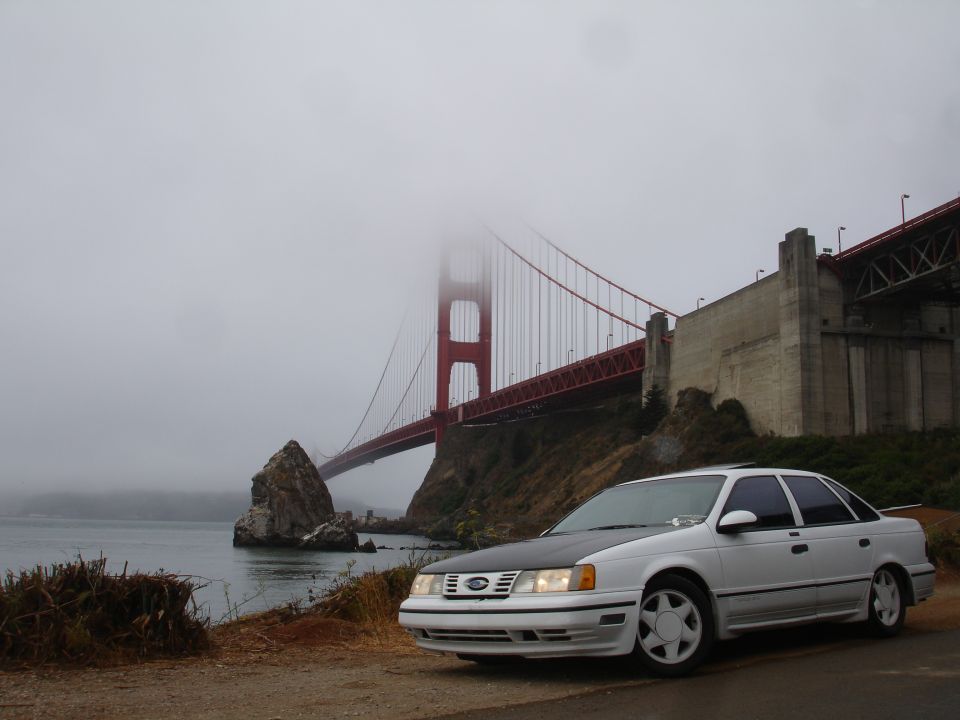
The 1986 model year introduced the first-generation Ford Taurus, a front-wheel-drive sedan and wagon that replaced the rear-wheel-drive Ford LTD. Its rounded, aerodynamic body, often called the jelly-bean shape, posted a 0.32 drag coefficient and marked a sharp break from the boxy American sedans of the early 1980s. The base engine in 1986 was a 2.5 HSC inline-four, with the pushrod Vulcan 3.0 V6 standard on GL and LX trims and optional on the L. For 1988 Ford added the Essex 3.8 V6 as the upper engine, rated at the same 140 horsepower as the 3.0 but producing more torque. Transmissions included a five-speed manual on the MT-5, the three-speed ATX automatic with the HSC four, and the four-speed AXOD automatic with the Vulcan and Essex V6 engines. For 1989 Ford introduced the Taurus SHO, fitted with a Yamaha-designed and Yamaha-built 3.0 dual-overhead-cam 24-valve V6 rated at 220 horsepower, paired only with a five-speed manual; after the early MT-5 manual model was discontinued, the SHO was the only manual-transmission Taurus from 1989 through 1991. First-generation production through 1991 totaled 1,959,671 units, comprising 1,487,514 sedans and 472,157 wagons. The Mercury Sable was the first-generation Taurus's badge-engineered sibling.
Other Ford Taurus generations
The 1986-1991 Ford Taurus at a glance
- Generation: first-generation Ford Taurus, the front-wheel-drive replacement for the rear-wheel-drive Ford LTD
- Years: 1986 through 1991, replaced by the second-generation Taurus for 1992
- Body styles: four-door sedan and four-door wagon
- Engines: 2.5 HSC inline-four; Vulcan 3.0 OHV V6; Essex 3.8 V6 (from 1988); SHO Yamaha 3.0 DOHC V6 (from 1989)
- Transmissions: five-speed manual (MT-5 and SHO); three-speed ATX automatic (HSC four); four-speed AXOD automatic (Vulcan and Essex V6)
- Aerodynamics: 0.32 drag coefficient
- Performance variant: Taurus SHO, introduced for 1989 with a Yamaha-built 3.0 V6 rated at 220 horsepower, manual only
- Sibling: the badge-engineered Mercury Sable
Ford Taurus 1986-1991 year by year
| Year | Ford Taurus changes | Engines offered |
|---|---|---|
| 1986 | First-generation Ford Taurus launches as a front-wheel-drive sedan and wagon replacing the rear-wheel-drive LTD; jelly-bean aerodynamic body at a 0.32 drag coefficient | 2.5 HSC I4; Vulcan 3.0 V6 |
| 1987 | The 1987 Ford Taurus continues with the same engine and trim lineup | 2.5 HSC I4; Vulcan 3.0 V6 |
| 1988 | The Essex 3.8 V6 is added as the upper engine on the 1988 Ford Taurus, rated at 140 horsepower with higher torque than the 3.0 | 2.5 HSC I4; Vulcan 3.0 V6; Essex 3.8 V6 |
| 1989 | The Taurus SHO debuts with a Yamaha-built 3.0 DOHC 24-valve V6 rated at 220 horsepower, paired only with a five-speed manual | 2.5 HSC I4; Vulcan 3.0 V6; Essex 3.8 V6; SHO Yamaha 3.0 V6 |
| 1990 | The 1990 Ford Taurus carries the sedan, wagon, and SHO lineup forward | 2.5 HSC I4; Vulcan 3.0 V6; Essex 3.8 V6; SHO Yamaha 3.0 V6 |
| 1991 | Final model year of the first-generation Ford Taurus before the 1992 restyle | 2.5 HSC I4; Vulcan 3.0 V6; Essex 3.8 V6; SHO Yamaha 3.0 V6 |
How the 1986 Taurus broke from the LTD
The 1986 Ford Taurus replaced the rear-wheel-drive Ford LTD with a front-wheel-drive platform and a rounded, aerodynamic body that contrasted with the boxy domestic sedans of the era. The design, widely called the jelly-bean shape, helped the first-generation Taurus reach a 0.32 drag coefficient. The Taurus was offered as a four-door sedan and a four-door wagon, with the Mercury Sable sold as its badge-engineered counterpart. Through 1991 the first-generation Taurus and Sable established the nameplate as a high-volume seller, with first-generation Taurus production totaling 1,959,671 units split into 1,487,514 sedans and 472,157 wagons.
Engines and transmissions of the 1986-1991 Ford Taurus
The 1986 Ford Taurus offered a 2.5 HSC inline-four and the pushrod Vulcan 3.0 V6, the latter rated at 140 horsepower and standard on the GL and LX trims. For 1988 Ford added the Essex 3.8 V6 as the upper engine; it carried the same 140-horsepower rating as the 3.0 but produced more torque, about 215 lb-ft. Transmission choices tracked the engine: the MT-5 used a five-speed manual, the HSC four-cylinder used the three-speed ATX automatic, and both the Vulcan 3.0 and Essex 3.8 V6 engines used the four-speed AXOD automatic. The first-generation Taurus was front-wheel drive across the line.
Trim levels and body styles
The 1986-1991 Ford Taurus was offered in trims that included the base L, the volume GL, and the higher LX, along with the MT-5 manual model early in the run and the performance SHO from 1989. Both the sedan and the wagon were available, and the Mercury Sable provided a parallel lineup under a separate badge. The first-generation Taurus's interior introduced rounded, integrated dashboard and control themes that matched the exterior styling direction.
The first Taurus SHO (1989-1991)
The Taurus SHO arrived for the 1989 model year as the performance Taurus. Its engine was a Yamaha-designed and Yamaha-built 3.0 dual-overhead-cam 24-valve V6 with an iron block and aluminum heads, rated at 220 horsepower at 6200 rpm and 200 lb-ft of torque at 4800 rpm, and able to rev to about 7000 rpm. The only transmission was a Mazda-built MTX-IV five-speed manual; following the discontinuation of the early MT-5 manual model, the SHO was the only manual-transmission Taurus available from 1989 through 1991. The 1989-1991 SHO was a sedan-only model and is regarded as a sleeper because it looked similar to ordinary Taurus sedans. This Yamaha V6 SHO continued into the second generation, where a 3.2 version was later added for automatic cars.
Frequently asked questions
What did the 1986 Ford Taurus replace?
The 1986 Ford Taurus replaced the rear-wheel-drive Ford LTD with a front-wheel-drive sedan and wagon. Its rounded, aerodynamic body reached a 0.32 drag coefficient and marked a clear break from the boxy American sedans of the early 1980s.
What engines did the 1986-1991 Ford Taurus use?
The first-generation Ford Taurus used a 2.5 HSC inline-four and the pushrod Vulcan 3.0 V6, with the Essex 3.8 V6 added for 1988 as the upper engine. The performance SHO, from 1989, used a separate Yamaha-built 3.0 dual-overhead-cam V6.
When did the Taurus SHO arrive?
The Ford Taurus SHO arrived for the 1989 model year with a Yamaha-built 3.0 dual-overhead-cam 24-valve V6 rated at 220 horsepower, paired only with a five-speed manual. After the early MT-5 manual model was discontinued, the SHO was the only manual-transmission Taurus from 1989 through 1991.
Was the first-generation Taurus front-wheel drive?
Yes. The 1986-1991 Ford Taurus was front-wheel drive across its lineup, including the SHO. All-wheel drive did not appear on the Taurus until the later D3-platform generations.
How many first-generation Ford Taurus units were built?
First-generation Ford Taurus production through 1991 totaled 1,959,671 units, made up of 1,487,514 sedans and 472,157 wagons.
Sources
- Wikipedia, Ford Taurus (first generation)
- Wikipedia, Ford SHO V6 engine
- Wikipedia, Ford Vulcan engine
- Ford-Taurus.org Taurus/Sable Encyclopedia, first-generation history
- Manufacturer specification figures and contemporary reporting
Asked all the time
What did the 1986 Ford Taurus replace?
The 1986 Ford Taurus replaced the rear-wheel-drive Ford LTD with a front-wheel-drive sedan and wagon. Its rounded, aerodynamic body reached a 0.32 drag coefficient and marked a clear break from the boxy American sedans of the early 1980s.
What engines did the 1986-1991 Ford Taurus use?
The first-generation Ford Taurus used a 2.5 HSC inline-four and the pushrod Vulcan 3.0 V6, with the Essex 3.8 V6 added for 1988 as the upper engine. The performance SHO, from 1989, used a separate Yamaha-built 3.0 dual-overhead-cam V6.
When did the Taurus SHO arrive?
The Ford Taurus SHO arrived for the 1989 model year with a Yamaha-built 3.0 dual-overhead-cam 24-valve V6 rated at 220 horsepower, paired only with a five-speed manual. After the early MT-5 manual model was discontinued, the SHO was the only manual-transmission Taurus from 1989 through 1991.
Was the first-generation Taurus front-wheel drive?
Yes. The 1986-1991 Ford Taurus was front-wheel drive across its lineup, including the SHO. All-wheel drive did not appear on the Taurus until the later D3-platform generations.
How many first-generation Ford Taurus units were built?
First-generation Ford Taurus production through 1991 totaled 1,959,671 units, made up of 1,487,514 sedans and 472,157 wagons.
Technical Reference
Member-uploaded diagrams & documents for this generation. AI-classified; community-verified where badged.
Data/Spec Plates (3)
- 1990 Ford Taurus 3.0L Smog Check Inspection Report (2004) - Passed EmissionsThis document is a California Smog Check Vehicle Inspection Report dated July 15, 2004 (9:45:30 am) for a 1990 Ford Taurus passenger car with a 3.0-liter, 6-cylinder gasoline engine, manual transmission, license plate…
- 1990 Ford Taurus 3.0L Smog Check VIR (2004) - Gross Polluter Fail, NOx ResultsThis document is a California Smog Check Vehicle Inspection Report (VIR) dated 07/12/2004 for a 1990 Ford Taurus passenger car with a 3.0L gasoline engine, automatic transmission, 6 cylinders, and 76,090 miles on the…
- Door jamb certification label reading MFD. BY FORD MOTOR CO. IN U.S.A. with fields for build date, GVWR, front and rear GAWR, VIN and type.
Brochures & Literature (3)
- Where Hot Rodding Lives and Oddball Is the Norm, by David Freiburger: a carbureted 3.0L Ford Taurus SHO V6 in an F/Gas Modified Roadster at Bonneville.
- Magazine Quick-Test of the 1991 Ford Taurus Cop Car with engine and interior photos and a 1991 Ford Taurus Police Package spec box.
- Ford Performance Group chart of 1989 Taurus SHO production, 15504 total, broken down by option code across Titanium, Black, Red and White.
Wiring Diagrams (1)
- Ford Taurus Sub Amp Wiring Diagram - Subwoofer Amplifier Wire ColorsThis is a hand-drawn wiring diagram (uploaded as "subamp.jpg") showing how a subwoofer amplifier, labeled "Sub Amp (Silver)," connects in a car audio system. On the input side, three wires come "From regular Amp…
Exploded Parts (1)
- Ford Taurus/Sable Relay Panel & Wiper Module Exploded Parts DiagramThis document is an exploded parts diagram showing the relay panel assembly and associated components mounted behind/under the instrument panel of a Ford Taurus/Mercury Sable. Ten numbered callouts identify parts in…
Manual Pages (1)
The wall · registered 1986-1991 Tauruss
Sorted by depth of documentation. Click any vehicle to open its permanent record.