This document contains diagrams and text, likely from a vehicle repair manual.
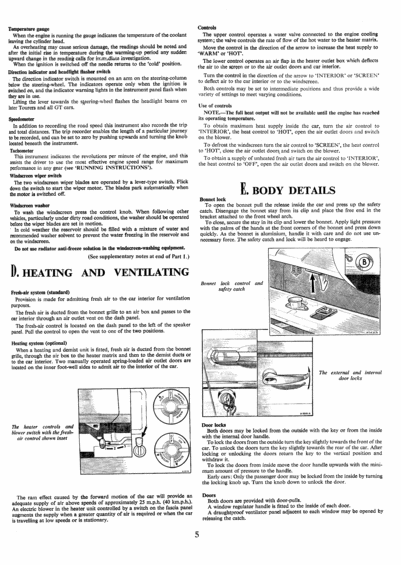
Temperature gauge When the engine is running the gauge indicates the temperature of the coolant leaving the cylinder head. As overheating may cause serious damage, the readings should be noted and after the initial rise in temperature during the warming-up period any sudden upward change in the reading calls for immediate investigation. When the ignition is switched off the needle returns to the cold position. Direction indicator and headlight asher switch The direction indicator switch is mounted on an arm on the steeringcolumn below the steering-wheel. The indicators operate only when the ignition is switched on, and the indicator warning lights in the instrumertt panel ash when they are in use. Lifting the lever towards the steering-wheel ashes the headlight beams on later Tourers and all GT cars. Speedometer In addition to recording the road speed this instrument also records the trip and total distances. The trip recorder enables the length of a particular journey to be recorded, and can be set to zero by pushing upwards and turning the knob located beneath the instrument. Tachometer This instrument indicates the revolutions per minute of the engine, and this assists the driver to use the most effective engine speed range for maximum performance in any gear (see RUNNING INSTRUCTIONS). Windscreen wiper switch The two windscreen wiper blades are operated by a lever-type switch. Flick down the switch to start the wiper motor. The blades park automatically when the motor is switched off. Windscreen washer To wash the windscreen press the control knob. When following other vehicles, particularly under dirty road conditions, the washer should be operated before the wiper blades are set in motion. In cold weather the reservoir should be lled with a mixture of water and recommended washer solvent to prevent the water freezing in the reservoir and on the windscreen. Do not use radiator anti-freeze solution in the windscreen-washing equipment. (See supplementary notes at end of Part 1.) D. HEATING AND VENTILATING Fresh-air system (standard) Provision is made for admitting fresh air to the car interior for ventilation purposes. The fresh air is ducted from the bonnet grille to an air box and passes to the car interior through an air outlet vent on the dash panel. The fresh-air control is located on the dash panel to the left of the speaker panel. Pull the control to open the vent to one of the two positions. Heating system (optional) When a heating and demist unit is tted, fresh air is ducted from the bonnet grille, through the air box to the heater matrix and then to the demist ducts or to the ear interior. Two manually operated spring-loaded air outlet doors are located on the inner foot-well sides to admit air to the interior of the car. The heater controls and blower switch with the fresh~ air control shown inset The ram effect caused by the forward motion of the car will provide an adequate supply of air above speeds of approximately 25 mph (40 km.p.h.). An electric blower in the heater unit controlled by a switch on the fascia panel augments the supply when a greater quantity of air is required or when the car is travelling at low speeds or is stationary. Controls The upper control operates a water valve connected to the engine cooling system; the valve controls the rate of ow of the hot water to the heater matrix. Move the control in the direction of the arrow to increase the heat supply to WARM or HOT. The lower control operates an air ap in the heater outlet box which deects the air to the screen or to the air outlet doors and car interior. Turn the control in the direction of the arrow to INTERIOR or SCREEN' to deect air to the car interior or to the windscreen. Both controls may be set to intermediate positions and thus provide a wide variety of settings to meet varying conditions. Use of controls NOTEThe full heat output will not be available until the engine has reached its operating temperature. To obtain maximum heat supply inside the car, turn the air control to INTERIOR, the heat control to HOT, open the air outlet doors and switch on the blower. To defrost the windscreen turn the air control to SCREEN, the heat control to HOT, close the air outlet doors and switch on the blower. To obtain a supply of unheated fresh air turn the air control to INTERIOR, the heat control to OFF, open the air outlet doors and switch on the blower. E. BODY DETAILS Bonnet lock To open the bonnet pull the release inside the car and press up the safety catch. Disengage the bonnet stay from its clip and place the free end in the bracket attached to the front wheel arch. To close, secure the stay in its clip and lower the bonnet. Apply light pressure with the palms of the hands at the front corners of the bonnet and press down quickly. As the bonnet is aluminium, handle it with care and do not use un necessary force. The safety catch and lock will be heard to engage. Bonnet lock control and safety catch The external and internal door locks A9qIA Door locks Both doors may be locked from the outside with the key or from the inside with the internal door handle. To lock the doors from the outside turn the key slightly towards the front of the car. To unlock the doors turn the key slightly towards the rear of the car. After locking or unlocking the doors return the key to the vertical position and withdraw it. To look the doors from inside move the door handle upwards with the mini- mum amount of pressure to the handle. Early cars: Only the passenger door may be locked from the inside by turning the locking knob up. Turn the knob down to unlock the door. Doors Both doors are provided with door-pulls. A window regulator handle is tted to the inside of each door. A draughtproof ventilator panel adjacent to each window may be Opened by releasing the catch.
Comments
More from this build
No comments yet.