This document contains text and diagrams related to a vehicle, possibly from a repair manual.
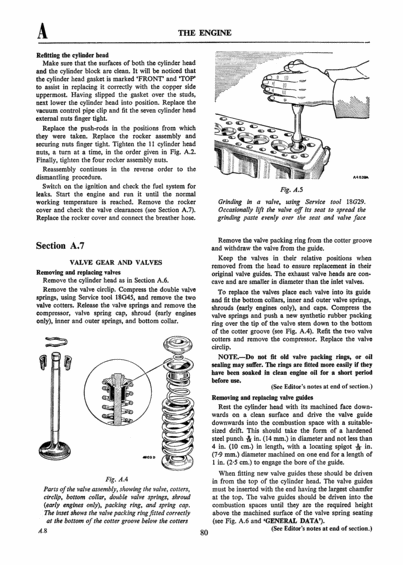
A THE ENGINE Retting the cylinder head Make sure that the surfaces of both the cylinder head and the cylinder block are clean. It will be noticed that the cylinder head gasket is marked FRONT and TOP to assist in replacing it correctly with the copper side uppermost. Having slipped the gasket over the studs, next lower the cylinder head into position. Replace the vacuum control pipe clip and t the seven cylinder head external nuts nger tight. Replace the push-rods in the positions from which they were taken. Replace the rocker assembly and securing nuts nger tight. Tighten the 11 cylinder head nuts, a turn at a time, in the order given in Fig. A.2. Finally, tighten the four rocker assembly nuts. Reassembly continues in the reverse order to the dismantling procedure. Switch on the ignition and check the fuel system for leaks. Start the engine and run it until the normal working temperature is reached. Remove the rocker cover and check the valve clearances (see Section A.7). Replace the rocker cover and connect the breather hose. Section A.7 VALVE GEAR AND VALVES Removing and replacing valves Remove the cylinder head as in Section A.6. Remove the valve circlip. Compress the double valve springs, using Service tool 18045, and remove the two valve cotters. Release the valve springs and remove the compressor, valve spring cap, shroud (early engines only), inner and outer springs, and bottom collar. Fig. A.4 Parts of the valve assembly, showing the valve, cotters, circlip. bottom collar, double valve springs, shroud (early engines only), packing ring, and spring cap. The inset shows the valve packing ring tted correctly at the bottom of the cotter groove below the cotters A.8 8O _ 'lllml! llllllll" umun Fig. A.5 Grinding in a valve, using Service tool 18G29. Occasionally lift the valve ojjr its seat to spread the grinding paste evenly over the seat and valve face Remove the valve packing ring from the cotter groove and withdraw the valve from the guide. Keep the valves in their relative positions when removed from the head to ensure replacement in their original valve guides. The exhaust valve heads are con- cave and are smaller in diameter than the inlet valves. To replace the valves place each valve into its guide and t the bottom collars, inner and outer valve springs, shrouds (early engines only), and caps. Compress the valve springs and push a new synthetic rubber packing ring over the tip of the valve stem down to the bottom of the cotter groove (see Fig. A.4). Ret the two valve cotters and remove the compressor. Replace the valve circlip. NOTE.Do not t old valve packing rings, or oil sealing may suffer. The rings are tted more easily if they have been soaked in clean engine oil for a short period before use. (See Editors notes at end of section.) Removing and replacing valve guides Rest the cylinder head with its machined face down- wards on a, clean surface and drive the valve guide downwards into the combustion space with a suitable- sized drift. This should take the form of a hardened steel punch 19.; in. (14 mm.) in diameter and not less than 4 in. (10 cm.) in length, with a locating spigot 15; in. (7-9 mm.) diameter machined on one end for a length of l in. (2-5 cm.) to engage the bore of the guide. When tting new valve guides these should be driven in from the top of the cylinder head. The valve guides must be inserted with the end having the largest chamfer at the top. The valve guides should be driven into the combustion spaces until they are the required height above the machined surface of the valve spring seating (see Fig. A.6 and GENERAL DATA). (See Editors notes at end of section.)
Comments
More from this build


No comments yet.