This is a scanned document page with text and columns.
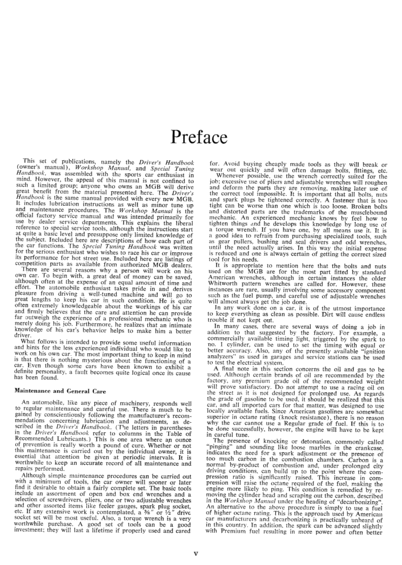
Preface This set of publications, namely the Drivers Handbook (owners manual), Workshop Manual, and Special Tuning Handbook, was assembled with the sports car enthusiast in mind. However, the appeal of this manual is not conned to such a limited group; anyone who owns an MGB will derive great benet from the material presented here. The Drivers Handbook is the same manual provided with every new MGB. It includes lubrication instructions as Well as minor tune up and maintenance procedures. The Workshop Manual is the ofcial factory service manual and was intended primarily for use by dealer service departments. This explains the liberal reference to special service tools, although the instructions start at quite a basic level and presuppose only limited knowledge of the subject. Included here are descriptions of how each part of the car functions. The Special Tuning Handbook was written for the serious enthusiast who wishes to race his car or improve its performance for hot street use. Included here are listings of competition parts as available from authorized MGB dealers. There are several reasons why a person will work on his own' car. To begin with, a great deal of money can be saved, although often at the expense of an equal amount of time and eifrt. The automobile enthusiast takes pride in and derives pleasure from driving a welltuned machine and will go to great lengths to keep his car in such condition. He is quite often extremely knowledgeable about the workings of his car and rmly believes that the care and attention he can provide far outweigh the experience of a professional mechanic who is merely doing his job. Furthermore, he realizes that an intimate lnowledge of his cars behavior helps to make him a better r1ver. What follows is intended to provide some useful information and hints for the less experienced individual who would like to work on his own car. The most important thing to keep in mind is that there is nothing mysterious about the functioning of a car. Even though some cars have been known to exhibit a denite personality, a fault becomes quite logical once its cause has been found. Maintenance and General Care An automobile, like any piece of machinery, responds well to regular maintenance and careful use. There is much to be gained by conscientiously following the manufacturers recom- mendations concerning lubrication and adjustments, as de scribed in the Drivers Handbook. (The letters in parentheses in the Drivers Handbook refer to columns in the Table of Recommended Lubricants.) This is one area where an ounce of prevention is really worth a pound of cure. Whether or not this maintenance is carried out by the individual owner, it is essential that attention be given at periodic intervals. It is Worthwhile to keep an accurate record of all maintenance and repairs performed. Although simple maintenance procedures can be carried out with a minimum of tools, the car owner will sooner or later nd it desirable to obtain a fairly complete set. The basic tools include an assortment of open and box end wrenches and a selection of screwdrivers, pliers, one or two adjustable wrenches and other assorted items like feeler gauges, spark plug socket, etc. If any extensive work is contemplated, a % or 1/2 drive socket set will be most useful. Also, a torque Wrench is a very worthwhile purchase. A good set of tools can be a good investment; they will last a lifetime if properly used and cared for. Avoid buying cheaply made tools as they will break or wear out quickly and will often damage bolts, ttings, etc. Whenever possible, use the wrench correctly suited for the job; excessive use of pliers and adjustable wrenches will roughen and deform the parts they are removing, making later use of the correct tool impossible. It is important that all bolts, nuts and spark plugs be tightened correctly. A fastener that is too tight can be worse than one which is too loose. Broken bolts and distorted parts are the trademarks of the musclebound mechanic. An experienced mechanic knows by feel how to tighten things and he develops this knowledge by long use of a torque wrench. If you have one, by all means use it. It is a good idea to refrain from purchasing specialized tools, such as gear pullers, bushing and seal drivers and odd wrenches, until the need actually arises. In this way the initial expense is reduced and one is always certain of getting the correct sized tool for his needs. It is appropriate to mention here that the bolts and nuts used on the MGB are for the most part tted by standard American wrenches, although in certain instances the older Whitworth pattern wrenches are called for. However, these instances are rare, usually involving some accessory component such as the fuel pump, and careful use of adjustable wrenches will almost always get the job done. In any work done on a car. it is of the utmost importance to keep everything as clean as possible. Dirt Will cause endless trouble if not kept out. In many cases, there are several ways of doing a job in addition to that suggested by the factory. For example, a commercially available timing light, triggered by the spark to no. 1 cylinder, can be used to set the timing with equal or better accuracy. Also, any of the presently available ignition analyzers as used in garages and service stations can be used to test the electrical system. A nal note in this section concerns the oil and gas to be used. Although certain brands of oil are recommended by the factory, any premium grade oil of the recommended weight will prove satisfactory. Do not attempt to use a racing oil on the street as it is not designed for prolonged use. As regards the grade of gasoline to be used, it should be realized that this car, and all imported cars for that matter, Was designed to use locally available fuels. Since American gasolines are somewhat superior in octane rating (knock resistance), there is no reason why the car cannot use a Regular grade of fuel. If this is to be done successfully, however, the engine will have to be kept in careful tune. The presence of knocking or detonation, commonly called pinging and sounding like loose marbles in the crankcase. indicates the need for a spark adjustment or the presence of too much carbon in the combustion chambers. Carbon is a normal byproduct of combustion and, under prolonged city driving conditions, can build up to the point where the com- pression ratio is signicantly raised. This increase in com- pression will raise the octane required of the fuel, making the engine more likely to ping. This condition is remedied by re- moving the cylinder head and scraping out the carbon, described in the Workshop Manual under the heading of decarbonizing. An alternative to the above procedure is simply to use a fuel of higher octane rating. This is the approach used by American car manufacturers and decarbonizing is practically unheard of in this country. In addition, the spark can be advanced slightly with Premium fuel resulting in more power and often better
Comments
More from this build


No comments yet.