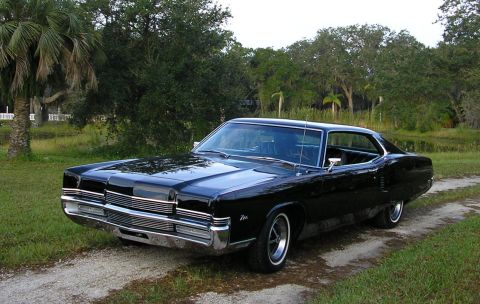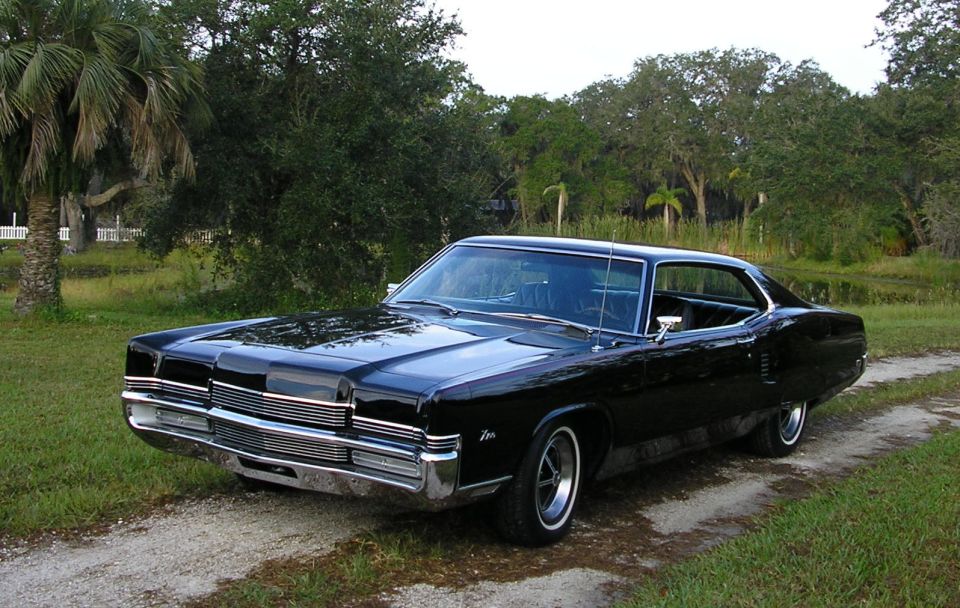
The 1969-1970 Mercury Marauder was a full-size two-door fastback hardtop built on the same body-on-frame architecture as the big Fords, riding a 121 inch wheelbase, three inches shorter than a Mercury Marquis sedan. Every Marauder got hidden headlamps and a flying-buttress roofline with a tunneled rear window. The base car ran Ford's 390 2V at 265 hp gross, with a 280 hp premium-fuel 390, a 320 hp 429 2V, and a 360 hp 429 4V on the option sheet. The X-100 made that 429 4V standard and added a matte-black rear deck, fender skirts, and styled aluminum wheels. Production lasted two model years: 14,666 cars for 1969 and 6,043 for 1970.
Other Mercury Marauder generations
Platform and body
The 1969-1970 Mercury Marauder is a full-size body-on-frame two-door hardtop, built on the 121 inch wheelbase it shared with the redesigned 1969 Ford XL and Galaxie, three inches shorter than the 124 inch span under the Mercury Marquis sedan. The Marquis donated its hidden-headlamp front end, while the flying-buttress roofline with the recessed, tunneled rear window came from the Ford side. Mercury offered no convertible; the hardtop coupe was the only body. The frame was a new perimeter design with four torque boxes, and curb weight ran 4,045 to 4,200 pounds depending on engine and equipment.
Engines
- 390 cubic inch 2V V8, standard on the base Marauder, rated at 265 hp gross on 9.5:1 compression. All ratings for these cars are pre-1972 gross figures.
- 390 cubic inch 2V V8, premium fuel, an extra-cost high-compression version rated at 280 hp gross, offered on base cars.
- 429 cubic inch 2V V8, optional on the base car, rated at 320 hp gross.
- 429 cubic inch 4V V8, standard on the X-100 and optional on the base car, rated at 360 hp gross and 480 lb-ft of torque on 10.5:1 compression.
The 390 is the older FE-family engine; both 429s are the newer 385-series big block, and the two families interchange nothing. The 429 4V is the engine to have. Period tests put a 429 4V X-100 at about 8.0 seconds to 60 mph and a quarter mile just under 16 seconds at 86 to 88 mph, with a top end around 125 mph. Motor Trend recorded 10.8 mpg, which is why the car carries a 24 gallon tank.
Drivetrain and transmissions
All 1969-1970 Marauders are rear-wheel drive with a 4-link live axle on coil springs. A 3-speed manual was the book-standard transmission on the base 390 car, though most were built with the SelectShift automatic (FMX behind the 390, C6 behind the 429). The 429 engines came only with the C6; there was no manual behind a 429, and every X-100 was an automatic. A loping 2.80:1 rear axle was the usual fit, with 3.25:1 gears and the Traction-Lok limited slip on the option sheet, along with a cheap competition handling package. Brakes were drums all around as delivered; power front discs were optional, and a front disc conversion is a common and sensible upgrade today.
Year by year
- 1969: First year. 14,666 built, 9,031 base cars and 5,635 X-100s. Base price was $3,368; the X-100 started at $4,091. The X-100 carried the matte-black "sports tone" rear deck (deletable for credit, and omitted when the vinyl roof was ordered), rear fender skirts with bright molding, styled aluminum wheels, a rim-blow steering wheel, an electric clock, and a choice of three seating arrangements: a leather-and-vinyl bench with dual center armrests, a split Twin Comfort Lounge bench, or all-vinyl buckets with a console and horseshoe shifter.
- 1970: Mechanically a carryover, with the 390 2V still standard and the 429 4V still standard on the X-100. The grille was revised to match the 1970 Marquis, block "Marauder" lettering and new front parking lamps appeared, and the instrument panel picked up dark teakwood appliques, a new steering wheel, and rocker-type light switches. On the X-100, luxury wheel covers replaced the styled aluminum wheels as standard, the sports-tone rear deck became an option rather than standard, and seating choices dropped to two: hi-back all-vinyl buckets with a center console standard, or the Twin Comfort Lounge bench at no extra cost. Production fell to 6,043 cars, 2,646 of them X-100s, and Mercury dropped the model after the 1970 run, leaving the Marauder name dormant until the 2003-2004 revival.
Trims and variants
- Marauder (base): 390 2V standard, cloth-and-vinyl bench interior, body-color rear deck with low-gloss two-tone taillamp surround, dual upper-body paint stripes. The 280 hp 390, both 429s, fender skirts, and styled wheels were all optional.
- Marauder X-100: 429 4V and SelectShift automatic standard, matte-black rear deck (standard in 1969, optional in 1970), rear fender skirts, styled aluminum wheels in 1969, upgraded interiors including leather-and-vinyl trim in 1969.
The X-100 is the collectible one, and it made up a growing share of production, about a third of 1969 cars and nearly half of 1970s. Because fender skirts and styled wheels could be ordered on a base car, and the black deck paint is easy to add, trim alone proves nothing. The VIN and data plate will settle what a car started as.
Asked all the time
What engines came in the 1969-1970 Mercury Marauder?
Four V8s, all rated in pre-1972 gross figures. The base 1969-1970 Mercury Marauder came standard with a 390 cubic inch 2V rated at 265 hp, with a premium-fuel high-compression 390 2V at 280 hp, a 429 2V at 320 hp, and a 429 4V at 360 hp and 480 lb-ft optional. The Marauder X-100 came standard with the 360 hp 429 4V.
What is the difference between the Marauder and the Marauder X-100?
On the 1969-1970 Mercury Marauder, the X-100 was the premium performance trim: standard 429 4V and SelectShift automatic instead of the base 390, a matte-black rear deck (standard in 1969, optional in 1970), rear fender skirts, styled aluminum wheels in 1969, a rim-blow steering wheel, an electric clock, and upgraded seating including a leather-and-vinyl bench, Twin Comfort Lounge, or buckets with console in 1969. Base cars had a cloth-and-vinyl bench and a body-color rear deck, though skirts and styled wheels could be ordered on them too.
How many 1969-1970 Mercury Marauders were built?
Mercury built 14,666 Marauders for 1969 (9,031 base and 5,635 X-100) and 6,043 for 1970 (3,397 base and 2,646 X-100), for a two-year total of 20,709 cars, 8,281 of them X-100s. The model was dropped after 1970.
Which year of Mercury Marauder should I look for?
Mechanically the 1969 and 1970 Mercury Marauders are the same car, so condition and drivetrain matter more than model year. A 429 4V X-100 of either year is the most sought after. 1969 X-100s carry the standard matte-black deck and styled aluminum wheels; 1970 cars are rarer, with a revised grille and luxury wheel covers standard.
What platform is the 1969-1970 Mercury Marauder built on?
The 1969-1970 Mercury Marauder uses Ford's full-size body-on-frame platform on a 121 inch wheelbase, the same as the Ford XL and Galaxie and three inches shorter than the Mercury Marquis sedan's 124 inches. It was offered only as a two-door hardtop with a flying-buttress tunneled rear roof, hidden headlamps from the Marquis front clip, and a perimeter frame with four torque boxes.
Is the 429 in the Marauder X-100 an FE engine?
No. The 429s in the 1969-1970 Mercury Marauder, both the 320 hp 2V and the 360 hp 4V in the X-100, are 385-series (Lima) big blocks. The 390s in the base Marauder are the older FE-family engine. The two families share essentially nothing, so parts sourcing and upgrade paths are completely different.
The wall · registered 1969-1970 Marauders
Sorted by depth of documentation. Click any vehicle to open its permanent record.