The registry
Ski-Doo Registry: Models, Builds & Photos
Ski-Doo is a snowmobile brand founded in 1959 by Joseph-Armand Bombardier in Valcourt, Quebec, Canada, as a product line of his company L'Auto-Neige Bombardier (later Bombardier Inc.). Bombardier, who had built multi-passenger tracked snow machines since 1937, created the lightweight one-person Ski-Doo when his seamless rubber-and-steel track design made a personal snowmobile practical; it effectively invented the recreational snowmobile market. Ski-Doo dominated the 1960s boom, survived the 1970s industry collapse that killed most of its roughly 100 competitors, and pioneered the REV rider-forward chassis in 2003 that reset modern snowmobile design. When Bombardier Inc. spun off its recreational-products division in 2003, Ski-Doo became the flagship brand of BRP Inc. (Bombardier Recreational Products), which still builds Ski-Doo snowmobiles in Valcourt today.
Pick your model
Key facts
| Founded | 1959, Valcourt, Quebec, Canada |
|---|---|
| Founders | Joseph-Armand Bombardier |
| Headquarters | Valcourt, Quebec, Canada |
| Parent / successor | BRP Inc. (Bombardier Recreational Products), spun off from Bombardier Inc. in 2003 |
| Fate / status | Active; flagship snowmobile brand of BRP Inc., still built in Valcourt |
| Best known for | MX Z, Summit, and the REV rider-forward chassis |
| Registry presence | 24 vehicles / 41 photos documented by owners on SuperMotors |
1922-1959: Joseph-Armand Bombardier, the Valcourt Garage, and the Road to a Personal Snowmobile
Ski-Doo existed because a Quebec mechanic spent thirty years trying to conquer snow before he ever built a machine for fun. Joseph-Armand Bombardier, born in Valcourt in 1907, demonstrated his first motorized sleigh as a teenager in 1922 and opened his own garage in Valcourt in 1926. The turning point was personal tragedy: in January 1934 his two-year-old son Yvon died of appendicitis because snowbound roads made the hospital unreachable. Bombardier redoubled his work on snow vehicles, and in 1937 he patented the sprocket-and-rubber-track drive system that made his seven-passenger B7 autoneige commercially viable. He incorporated L'Auto-Neige Bombardier Limitee in 1942 to build large enclosed snow coaches for doctors, mail carriers, and rural bus routes.
The postwar years nearly undid the company for a reason that would shape Ski-Doo's birth: Quebec began plowing rural roads, gutting demand for passenger snow coaches. Bombardier pivoted to industrial tracked vehicles, notably the Muskeg tractor of 1953, and kept the firm alive on utility sales. But he never abandoned the idea of a small machine one person could ride over open snow. Two enabling technologies made the difference: a lightweight, seamless, wide rubber track his engineers (including his son Germain Bombardier) perfected in the late 1950s, and compact lightweight engines, first American-built Kohler four-strokes and soon the Austrian-built Rotax two-strokes that became standard in the early 1960s, a supplier relationship so important that Bombardier's company would later buy Rotax's parent Lohner-Werke outright in 1970. By 1958 prototypes of a small, ski-steered, track-driven sled were running around Valcourt, and the company that had spent two decades building snow buses was about to invent an entirely new sport.
1959-1964: The First Ski-Doo, a Typo That Stuck, and the Founder's Death
The machine that created the snowmobile industry went on sale in 1959, and its name was reportedly a printing error. Joseph-Armand Bombardier intended to call his new one-person sled the "Ski-Dog," a working dog-team replacement for trappers, missionaries, and surveyors; a typographical slip in early sales material rendered it "Ski-Doo," the name tested well, and Bombardier let it stand. The first production Ski-Doo weighed roughly 135 kilograms, a fraction of anything tracked that came before it, and used a 7-horsepower Kohler four-stroke (Rotax two-strokes soon replaced it), wooden skis, and that crucial seamless rubber track. L'Auto-Neige Bombardier built 225 of them for the 1959-60 season and sold every one.
What surprised the founder was who bought them. The utility customers came as expected, but so did people who simply wanted to ride for pleasure, and word of mouth in snow-country towns did the marketing. Production climbed to roughly 8,200 units by 1963-64. Bombardier himself was famously cautious about the recreational boom, worried it would distract from the industrial vehicle business that had saved the company in the 1950s, and he deliberately throttled expansion.
Then the founder was gone. Joseph-Armand Bombardier died of cancer on February 18, 1964, at age 56, just as his last invention was becoming a phenomenon. Control passed to the family, with son Germain Bombardier briefly at the head; within two years leadership settled on the founder's son-in-law, a young chartered accountant named Laurent Beaudoin. Beaudoin had none of the founder's hesitancy about recreation. He bet the company on the Ski-Doo, and the bet defined the next decade.
1964-1972: Laurent Beaudoin's Boom Years and the Yellow Machine That Owned Winter
Under Laurent Beaudoin, who joined as comptroller in 1963, became general manager in 1964, and was named president in 1966 at just 28, Ski-Doo grew from a sideline into one of the great consumer-product booms of the 1960s. Beaudoin professionalized the family firm, renamed it Bombardier Limitee in 1967, and took it public on the Montreal and Toronto exchanges in January 1969. Ski-Doo sales rose from about 8,200 units in 1964 to roughly 200,000 sleds a year by the 1970-71 season; trade-press data credited Bombardier's two brands, Ski-Doo and Moto-Ski, with more than 260,000 of the roughly half-million snowmobiles the industry built for 1971. The bright yellow Ski-Doo became so dominant that "ski-doo" turned generic, used as a verb for snowmobiling itself, a genericization risk common to breakthrough brand names.
Beaudoin's strategy was vertical integration and racing. In 1970 Bombardier bought Lohner-Werke of Vienna to secure Rotax, its engine supplier, and it acquired plants for tracks, clothing, and components across Quebec. On the ice ovals and cross-country courses that sold sleds, the Ski-Doo Blizzard race program (whose lineage the registry's later Blizzard 5500 MX and Blizzard 9700 consumer machines carried into the 1980s) battled Polaris and Arctic Cat, with drivers like Yvon Duhamel making the brand a French-Canadian sporting institution. Racing mattered commercially because roughly 100 manufacturers, from Sears to Johnson, had piled into the market, and podiums were product differentiation.
The era's mass-market masterstroke came in 1971: the Elan, a small, cheap, nearly indestructible entry sled (represented in the registry by the Elan 250M) that stayed in production for a quarter century and put first-time riders, trappers, and northern communities on Ski-Doos by the hundreds of thousands. At the peak, Bombardier was Quebec's industrial pride and Beaudoin its wunderkind. The peak did not last.
1972-1982: The Industry Collapse, the Moto-Ski Takeover, and the Train That Saved the Snowmobile
The snowmobile industry that Ski-Doo created nearly killed its creator between 1972 and 1982. The 1973 OPEC oil embargo, a string of poor snow winters, rising insurance costs, and brutal overcapacity collapsed North American snowmobile sales from about 495,000 units in 1970-71 to under 200,000 by the late 1970s and barely 80,000 by the early 1980s. Of the roughly 100 manufacturers of 1971, only a handful survived the decade. Bombardier's own sled volumes fell by more than half, and the newly public company slid into losses in the mid-1970s.
Laurent Beaudoin's response set the template for Bombardier's next forty years: consolidate the shrinking industry and diversify away from it. In 1971 Bombardier had already bought Moto-Ski, its financially failing Quebec rival in La Pocatiere, keeping the badge alive as a second brand until retiring it in 1985. The decisive move came in 1974, when Bombardier won the contract to build 423 rubber-tired cars for the Montreal Metro. Rail vehicles, and later aerospace, became the company's center of gravity; the La Pocatiere snowmobile plant itself was converted to build subway cars. Ski-Doo survived the shakeout precisely because it was no longer the whole company, a luxury pure-play competitors did not have.
The sleds themselves turned defensive and pragmatic. The Elan kept selling to buyers who wanted cheap transport, and utility-oriented machines like the long-lineage Tundra, introduced for deep-snow workhorse duty, and the family-oriented Safari touring line kept dealers alive through thin winters. Factory oval racing was cut back sharply in the mid-1970s as a cost measure, though the Blizzard name survived on fast consumer sleds. By 1982 the snowmobile division was a modest, profitable corner of a transportation conglomerate, and it was about to get a machine that redefined it.
1982-1994: Pierre Beaudoin's Proving Ground and the Formula Chassis Revival
Ski-Doo's comeback machine arrived in 1985, and it was called Formula. As the surviving snowmobile market stabilized around four players (Ski-Doo, Polaris, Arctic Cat, and Yamaha), Bombardier's Valcourt engineers answered Polaris's independent-front-suspension Indy with the Formula platform: a modern chassis with progressive-rate suspension and liquid-cooled Rotax twins that made Ski-Doo competitive with performance buyers again after a decade of playing defense. The Formula Plus carried the volume performance segment, the sport-touring Formula STX broadened the line, and in 1989 the Formula Mach 1 gave the brand a lake-racer flagship whose speed restored the muscle credibility the old Blizzards had built. The Mach line later stood on its own, topped by the Mach Z triples of the mid-1990s.

The corporate story of the era was succession by apprenticeship. Bombardier Inc. was now a rail and aerospace giant (Canadair was acquired in 1986), and the recreational division could have withered as a rounding error. Instead Laurent Beaudoin used it as a family proving ground: his son Pierre Beaudoin joined the marine-products unit in 1985, worked on the Sea-Doo watercraft relaunch, and rose to president of the Sea-Doo/Ski-Doo division in 1994 and of all Bombardier recreational products in 1996, the same path by which he would eventually run all of Bombardier. Sea-Doo's success mattered to Ski-Doo directly, because year-round watercraft revenue funded snowmobile engineering through weak winters and kept Rotax's Austrian engine plant busy in summer.
By the early 1990s the strategy had worked: snowmobile industry sales recovered toward 200,000 units a year, and Ski-Doo fought Polaris for North American market leadership. The division's next act was to stop chasing and start defining the segments.
1993-2003: The MX Z, the Summit, and the Spin-Off That Created BRP
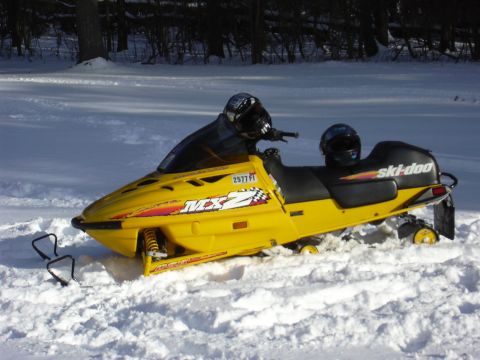
Between 1993 and 2003 Ski-Doo segmented the modern snowmobile market and then got sold by its own parent. The MX Z, introduced for 1993 as the Formula MX Z and a standalone nameplate from 1994, established the aggressive trail-sport category that became the industry's volume heart; registry examples like the MX Z 670 and MX Z 500 Sport trace the line's spread across displacements. The Summit line, launched in 1994, chased the fast-growing Rocky Mountain deep-powder market Polaris had staked out with its long-track mountain sleds (Polaris's purpose-built RMK answer followed in 1996); the Summit 800 Highmark X generation shows how specialized those machines became. Touring buyers got the plush Grand Touring, and in 2002 the Legend family (including the Legend 600 SE and the semi-direct-injection Legend 600 H.O. SDI) packaged comfort on the ZX platform. A genuine Valcourt engineering first arrived in 1998: RER electronic reverse, which reversed the two-stroke engine's rotation instead of adding a heavy mechanical reverse gear; it debuted on utility and touring models and later spread to sleds like the MX Z 600 Renegade RER.
The corporate earthquake came from far outside snowmobiling. Bombardier Inc., by then one of the world's largest aircraft and train makers, was gutted by the post-9/11 collapse of the regional-jet market and carried heavy debt. To raise cash, the board sold the entire recreational-products division, the founding business of the company, in a deal completed in December 2003 valued at about C$960 million (BRP's own SEC 20-F reports total consideration of US$806.3 million). The buyers kept it in the family: members of the Bombardier-Beaudoin family took roughly 35 percent, Bain Capital 50 percent, and Quebec's Caisse de depot 15 percent. The new company, Bombardier Recreational Products Inc. (BRP), headquartered in Valcourt, inherited Ski-Doo, Sea-Doo, ATVs, and Rotax. Ski-Doo was no longer a division's product line; it was the flagship of a standalone powersports company that lived or died on it.
2003-2015: The REV Revolution, Jose Boisjoli's BRP, and the Rider-Forward Reset
The 2003 Ski-Doo REV changed how every manufacturer on earth builds a snowmobile. Developed in Valcourt from snocross racing experience, the REV chassis moved the rider dramatically forward and upward into an attack posture, letting riders stand and absorb bumps with their legs rather than their spines. Competitors mocked the look, then copied the layout; within a decade rider-forward architecture was the industry standard at Polaris, Arctic Cat, and Yamaha alike. Registry-era machines like the MX Z 800 R Adrenaline and the race-derived MX Zx 800 ride on REV-family platforms. Combined with clean-burning E-TEC direct-injection two-strokes and the four-stroke options emissions rules demanded, the REV pushed Ski-Doo back to number-one market share in North American snowmobiles, a position it has broadly held since the mid-2000s.

The man running the show was Jose Boisjoli, an engineer who had led Bombardier's snowmobile-and-watercraft division since 1998 and became BRP's first CEO at the 2003 spin-off; he would hold the job for more than two decades, a continuity of leadership rare in powersports. Boisjoli's BRP diversified hard into Can-Am ATVs, side-by-sides, and the Spyder roadster so that a snowless winter could no longer sink the company, the same logic Laurent Beaudoin had applied in the 1970s, now executed inside a pure powersports firm. BRP survived the 2008-09 financial crisis with layoffs and production cuts in Valcourt but without losing the brand, and Boisjoli took the company public on the Toronto Stock Exchange in May 2013 (a Nasdaq listing followed in 2018), beginning Bain Capital's exit while the Beaudoin family retained a controlling voice through multiple-voting shares.
2015-Today: BRP's Flagship in an Electrifying, Consolidating Sport
Ski-Doo enters its seventh decade as the market leader of a sport that is smaller, older, and more specialized than the one it invented. Worldwide snowmobile sales, about 112,000 units in 2024 and roughly 92,000 in 2025 by industry-association counts, now run at barely a fifth of the 1971 peak, and Ski-Doo takes roughly half of them. How fragile the industry has become showed in 2025, when Textron halted Arctic Cat snowmobile production and sold the brand that April to an investor group led by Argo chief executive and Arctic Cat veteran Brad Darling, which restarted the Minnesota production line. BRP's Gen4 (2017) and Gen5 (2023) platforms continued the REV lineage, and the pandemic winters of 2020-22 delivered a demand spike that Valcourt struggled to supply, followed by the inventory hangover that hit all of powersports in 2024-25.
The strategic questions of the era are the founder's questions in modern dress: how to keep a snow-dependent product alive as winters shorten, and what powers it next. BRP's answers have been crossover and deep-snow segments on the product side, and electrification on the propulsion side: the Ski-Doo Grand Touring Electric, an EV touring sled piloted with guided-tour operators, reached limited production for the 2024 season, the first electric snowmobile from an established major manufacturer. BRP shut down its Evinrude outboard business in 2020 and put its boat brands up for sale in 2024 to refocus on core powersports, and Jose Boisjoli, CEO since the spin-off, announced his retirement in May 2025 and handed BRP to Denis Le Vot on February 1, 2026, the company's first change of chief executive since its creation.
The continuity is unusual: the machine Joseph-Armand Bombardier built in a Valcourt garage in 1959 is still designed and built in Valcourt, still powered by Rotax engines, and still watched over by the founding family, with Pierre Beaudoin taking the chair of BRP's board in 2026. The brand's birthplace, its engine maker, and its founding family have stayed together through more than six decades of booms, collapses, and corporate restructuring.
Leadership
| Leader | Role | Tenure | Note |
|---|---|---|---|
| Joseph-Armand Bombardier | Founder and president, L'Auto-Neige Bombardier | 1942-1964 | Patented the sprocket-and-track drive (1937), invented the Ski-Doo (1959), and led the company until his death in February 1964. |
| Germain Bombardier | President | 1964-1966 | The founder's son; headed the family firm briefly before departing in 1966. |
| Laurent Beaudoin | General manager (1964), president (1966), chairman and CEO of Bombardier Inc. (from 1979) | 1964-2008 (board member to 2018) | The founder's son-in-law; drove the Ski-Doo boom, the January 1969 IPO, and the rail-and-aerospace diversification that carried the brand through the 1970s crash. |
| Pierre Beaudoin | President, Sea-Doo/Ski-Doo division (1994); president and COO, Bombardier Recreational Products (1996-2001) | 1985-2001 (recreational products) | Laurent Beaudoin's son; joined the marine-products unit in 1985, later CEO of Bombardier Inc.; appointed chair of BRP's board effective February 2026. |
| Jose Boisjoli | President, snowmobile and watercraft division (1998); founding president and CEO, BRP Inc. (2003) | 1998-2026 | Ran BRP from the December 2003 spin-off until his retirement on February 1, 2026, after 22 years at the helm. |
| Denis Le Vot | President and CEO, BRP Inc. | 2026-present | Automotive-industry veteran appointed in December 2025, effective February 1, 2026, as BRP's second CEO. |
Timeline
| Year | Event / model | Note |
|---|---|---|
| 1922 | First propeller-driven snow machine | Fifteen-year-old Joseph-Armand Bombardier tests a propeller sleigh in Valcourt, Quebec. |
| 1937 | B7 auto-neige | Bombardier patents his sprocket-and-track system and sells the seven-passenger B7 snow coach. |
| 1942 | L'Auto-Neige Bombardier founded | Bombardier incorporates the company in Valcourt to build tracked snow vehicles. |
| 1959 | First Ski-Doo | The lightweight one-person snowmobile launches with a 7-hp Kohler engine; a printer's error turned the intended "Ski-Dog" name into Ski-Doo. |
| 1964 | Death of Joseph-Armand Bombardier | The founder dies of cancer at 56; family leadership passes toward son-in-law Laurent Beaudoin. |
| 1966 | Laurent Beaudoin becomes president | Beaudoin, general manager since 1964, scales production as the 1960s snowmobile boom accelerates. |
| 1968 | Plaisted expedition reaches the North Pole | Ralph Plaisted's Ski-Doo-mounted team, including Jean-Luc Bombardier, completes the first confirmed surface journey to the North Pole on April 19, 1968, cementing the brand's utility credentials. |
| 1970 | Rotax acquisition | Bombardier buys Austrian engine maker Lohner-Rotax, securing its engine supply. |
| 1971 | Moto-Ski acquired | Bombardier absorbs Quebec rival Moto-Ski as the industry begins to consolidate. |
| 1971 | Elan | The simple, affordable Elan becomes a long-running utility and trainer sled, built until 1996. |
| 1974 | Diversification into rail | The Montreal Metro rail contract offsets a snowmobile market collapsing from roughly 100 makers to a handful. |
| 1978 | Blizzard goes consumer | The race-bred Blizzard name moves to fast consumer trail sleds, a performance line that runs into the mid-1980s with machines like the Blizzard 9700. |
| 1984 | Tundra | The long-track utility Tundra debuts for deep-snow work in the north. |
| 1984 | Safari | The Safari family covers the touring and family segment of the mid-1980s lineup. |
| 1985 | Formula chassis | The Formula platform (the Formula Plus, joined in 1989 by the Formula Mach 1) revives Ski-Doo's performance reputation. |
| 1993 | MX Z introduced | Debuting as the Formula MX Z, the MX Z becomes Ski-Doo's core trail-performance nameplate, spanning models from the MX Z 670 to the MX Z 800 R Adrenaline. |
| 1993 | Mach Z | The triple-cylinder Mach Z debuts, anchoring the lake-racer end of the lineup. |
| 1994 | Summit introduced | The Summit creates Ski-Doo's dedicated deep-snow mountain line, later including the Summit 800 Highmark X. |
| 1998 | RER electronic reverse | Valcourt's electronic reverse spins the two-stroke backward instead of adding a reverse gear, debuting on utility and touring sleds before spreading across the line. |
| 2002 | Legend touring line | The Legend series (including the Legend V-1000 Sport) covers sport-touring before the REV transition. |
| 2003 | REV chassis | The rider-forward REV platform resets snowmobile ergonomics; competitors follow within a few seasons. |
| 2003 | BRP spin-off | Bombardier Inc. sells its recreational-products division; Ski-Doo becomes the flagship of BRP Inc. under CEO Jose Boisjoli. |
| 2013 | BRP IPO | BRP lists on the Toronto Stock Exchange as DOO; a Nasdaq listing (DOOO) follows in 2018. |
| 2020 | 850 E-TEC Turbo | Ski-Doo launches the industry's first factory-turbocharged two-stroke snowmobile engine on the Summit in January 2020. |
| 2024 | Grand Touring Electric | Ski-Doo's first production electric snowmobile reaches guided-tour and rental fleets in limited numbers for the 2024 season. |
| 2025-26 | Leadership and industry reshuffle | Textron halts and then sells Arctic Cat (April 2025); Jose Boisjoli retires after 22 years and Denis Le Vot becomes BRP's second CEO on February 1, 2026. |
Asked all the time
Who founded Ski-Doo?
Joseph-Armand Bombardier, the Quebec inventor who had built multi-passenger tracked snow coaches since 1937, launched the first Ski-Doo in 1959 as a product of his company L'Auto-Neige Bombardier in Valcourt, Quebec.
Is Ski-Doo still in business?
Yes. Ski-Doo is the flagship snowmobile brand of BRP Inc. (Bombardier Recreational Products) and its sleds are still built in Valcourt, Quebec.
Why is it called Ski-Doo instead of Ski-Dog?
As BRP and most histories tell it, a typo reportedly turned Ski-Dog into Ski-Doo.
What is the relationship between Ski-Doo and Bombardier?
Ski-Doo began as a product line of L'Auto-Neige Bombardier, which grew into Bombardier Inc. When Bombardier spun off its recreational-products division in 2003, Ski-Doo transferred to the new company, BRP Inc.
How did Ski-Doo survive the 1970s snowmobile crash?
The early-1970s market collapse killed most of the roughly 100 snowmobile makers, but Bombardier diversified into rail transit with the 1974 Montreal Metro contract, acquired rival Moto-Ski in 1971, and kept the Ski-Doo line running through the downturn.
What is Ski-Doo best known for?
Inventing the recreational snowmobile market with the 1959 Ski-Doo, dominating the 1960s boom, and introducing the rider-forward REV chassis in 2003, which reset modern snowmobile design.
Who owns Ski-Doo today?
BRP Inc., the publicly traded company (TSX: DOO, Nasdaq: DOOO) formed from Bombardier's 2003 recreational-products spin-off. Jose Boisjoli led BRP from the spin-off until February 2026, when Denis Le Vot became president and CEO.
The wall
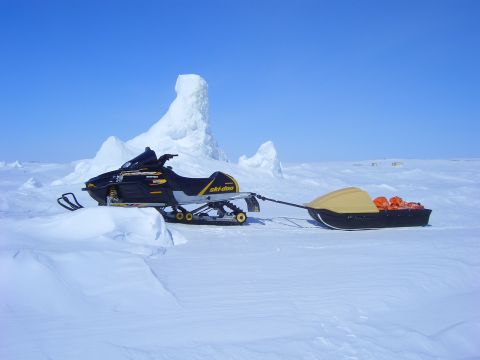
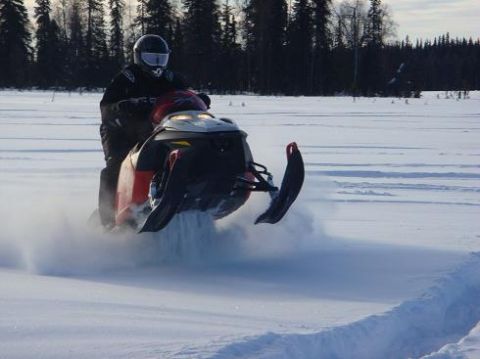
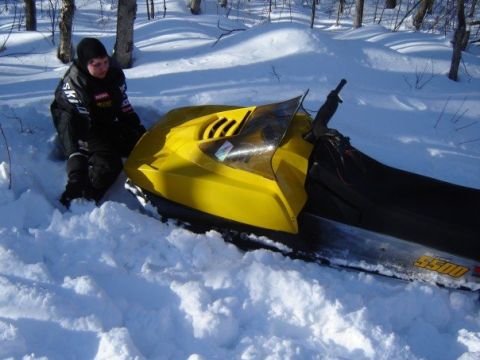
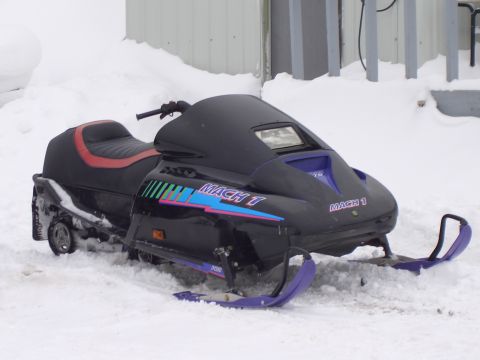
The most-documented Ski-Doo vehicles in the registry, every photo by the owner.