Home/
Registry/
Ford/
Fairlane/
1968-1969/
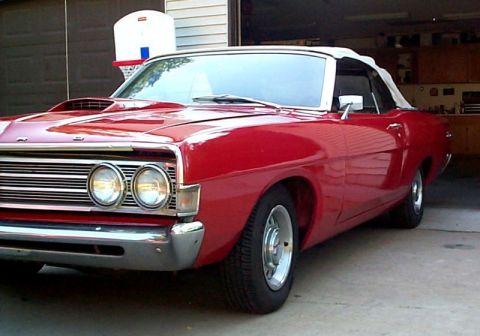
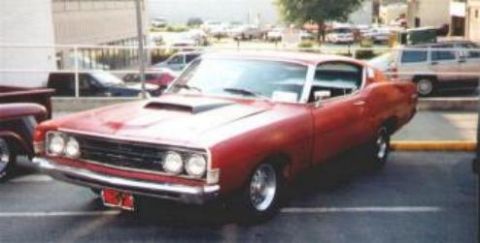
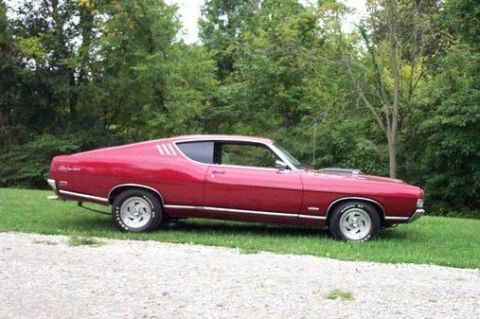
1969 Ford Fairlane/
Photo
supermotors.net/registry/media/1007549
A page from a technical document detailing internal combustion engines and turbines.
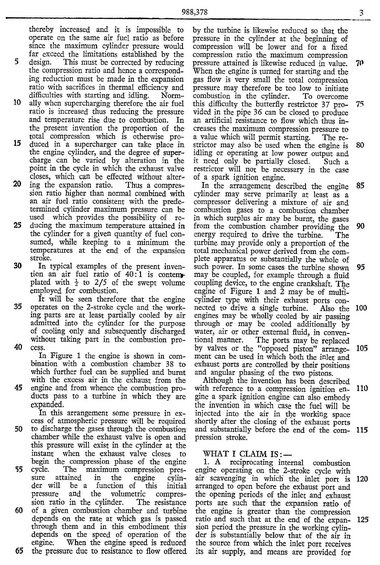
-u____~__________._-__ 10 15 20 25 30 35 40 45 50 55 60 65 988,378 thereby increased and it is impossible to operate on the same air fuel ratio as before since the maximum cylinder pressure would far exceed the limitations established by the design. This must be corrected by reducing the compression ratio and hence a correspond- ing reduction must be made in the expansion ratio with sacrices in thermal eicieney and diiculties with starting and idling. Norm- ally when supercharging therefore the air fuel ratio is increased thus reducing the pressure and temperature rise due to combustion. In the present invention the proportion of the total compression which is otherwise pro- duced in a supercharger can take place in the engine cylinder, and the degree of super- charge can be varied by alteration in the point in the cycle in which the exhaust valve closes, which can be effected without alter- ing the expansion ratio. Thus a compres- sion ratio higher than normal combined with an air fuel ratio consistent with the prede termined cylinder maximum pressure can be used which provides the possibility of re ducing the maximum temperature attained in the cylinder for a given quantity of fuel con sumed, while keeping to a minimum the temperatures at the end of the expansion stroke. In typical examples of the present inven- tion an air fuel ratio of 40:1 is contem- plated with -} to 2/5 of the swept volume employed for combustion. It will be seen therefore that the engine operates on the Z-stroke cycle and the work- ing parts are at least partially cooled by air admitted into the cylinder for the purpose of cooling only and subsequently discharged without taking part in the combustion pro- cess. In Figure 1 the engine is shown in com bination with a combustion chamber 38 to which further fuel can be supplied and burnt with the excess air in the exhaust from the engine and from whence the combustion pro- ducts pass to a turbine in which they are expanded. In this arrangement some pressure in ex- cess of atmospheric pressure will be required to discharge the gases through the combustion- chamber while the exhaust valve is open and this pressure will exist in the cylinder at the instant when the exhaust valve closes to begin the compression phase of the engine cycle. The maximum compression pres- sure attained in the engine cylin- der will be a function of this initial pressure and the volumetric compres sion ratio in the cylinder. The resistance of a. given combustion chamber and turbine depends on the rate at which gas is passed through them and in this embodiment this depends on the speed of operation of the engine. When the engine speed is reduced the pressure due to resistance to ow offered by the turbine is likewise reduced so that the pressure in the cylinder at the beginning of compression will be lower and for a xed compression ratio the maximum compression pressure attained is likewise reduced in value. When the engine is turned for starting and the gas ow is very small the total compression pressure may therefore be too low to initiate combustion in the cylinder. To overcome this difculty the buttery restrictor 37 pro- vided in the pipe 36 can be closed to produce an articial resistance to ow which thus in creases the maximum compressiou pressure to a value which will permit starting. The re- strictor may also be used when the engine is idling or operating at low power output and it need only be partially closed. Such a restrictor will not be necessary in the case of a spark ignition engine. In the arrangement deseribed the engine cylinder may serve primarily at least as a compressor delivering a mixture of air and combustion gases to a combustion chamber in which surplus air may be burnt, the gases from the combustion chamber providing the energy required to drive the turbine. The turbine may provide only a proportion of the total mechanical power derived from the com- plete apparatus or substantially the whole of such power. In some cases the turbine shown may be coupled, for example through a uid coupling device, to the engine crankshaft. The engine of Figure 1 and 2 may be of multi- cylinder type with their exhaust ports con nected to drive a single turbine. Also the engines may be wholly cooled by air passing through or may be cooled additionally by water, air or other external uid, in conven- tional manner. The ports may be replaced by valves or the opposed piston arrange- ment can be used in which both the inlet and exhaust ports are controlled by their positions and angular phasing of the two pistons. Although the invention has been described with reference to a compression ignition en- ginc a spark ignition engine can also embody the invention in which case the fuel will be injected into the air in the working space shortly after the closing of the exhaust ports and substantially before the end of the com- pression stroke. WHAT I CLAIM IS: 1. A reciprocating internal combustion engine operating on the Zstroke cycle with air scavenging in which the inlet port is arranged to open before the exhaust port and the opening periods of the inlet and exhaust ports are such that the expansion ratio of the engine is greater than the compression ratio and such that at the end of the expan- sion period the pressure in the working cylin- der is substantially below that of the air in the source from which the inlet port receives its air supply, and means are provided for s 70 75 80 85 90 95 100 105 110 115 120 125
Comments
More from this build
No comments yet.