Home/
Registry/
Ford/
Fairlane/
1968-1969/
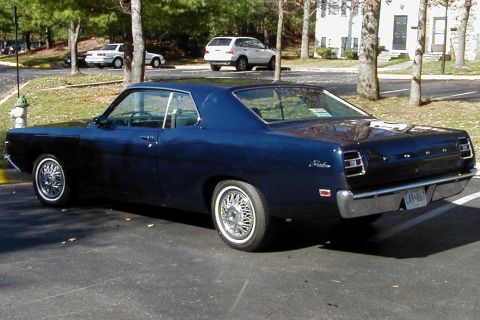
1969 Ford Fairlane/
Photo
supermotors.net/registry/media/1007548
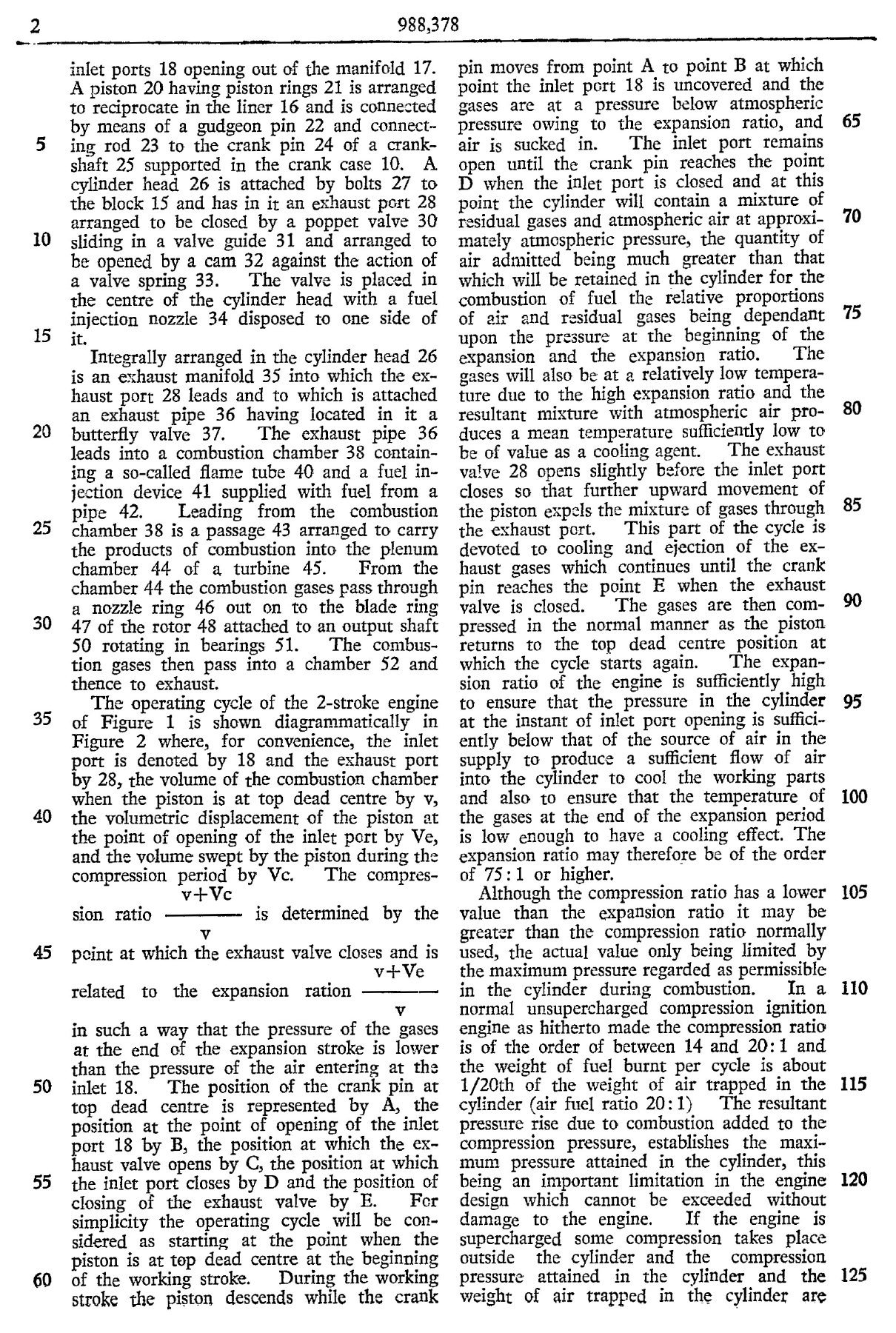
British Patent 988,378 Page 2 - Chatterton Hyperexpansion 2-Stroke Engine Cycle
Reference · 1968-1969 FairlaneAll 8 manual pages
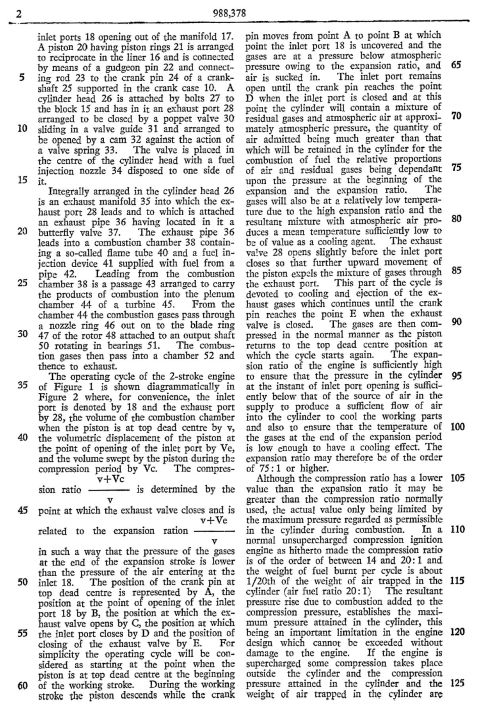
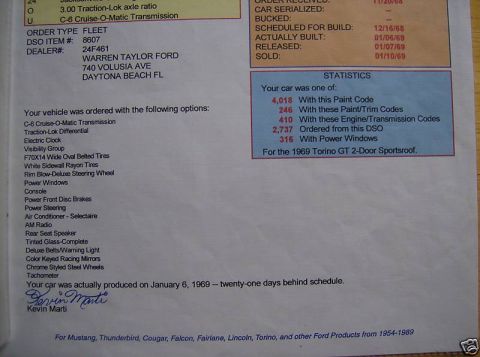
Scanned patent specification page of numbered prose describing a two-stroke engine operating cycle.
Part of 1968-1969 Ford Fairlane Manual Pages
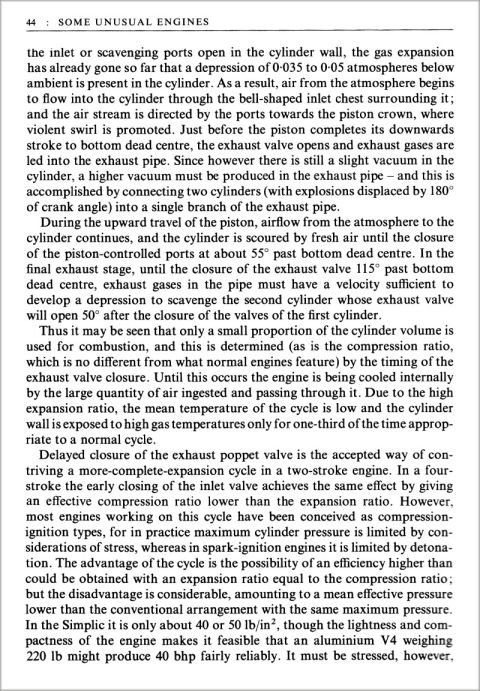
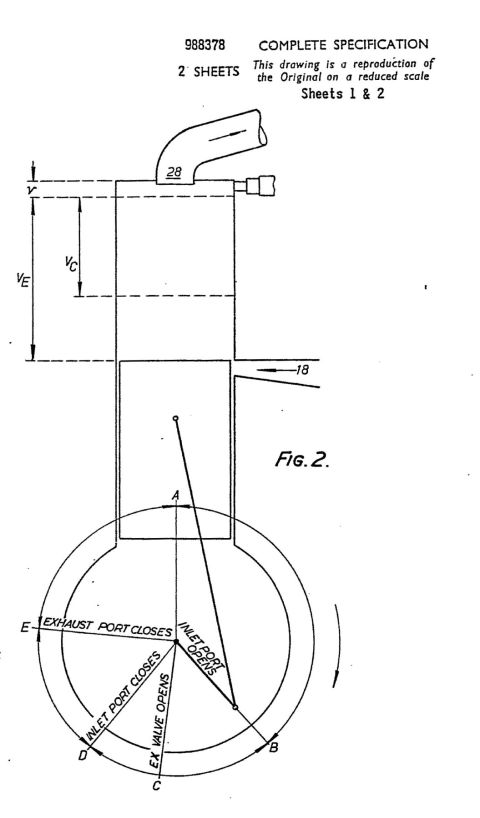
This is page 2 of British Patent 988,378 (the "Chatterton hyperexpansion" engine patent), describing a 2-stroke compression-ignition engine with an extremely high expansion ratio. The page continues the mechanical description: a piston (20) with rings (21) in a liner (16), connected via gudgeon pin (22) and connecting rod (23) to a crankshaft (25); a cylinder head (26) with an exhaust port (28) closed by a cam-operated poppet valve (30), a central fuel injection nozzle (34), an integral exhaust manifold (35), an exhaust pipe (36) with butterfly valve (37) feeding a separate combustion chamber (38) with flame tube (40) and fuel injector (41), whose gases drive a turbine (45) via a nozzle ring (46) and blade ring (47) on an output shaft (50). It then explains the operating cycle shown in Figure 2, defining compression ratio (v+Vc)/v and expansion ratio (v+Ve)/v, and crank-pin positions A-E for port and valve events. The cycle uses excess inducted air as a cooling agent, with an expansion ratio of the order of 75:1 or higher, and discusses how maximum combustion pressure limits the compression ratio, comparing with conventional unsupercharged compression-ignition engines (compression ratios 14-20:1, air-fuel ratio about 20:1).
Is this accurate? Sign in to help verify it.
Frequently asked questions
- What expansion ratio does the hyperexpansion engine in Patent 988,378 use?
- The document states the expansion ratio may be of the order of 75:1 or higher, chosen so cylinder pressure at inlet port opening is below the supply air pressure and exhaust gas temperature is low enough to have a cooling effect.
- How are the compression and expansion ratios defined in this patent?
- The compression ratio is (v+Vc)/v and the expansion ratio is (v+Ve)/v, where v is the combustion chamber volume at top dead centre, Ve is the piston displacement at the point of inlet port opening, and Vc is the volume swept during the compression period.
- What do the crank pin positions A, B, C, D and E represent in the operating cycle?
- A is top dead centre, B is the point of inlet port 18 opening, C is where the exhaust valve opens, D is where the inlet port closes, and E is the position at which the exhaust valve closes.
- Why does the engine admit more air than needed for combustion?
- The quantity of air admitted is much greater than that retained for combustion; the residual gases are at low temperature due to the high expansion ratio, and mixing with atmospheric air produces a mean temperature low enough for the mixture to act as a cooling agent.
- What compression ratios does the patent cite for a normal unsupercharged compression ignition engine?
- It states the compression ratio is of the order of between 14 and 20:1, with fuel burnt per cycle about 1/20th of the weight of trapped air (air fuel ratio 20:1).
No comments yet.