Home/
Registry/
Ford/
Bronco/
1987-1991/
1989 Ford Bronco/
Photo
supermotors.net/registry/media/708569
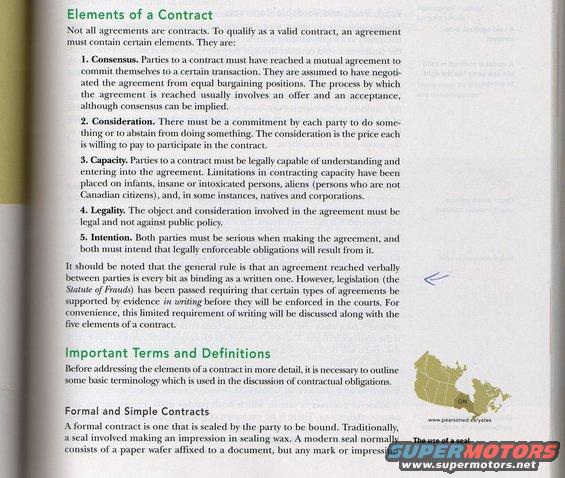
A document page detailing the elements of a contract, including consensus, consideration, capacity, legality, and intention.
Elements of a Contract Not all agreements are contracts. To qualify as a valid contract, an agreement must contain certain elements. They are: 1. Consensus. Parties to a contract must have reached a mutual agreement to commit themselves to a certain transaction. They are assumed to have negoti- ated the agreement from equal bargaining positions. The process by which the agreement is reached usually involves an offer and an acceptance, although consensus can be implied. 2. Consideration. There must be a commitment by each party to do some? thing or to abstain from doing something. The consideration is the price each is willing to pay to participate in the contract. 3. Capacity. Parties to a contract must be legally capable of understanding and entering into the agreement. Limitations in contracting capacity have been placed on infants, insane or intoxicated persons, aliens (persons who are not Canadian citizens), and, in some instances, natives and corporations. 4. Legality. The object and consideration involved in the agreement must be legal and not against public policy. 5. Intention. Both parties must be serious when making the agreement, and both must intend that legally enforceable obligations will result from it. It should be noted that the general rule is that an agreement reached verbally between parties is every bit as binding as a written one. However, legislation (the Statute of Frauds) has been passed requiring that certain types of agreements be supported by evidence in writing before they will be enforced in the courts. For convenience, this limited requirement of writing will be discussed along with the ve elements of a contract. Important Terms and Definitions Before addressing the elements of a contract in more detail, it is necessary to outline some basic terminology which is used in the discussion of contractual obligations. Formal and Simple Contracts A formal contract is one that is sealed by the party to be bound. Traditionally, a seal involved making an impression in sealing wax. A modern seal normally consists of a paper wafer afxed to a document, but any mark or impression www.pearsoned. . The use of a seal
Comments
More from this build














No comments yet.