This is a document with diagrams and text, not a photo of a vehicle.
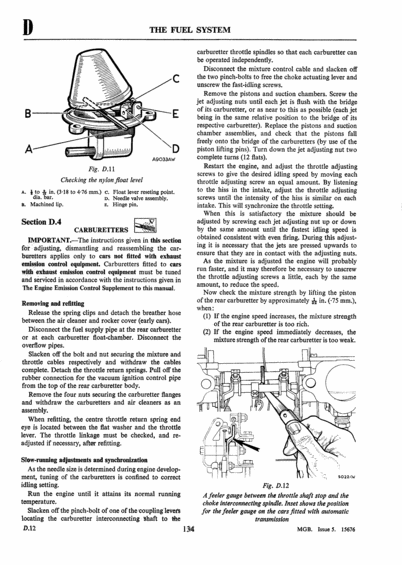
THE FUEL SYSTEM A9033AW Fig. D.ll Checking the nylon oat level A. {- to f, in. (318 to 476 mm.) c. Float lever reseting point. dla. bar. D. Needle valve assembly. B. Machined lip. E. Hinge pin. Section D.4 CARBURETTERS IMPORTANT.The instructions given in this section for. adjusting, dismantling and reassembling the car- buretters applies only to cars not tted with exhaust emission control equipment. Carburetters tted to cars with'exhaust emission control equipment must be tuned and serviced in accordance with the instructions given in The Engine Emission Control Supplement to this manual. Removing and retting Releasethe spring clips and detach the breather hose betweenthe air cleaner and rocker cover (early cars). Disconnect the fuel supply pipe at the rear carburetter or at each carburetter oat-chamber. Disconnect the overow pipes. Slacken off the bolt and nut securing the mixture and throttle cables respectively and withdraw the cables complete. Detach the throttle return springs. Pull off the rubber connection for the vacuum ignition control pipe from the top of the rear carburetter body. Remove the four nuts securing the carburetter anges and withdraw the carburetters and air cleaners as an assembly. When retting, the centre throttle return spring end eye is located between the at washer and the throttle lever. The throttle linkage must be checked, and re- adjusted if necessary, after retting. Slow-running adjustments and synchronization As the needle size is determined during engine develop- ment, tuning of the carburetters is conned to correct idling setting. Run the engine until it attains its normal running temperature. Slacken o the pinch-bolt of one of the couplinglevers locating the carburetter interconnecting shaft to the D.l2 13134 carburetter throttle spindles so that each carburetter can be operated independently. Disconnect the mixture control cable and slacken oil the two pinch-bolts to free the choke actuating lever and unscrew the fast-idling screws. Remove the pistons and suction chambers. Screw the jet adjusting nuts until each jet is ush with the bridge of its carburetter, or as near to this as possible (each jet being in the same relative position to the bridge of its respective carburetter). Replace the pistons and suction chamber assemblies, and check that the pistons fall freely onto the bridge of the carburetters (by use of the piston lifting pins). Turn down the jet adjusting nut two complete turns (12 ats). Restart the engine, and adjust the throttle adjusting screws to give the desired idling speed by moving each throttle adjusting screw an equal amount. By listening to the hiss in the intake, adjust the throttle adjusting screws until the intensity of the hiss is similar on each intake. This will synchronize the throttle setting. When this is satisfactory the mixture should be adjusted by screwing each jet adjusting nut up or down by the same amount until the fastest idling speed is obtained consistent with even ring. During this adjust- ing it is necessary that the jets are pressed upwards to ensure that they are in contact with the adjusting nuts. As the mixture is adjusted the engine will probably run faster, and it may therefore be necessary to unscrew the throttle adjusting screws a little, each by the same amount, to reduce the speed. Now check the mixture strength by lifting the piston of the rear carburetter by approximately 3]; in. (-75 mm.), when: (1) If the engine speed increases, the mixture strength of the rear carburetter is too rich. (2) If the engine speed immediately decreases, the mixture strength of the rear carburetter is too weak. Fig. 0.12 A feeler gauge between the throttle shaft stop and the choke interconnecting spindle. Inset shows the position for the feeIer gauge on the cars tted with automatic transmission MGB. Issue 5. 15676
Comments
More from this build


No comments yet.