Document page with columns of text and a page number at the top
A document page with text arranged in columns and a page number at the top.
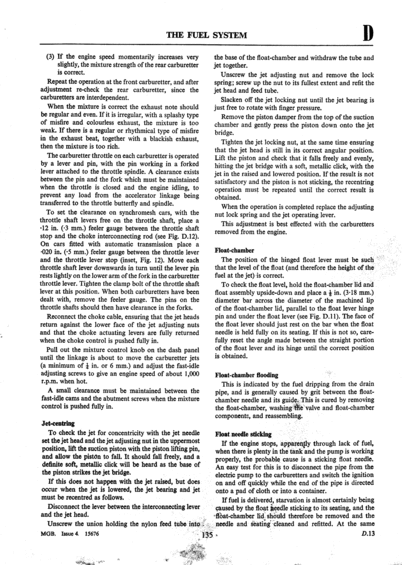
TI-IE FUEL SYSTEM D (3) If the engine speed momentarily increases very slightly, the mixture strength of the rear carburetter is correct. Repeat the operation at the front carburetter, and after adjustment re-check the rear carburetter, since the carburetters are interdependent. When the mixture is correct the exhaust note should be regular and even. If it is irregular, with a splashy type of misre and colourless exhaust, the mixture is too weak. If there is a regular or rhythmical type of misre in the exhaust beat, together with a blackish exhaust, then the mixture is too rich. The carburetter throttle on each carburetter is operated by a lever and pin, with the pin working in a forked lever attached to the throttle spindle. A clearance exists between the pin and the fork which must be maintained when the throttle is closed and the engine idling, to prevent any load from the accelerator linkage being transferred to the throttle buttery and spindle. To set the clearance on synchromesh cars, with the throttle shaft levers free on the throttle shaft, place a ~12 in. (-3 mm.) feeler gauge between the throttle shaft stop and the choke interconnecting rod (see Fig. D.12). On cars tted with automatic transmission place a 020 in. (-5 mm.) feeler gauge between the throttle lever and the throttle lever stop (inset, Fig. 12). Move each throttle shaft lever downwards in turn until the lever pin rests lightly on the lower arm of the fork in the carburetter throttle lever. Tighten the clamp bolt of the throttle shaft lever at this position. When both carburetters have been dealt with, remove the feeler gauge. The pins on the throttle shafts should then have clearance in the forks. Reconnect the choke cable, ensuring that the jet heads return against the lower face of the jet adjusting nuts and that the choke actuating levers are fully returned when the choke control is pushed fully in. Pull out the mixture control knob on the dash panel until the linkage is about to move the carburetter jets (a minimum of l in. or 6 mm.) and adjust the fast-idle adjusting screws to give an engine speed of about 1,000 rpm. when hot. A small clearance must be maintained between the fast-idle cams and the abutment screws when the mixture control is pushed fully in. J et-centring To check the jet for concentricity with the jet needle set the jet head and the jet adjusting nut in the uppermost position, lift the suction piston with the piston lifting pin, and allow the pistOn to fall. It should fall freely, and a denite soft, metallic click will be heard as the base of the piston strikes the jet bridge. If this does not happen with the jet raised, but does occur when the jet is lowered, the jet bearing and jet must be recentred as follows. Disconnect the lever between the interconnecting lever , and the jet head. Unscrew the union holding the nylon feed tube in MGB. Issue 4 15676 the base of the oat-chamber and withdraw the tube and jet together. Unscrew the jet adjusting nut and remove the lock spring; screw up the nut to its fullest extent and ret the jet head and feed tube. Slacken off the jet locking nut until the jet bearing is just free to rotate with nger pressure. Remove the piston damper from the top of the suction chamber and gently press the piston down onto the jet bridge. Tighten the jet locking nut, at the same time ensuring that the jet head is still in its correct angular position. Lift the piston and check that it falls freely and evenly, hitting the jet bridge with a soft, metallic click, with the jet in the raised and lowered position. If the result is not satisfactory and the piston is not sticking, the recentring operation must be repeated until the correct result is obtained. When the operation is completed replace the adjusting nut lock spring and the jet operating lever. This adjustment is best effected with the carburetters removed from the engine. Float-chamber The position of the hinged oat lever must be such. fit that the level of the oat (and therefore the height of the} V~ '4 , fuel at the jet) 1s correct. To check the oat level, hold the oat-chamber lid and oat assembly upside-down and place a l in. (3-18 mm.) diameter bar across the diameter of the machined lip of the oat-chamber lid, parallel to the oat lever hinge pin and under the oat lever (see Fig. D.11). The face of the oat lever should just rest on the bar when the oat needle is held fully on its seating. If this is not so, care- fully reset the angle made between the straight portion of the oat lever and its hinge until the correct position is obtained. Float-chamber ooding This is indicated by the fuel dripping from the drain pipe, and is generally caused by grit between the oat- chamber needle and its guide-s This is cured by removing the oat-chamber, washing r is valve and oat- chamber components and reassembling. Float needle sticking If the engine stops, apparently through lack of fuel, when there' 1s plenty' 1n the tank and the pump is working properly, the probable cause is a sticking oat needle. An easy test for this is to disconnect the pipe from the electric pump to the carburetters and switch the ignition on and o quickly while the end of the pipe is directed onto a pad of cloth or into a container. If fuel 1s delivered, starvation is almost certainly being " caused by the oat needle sticking to its seating, and the rfIOat-chamber lid should therefore be removed and the needle and seating el'e'aned and retted. At the same f. D.13
Is this accurate? Sign in to help verify it.
Comments
More from this build

No comments yet.