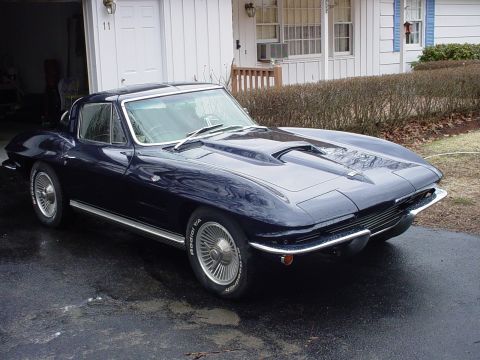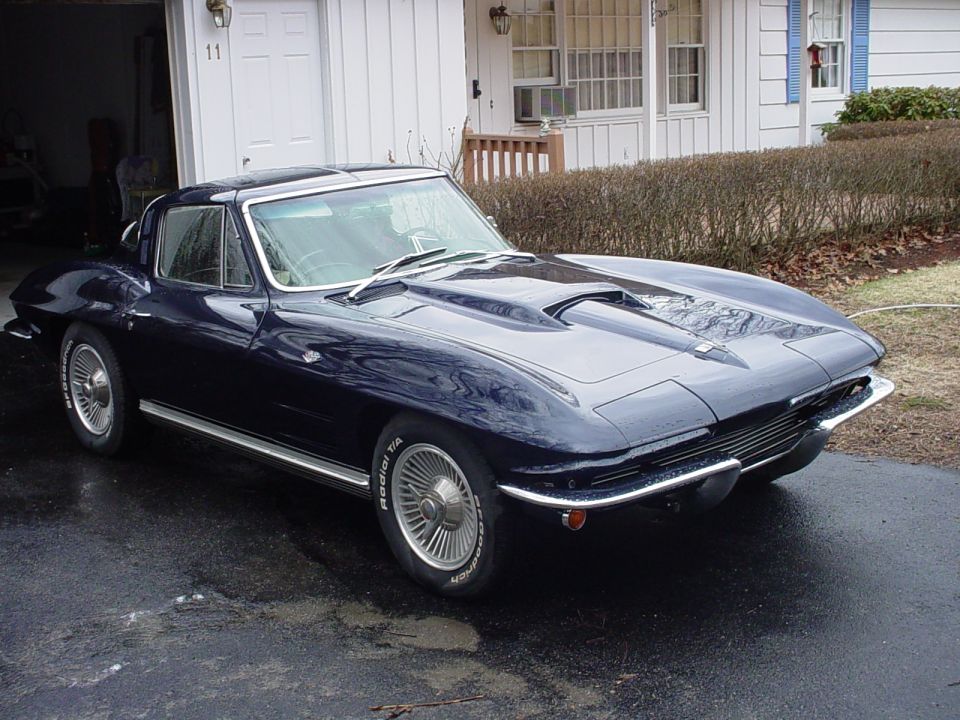
The Chevrolet Corvette C2 Sting Ray ran five model years, 1963 through 1967, and brought the Corvette its first independent rear suspension and its first coupe body. The 1963 coupe carried a divided rear window for that one year only. Power started with the 327 cubic inch small block, offered with Rochester mechanical fuel injection through 1965, then grew with the 396 big block in 1965 and the 427 in 1966 and 1967, topping out with the race-oriented L88.
Other Chevrolet Corvette generations
Platform and chassis
The 1963-1967 Corvette Sting Ray sits on a 98 inch wheelbase ladder frame, four inches shorter than the C1 it replaced. The big change underneath is the independent rear suspension: a transverse leaf spring, halfshafts acting as upper links, and trailing arms locating each rear wheel. Body is fiberglass over the steel frame, offered as a coupe for the first time alongside the convertible. Steering is recirculating ball. Drum brakes were standard in 1963 and 1964; four wheel disc brakes became standard equipment for 1965, though a 1965 buyer could still take drum brakes back for a $64.50 credit under RPO J61, and 316 cars left the factory that way.
Engine lineup
Every engine in a C2 is rated in gross horsepower, so compare accordingly against later net-rated cars.
- 327 small block (1963-1967): The base engine was the 250 hp 327 from 1963 through 1965, with a 300 hp version optional in those years. For 1966 the 250 was dropped and the 300 hp engine became the base motor through 1967. In 1963 the solid lifter L76 made 340 hp and the fuel injected L84 made 360 hp. For 1964 those climbed to 365 hp (L76) and 375 hp (L84 fuelie). 1965 was the last year for Rochester fuel injection. From 1965 the hydraulic cam L79 327 made 350 hp and stayed in the lineup through 1967.
- 396 big block (1965 only): The L78 396, rated 425 hp, arrived mid year 1965 with the bulged big block hood. One year only in a Corvette.
- 427 big block (1966-1967): For 1966, the L36 427 made 390 hp and the solid lifter L72 made 425 hp; the L72 was announced at 450 hp, then Chevrolet cut the official rating to 425 about a month into production without changing the engine. For 1967 the lineup was the L36 at 390 hp, the L68 at 400 hp with three two barrel carburetors, and the L71 at 435 hp with the same triple carb setup and a solid lifter cam. The L89 option put aluminum heads on the L71 at the same 435 hp rating; only 16 were built for 1967.
- L88 (1967): An aluminum head 427 built for racing, officially rated 430 hp, deliberately understated below the L71 to steer street buyers away. It ran 12.5:1 compression, required 103 octane fuel, came without a radio or heater, and 20 were built for 1967.
Drivetrain and transmissions
All C2 Corvettes are front engine, rear drive, with the differential mounted to the frame as part of the independent rear suspension. A 3 speed manual was the nominal base transmission but few cars got it. Most buyers took the 4 speed manual: the Borg-Warner T10 at first, replaced by the Muncie during the 1963 model year, in wide ratio M20 and close ratio M21 forms, with the heavy duty M22 built in small numbers from 1965. The 2 speed Powerglide was the only automatic, and it was not available behind the top solid lifter engines. A Positraction limited slip differential was a common option across a range of axle ratios.
Year by year
- 1963: First year. Split rear window on the coupe, one year only. Hood has non-functional grille panels. Z06 competition package offered with the 360 hp fuelie, initially on the coupe; 199 built, nearly all coupes, with one convertible claimed but never fully documented. Engines: 250, 300, 340, and 360 hp 327s.
- 1964: Rear window becomes one piece. Fake hood grille inserts deleted, though the recesses remained. Top 327s rise to 365 hp (L76) and 375 hp (L84 injection).
- 1965: Four wheel disc brakes standard. Functional front fender louvers replace the earlier non-functional depressions. L78 396/425 arrives mid year. Last year for fuel injection on the 327.
- 1966: 427 replaces the 396: L36 390 hp and L72 425 hp. Egg crate grille replaces horizontal bars.
- 1967: Cleanest trim of the run: five smaller fender louvers, less exterior badging, optional bolt-on aluminum wheels replacing the earlier knock-offs. Big blocks get the stinger hood scoop. L71 435 hp tri-power, L89 aluminum heads, and the L88 arrive.
Trims and variants
Chevrolet did not use trim levels; a C2 is defined by its RPO sheet. The ones that move the market: L84 fuel injection cars (1963-1965), the 1963 Z06 coupe, L79 small block cars as the usable street sweet spot, L71 and L89 427s, and the 1967 L88. Air conditioning (C60, first offered 1963), power steering, power brakes, off road exhaust (N14 side pipes from 1965), and the 36 gallon tank option (N03, coupes only because the tank would not fit the convertible) are all documented options that affect value. Verify numbers matching drivetrains carefully; these cars have been rebodied and re-stamped for decades.
Asked all the time
What engines came in the 1963-1967 Corvette Sting Ray?
The 1963-1967 Corvette C2 used the 327 cubic inch small block in 250 to 375 hp gross ratings, including Rochester fuel injected versions through 1965; the 250 hp base was dropped after 1965 and the 300 hp engine became base for 1966-1967. Big blocks arrived mid 1965 with the 396 L78 (425 hp), replaced for 1966-1967 by the 427 in 390, 400, 425, and 435 hp versions plus the 1967-only L88.
What is special about the 1963 Corvette split window?
The 1963 Corvette Sting Ray coupe used a divided rear window, split by a body colored spine, for that single model year. Chevrolet switched to a one piece rear window for 1964, which makes original 1963 split window coupes the most sought after body of the C2 run.
When did the Corvette get four wheel disc brakes?
The Corvette Sting Ray made four wheel disc brakes standard for the 1965 model year. The 1963 and 1964 cars used drum brakes all around, so a 1965-1967 car is the pick if you plan to drive one hard.
What is the Corvette L88 and why is its horsepower rating misleading?
The L88 was a 1967 (through 1969 on the C3) race option 427 with aluminum heads, 12.5:1 compression, and a single 850 cfm Holley. Chevrolet rated it at 430 hp gross, five below the street L71 435 hp engine, on purpose to discourage street buyers. Actual output was well above the rating. Only 20 were built for 1967.
Which 1963-1967 Corvette is the best one to actually drive?
For street use, most C2 owners point to a 1965-1967 small block car with the L79 350 hp 327 and a Muncie 4 speed: hydraulic lifters, standard disc brakes, and less nose weight than a 427 car. Big block cars are faster in a straight line but heavier up front and thirstier.
What changed each year on the C2 Corvette?
On the 1963-1967 Corvette Sting Ray: 1963 had the split window and fake hood grilles; 1964 got a one piece window; 1965 added standard disc brakes, functional fender louvers, and the 396; 1966 brought the 427; 1967 got five fender louvers, a bolt-on aluminum wheel option, and the top 427s including the L71 and L88.
Technical Reference
Member-uploaded diagrams & documents for this generation. AI-classified; community-verified where badged.
Wiring Diagrams (1)
The wall · registered 1963-1967 Corvettes
Sorted by depth of documentation. Click any vehicle to open its permanent record.