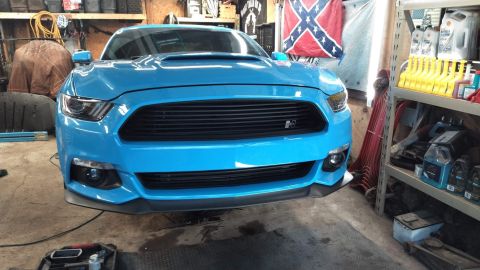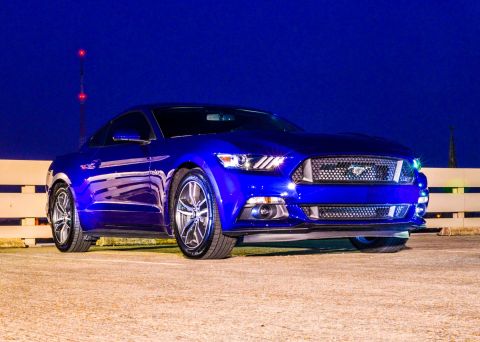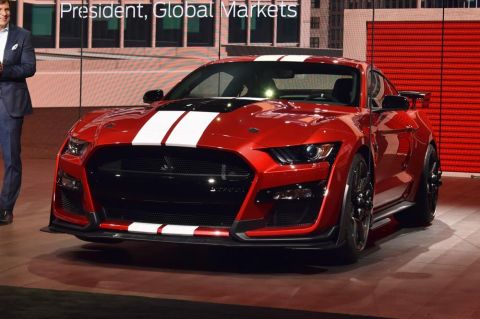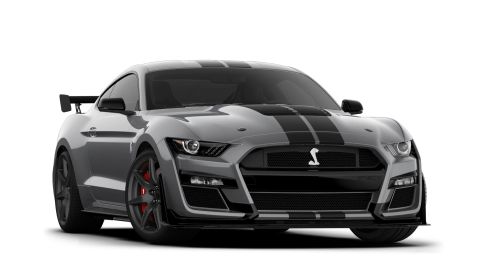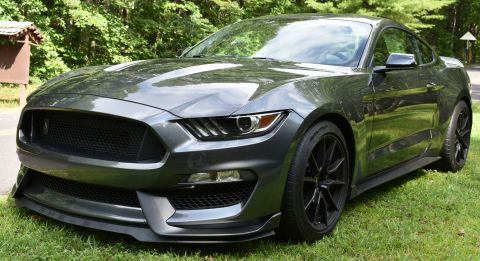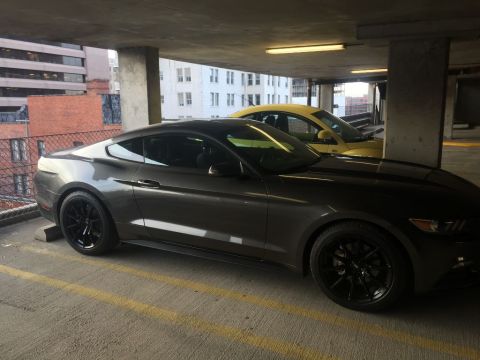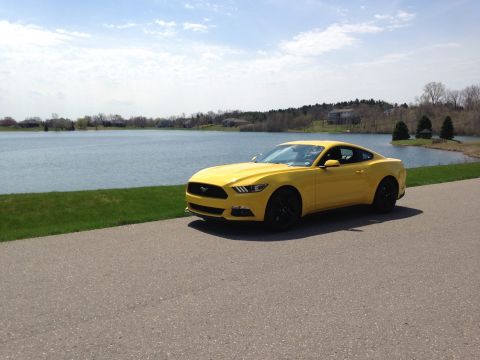
The sixth-generation Ford Mustang launched for 2015 on the S550 platform, the first Mustang to make an integral-link independent rear suspension standard across the entire range, retiring the solid live axle that every prior coupe had used. Ford also engineered the S550 as a global, right-hand-drive-capable product, sold in markets that had never received a factory Mustang. The 2015 lineup paired a carryover 3.7L Cyclone V6 with two distinct performance engines: a new 2.3L EcoBoost turbocharged inline-four rated at 310 hp and the 5.0L Coyote V8 rated at 435 hp. Body styles were the fastback coupe and the convertible; the hatchback did not return. Over the run Ford added the naturally aspirated 5.2L flat-plane-crank Shelby GT350 for 2016, a 2018 facelift that dropped the V6 and raised the V8 to 460 hp, the 2019 Bullitt at 480 hp, the supercharged 760 hp Shelby GT500 for 2020, and a revived Mach 1 for 2021. Production of the S550 ran through the 2023 model year.
Other Ford Mustang generations
At a glance
- Years: 2015-2023 (sixth generation, S550)
- Platform: Ford S550; the first Mustang with independent rear suspension standard across the whole line
- Body styles: fastback coupe and convertible
- Engines: 2.3L EcoBoost turbo inline-four, 3.7L V6 (2015-2017), 5.0L "Coyote" V8, naturally aspirated 5.2L "Voodoo" flat-plane V8 (GT350), supercharged 5.2L "Predator" V8 (GT500)
- Performance models: GT, Shelby GT350 and GT350R (2016-2020), Bullitt (2019-2020), Shelby GT500 (2020-2022), Mach 1 (2021-2023)
- Transmissions: 6-speed manual; 10-speed automatic from 2018
- Horsepower basis: SAE net
Year-by-year changes
| Year | Key changes and specifications |
|---|---|
| 2015 | The 2015 Mustang introduced the S550 platform with standard integral-link independent rear suspension. Engines: 3.7L (227 cu in) Cyclone V6 at 300 hp, the new 2.3L (140 cu in) EcoBoost turbocharged I4 at 310 hp, and the 5.0L (302 cu in) Coyote V8 at 435 hp. Fastback and convertible only. A 50 Years Limited Edition marked the model's 50th anniversary. |
| 2016 | The 2016 Mustang added the Shelby GT350 with the naturally aspirated 5.2L (315 cu in) Voodoo flat-plane-crank V8 rated 526 hp with an 8250 rpm redline, fitted only with a 6-speed manual. The 2016 GT350R added carbon-fiber wheels and deleted rear seats and air conditioning for track use. |
| 2017 | The 2017 Mustang carried the lineup largely unchanged. The 5.0L Coyote V8 GT, 2.3L EcoBoost, and 3.7L V6 continued, with the Shelby GT350 and GT350R in their second year on the 5.2L Voodoo V8. |
| 2018 | The 2018 Mustang received a facelift with revised front and rear styling. The 3.7L V6 was dropped, leaving the 2.3L EcoBoost and the 5.0L Coyote V8, which rose to 460 hp and 420 lb-ft with direct plus port injection. A 10-speed automatic replaced the prior 6-speed automatic. |
| 2019 | The 2019 Mustang revived the Bullitt, a dark-green 5.0L V8 model rated 480 hp with a white cue-ball shifter and no GT badging. The Shelby GT350 continued on the 5.2L Voodoo V8. |
| 2020 | The 2020 Mustang added the Shelby GT500 with a supercharged 5.2L (315 cu in) Predator cross-plane-crank V8 rated 760 hp and 625 lb-ft, paired exclusively with a 7-speed dual-clutch transmission. The 2020 Bullitt continued at 480 hp. The 2.3L EcoBoost gained an available High Performance Package. |
| 2021 | The 2021 Mustang revived the Mach 1, a track-focused 5.0L V8 model rated 480 hp that drew driveline and cooling parts from the Shelby GT350 and GT500. The Shelby GT500 continued at 760 hp. |
| 2022 | The 2022 Mustang carried the GT (now 450 hp), EcoBoost, Mach 1 (now 470 hp), and GT500 (760 hp), the final year for the supercharged Shelby GT500, offered with a GT500 Heritage Edition package. The Shelby GT350 was discontinued after 2020, leaving the Mach 1 as the top naturally aspirated S550. |
| 2023 | The 2023 Mustang was the final S550 model year, offered with the 2.3L EcoBoost, the 5.0L Coyote V8 GT (450 hp), and the Mach 1 (470 hp), along with appearance and special-edition packages. The Shelby GT500 was not offered for 2023; it had ended after the 2022 model year. The S650 seventh generation arrived for 2024. |
The S550 platform and standard independent rear suspension
The sixth-generation Mustang moved to the S550 platform for 2015 and made an integral-link independent rear suspension standard on every model, the first time in Mustang history that the entire line abandoned the solid live rear axle. Earlier Mustangs had offered independent rear suspension only on select high-end variants, such as the 1999 and 2003-2004 SVT Cobra. The S550 used MacPherson struts in front with a perimeter subframe and the multi-link rear, improving ride compliance and grip at the limit. Ford engineered the S550 as a global product capable of factory right-hand-drive assembly, which let the Mustang reach markets in the United Kingdom, Australia, and elsewhere that had never received a factory-built car.
The 2015 engine range: EcoBoost, V6, and Coyote V8
The 2015 Mustang launched with three engines. The base 3.7L (227 cu in) Cyclone V6 carried over from the prior generation and was rated 300 hp. The newcomer was the 2.3L (140 cu in) EcoBoost inline-four, a turbocharged direct-injection engine rated 310 hp and 320 lb-ft, the first turbocharged four in a Mustang since the Fox-body 2.3L turbo era. The 5.0L (302 cu in) Coyote V8 in the GT was rated 435 hp and 400 lb-ft. A Getrag-sourced 6-speed manual was standard and a 6-speed automatic was optional. Ford built a 50 Years Limited Edition for 2015 to mark the half-century since the Mustang's April 1964 debut, finished in Wimbledon White or Kona Blue with chrome trim.
The 2016 Shelby GT350 and the Voodoo flat-plane V8
The 2016 Shelby GT350 introduced the 5.2L (315 cu in) Voodoo V8, a naturally aspirated engine with a flat-plane crankshaft, an unusual layout for a large-displacement American V8 that gives the engine an even firing order between banks and a high-revving character closer to a European exotic. The 2016 GT350 Voodoo was rated 526 hp and 429 lb-ft with an 8250 rpm redline, and it came only with a 6-speed manual. The 2016 GT350R was the track variant, adding carbon-fiber wheels, a large rear wing, and deleted rear seats and air conditioning. The GT350 and GT350R continued through 2020 before the model was discontinued.
The 2018 facelift, the 460 hp Coyote, and the 10-speed automatic
The 2018 Mustang received a styling refresh and a powertrain overhaul. Ford dropped the 3.7L V6, leaving the 2.3L EcoBoost and the 5.0L V8 as the engine choices on the standard line. The 2018 5.0L Coyote V8 gained a dual fuel system combining direct and port injection and rose to 460 hp and 420 lb-ft. A 10-speed automatic, co-developed with General Motors, replaced the previous 6-speed automatic across the range. The 2018 facelift also added a 12-inch all-digital instrument cluster as an option.
The Bullitt, the GT500 Predator, and the revived Mach 1
The 2019 Bullitt returned the heritage name with a Dark Highland Green 5.0L V8 rated 480 hp, a white cue-ball shifter knob, and minimal exterior badging, echoing the 1968 film car. The 2020 Shelby GT500 used a supercharged 5.2L (315 cu in) Predator V8, which unlike the GT350's Voodoo used a conventional cross-plane crankshaft for low-end torque, rated 760 hp and 625 lb-ft and paired only with a 7-speed Tremec dual-clutch transmission, making it the most powerful factory Mustang to that point. The 2021 Mach 1 revived another heritage name as a 5.0L V8 track model rated 480 hp that borrowed cooling and driveline components from the GT350 and GT500, slotting between the GT and the Shelby cars. The S550 generation ran through 2023, the final year before the S650 seventh generation arrived for 2024.
Frequently asked questions
What made the 2015 Mustang's suspension different from earlier Mustangs?
The 2015 Mustang was the first to make an integral-link independent rear suspension standard across the entire line on the new S550 platform. Every prior generation used a solid live rear axle on its mainstream models, offering independent rear suspension only on limited variants such as the 1999 and 2003-2004 SVT Cobra. The change improved both ride quality and grip at the limit.
How does the 2016 Shelby GT350's Voodoo engine differ from the 2020 GT500's Predator?
The 2016 Shelby GT350 used the 5.2L Voodoo V8, naturally aspirated with a flat-plane crankshaft, rated 526 hp with an 8250 rpm redline. The 2020 Shelby GT500 used a 5.2L Predator V8 of the same displacement but with a cross-plane crankshaft and an Eaton supercharger, rated 760 hp and tuned for low-end torque rather than high-rpm response.
Why did the 2018 Mustang drop the V6?
The 2018 Mustang dropped the 3.7L Cyclone V6 because the 2.3L EcoBoost turbocharged inline-four had matched or exceeded its output while delivering better fuel economy, making the V6 redundant. After 2018 the standard line offered the 2.3L EcoBoost and the 5.0L Coyote V8, which rose to 460 hp that year.
What was the 2021 Mach 1's place in the S550 lineup?
The 2021 Mach 1 was a track-focused 5.0L Coyote V8 model rated 480 hp that slotted above the GT and below the Shelby cars. It borrowed cooling, driveline, and chassis components from the Shelby GT350 and GT500, and it became the top naturally aspirated S550 after the GT350 was discontinued following 2020.
How powerful was the most powerful sixth-generation Mustang?
The 2020 Shelby GT500 was the most powerful factory Mustang of the S550 generation, with a supercharged 5.2L Predator V8 rated 760 hp and 625 lb-ft. It was paired exclusively with a 7-speed Tremec dual-clutch transmission and continued in the lineup through 2022.
Sources
- Ford factory press materials and model-year specifications for the 2015-2023 Mustang.
- Ford SVT and Ford Performance documentation for the Shelby GT350, GT350R, GT500, Bullitt, and Mach 1.
- Period road tests and engine technical write-ups covering the Voodoo and Predator 5.2L V8 families.
- Mustang enthusiast and marque-history references for platform, suspension, and trim details.
Asked all the time
What made the 2015 Mustang's suspension different from earlier Mustangs?
The 2015 Mustang was the first to make an integral-link independent rear suspension standard across the entire line on the new S550 platform. Every prior generation used a solid live rear axle on its mainstream models, offering independent rear suspension only on limited variants such as the 1999 and 2003-2004 SVT Cobra. The change improved both ride quality and grip at the limit.
How does the 2016 Shelby GT350's Voodoo engine differ from the 2020 GT500's Predator?
The 2016 Shelby GT350 used the 5.2L Voodoo V8, naturally aspirated with a flat-plane crankshaft, rated 526 hp with an 8250 rpm redline. The 2020 Shelby GT500 used a 5.2L Predator V8 of the same displacement but with a cross-plane crankshaft and an Eaton supercharger, rated 760 hp and tuned for low-end torque rather than high-rpm response.
Why did the 2018 Mustang drop the V6?
The 2018 Mustang dropped the 3.7L Cyclone V6 because the 2.3L EcoBoost turbocharged inline-four had matched or exceeded its output while delivering better fuel economy, making the V6 redundant. After 2018 the standard line offered the 2.3L EcoBoost and the 5.0L Coyote V8, which rose to 460 hp that year.
What was the 2021 Mach 1's place in the S550 lineup?
The 2021 Mach 1 was a track-focused 5.0L Coyote V8 model rated 480 hp that slotted above the GT and below the Shelby cars. It borrowed cooling, driveline, and chassis components from the Shelby GT350 and GT500, and it became the top naturally aspirated S550 after the GT350 was discontinued following 2020.
How powerful was the most powerful sixth-generation Mustang?
The 2020 Shelby GT500 was the most powerful factory Mustang of the S550 generation, with a supercharged 5.2L Predator V8 rated 760 hp and 625 lb-ft. It was paired exclusively with a 7-speed Tremec dual-clutch transmission and continued in the lineup through 2022.
Technical Reference
Member-uploaded diagrams & documents for this generation. AI-classified; community-verified where badged.
Brochures & Literature (1)
The wall · registered 2015-2023 Mustangs
Sorted by depth of documentation. Click any vehicle to open its permanent record.