Oil Catch Can & Check Valve Routing Diagram - PCV Dirty Gas Flow Sketch
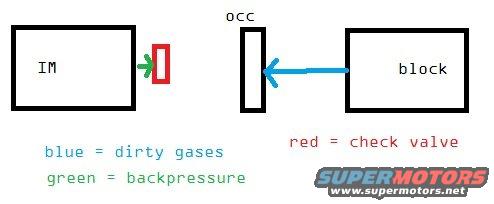
PCV/crankcase ventilation routing diagram showing dirty-gas and backpressure flow between block, oil catch can, and intake manifold.
Part of 2004-2009 Mazda 3 Vacuum Routing Diagrams
This is a simple hand-drawn diagram (created in a basic paint program) illustrating a PCV/crankcase ventilation routing concept with an oil catch can (OCC) and check valves. The diagram shows three boxes: 'IM' (intake manifold) on the left, 'occ' (oil catch can) in the middle, and 'block' (engine block) on the right. A blue arrow, labeled 'dirty gases,' flows from the block into the catch can, representing crankcase vapors traveling from the engine block to the OCC. A green arrow, labeled 'backpressure,' points from the IM toward a red rectangle placed between the IM and the catch can. The color legend states: blue = dirty gases, green = backpressure, red = check valve. The red check valve symbols are positioned at the catch can inlet/outlet, indicating the placement of one-way valves to prevent intake manifold backpressure (boost or reversion) from flowing backward into the catch can and crankcase while still allowing dirty crankcase gases to be drawn out. The document is undated and does not name a specific vehicle, engine, or part numbers; it appears to be a conceptual companion sketch to another catch-can setup document in the same album.
Is this accurate? Sign in to help verify it.
Frequently asked questions
- What does the blue line in this diagram represent?
- Blue represents 'dirty gases', the flow from the engine block toward the oil catch can (occ).
- What do the red rectangles indicate?
- Per the legend, red = check valve. Red check valves are drawn at the connection near the intake manifold (IM) and at the catch can.
- What does the green arrow mean?
- Green = backpressure, shown coming from the intake manifold (IM) side toward the check valve.
- What direction do the crankcase gases flow in this setup?
- The blue 'dirty gases' arrow flows from the block into the occ (oil catch can), heading toward the IM (intake manifold).
Comments
More from this build


No comments yet.