Home/
Registry/
Mazda/
MX-3/
1992-1996/
“AKA Eunos Presso”/
Photo
supermotors.net/registry/media/890046
Mazda Miller Cycle Engine Diagram - Lysholm Compressor Operation (French)
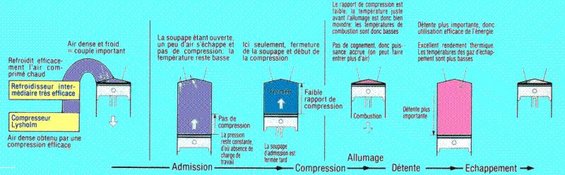
Schematic illustrating intercooler operation and four-stroke cycle phases (Admission, Compression, Allumage, Detente, Echappement) in French.
Part of 1992-1996 Mazda MX-3 Schematics
This is a French-language technical schematic explaining the operation of the Miller-cycle engine with a Lysholm compressor (supercharger). The diagram illustrates the engine cycle across five stages: Admission (intake), Compression, Allumage (ignition), Détente (expansion/power stroke), and Échappement (exhaust). Key concepts explained include: the Lysholm compressor produces dense air through efficient compression, and a highly effective intercooler cools the hot compressed air, yielding dense cold air for greater torque. During intake, the intake valve stays open late, so some air escapes and no compression occurs, keeping temperatures low; compression only begins once the valve closes, resulting in a low effective compression ratio. Because the temperature just before ignition is lower, combustion temperatures are also low, preventing knock (cognement) and allowing more air to be admitted for increased power. The expansion stroke is longer than the compression stroke, making efficient use of energy, giving excellent thermal efficiency and lower exhaust gas temperatures. Piston diagrams with annotations accompany each stage. The document appears to be part of a multi-page set explaining Miller-cycle technology (as used by Mazda), though it does not itself name a specific vehicle, year, or engine.
Is this accurate? Sign in to help verify it.
Frequently asked questions
- What does this diagram explain?
- It explains the stages of a Miller-cycle engine with a Lysholm compressor: admission (intake), compression, allumage (ignition), détente (expansion), and échappement (exhaust), in French.
- Why does the temperature stay low during intake in the Miller cycle?
- Because the intake valve remains open, some air escapes and there is no compression, so the temperature stays low ('La soupape étant ouverte, un peu d'air s'échappe et pas de compression: la température reste basse').
- How does the Miller cycle prevent engine knock?
- The compression ratio is low, so the temperature just before ignition is much lower and combustion temperatures are low, resulting in no knocking ('Pas de cognement'), which allows more air to be admitted and increases power.
- What role does the intercooler play in this system?
- The very efficient intermediate cooler ('Refroidisseur intermédiaire très efficace') effectively cools the hot compressed air from the Lysholm compressor, producing dense, cold air which yields significant torque.
- Why does the Miller cycle achieve good thermal efficiency?
- The expansion (détente) is longer/more important, allowing efficient use of energy, giving excellent thermal efficiency and lower exhaust gas temperatures.
Comments
More from this build
No comments yet.