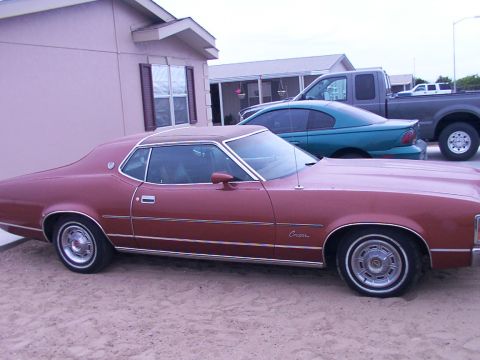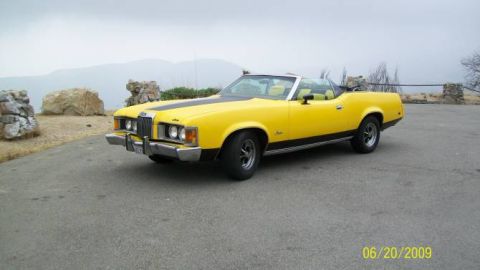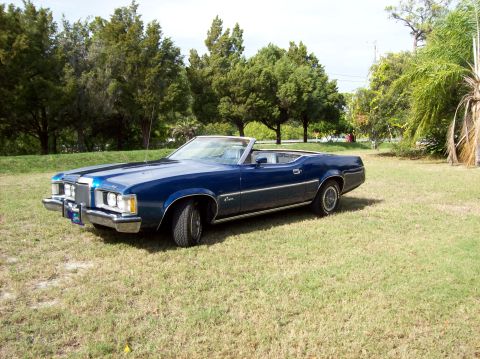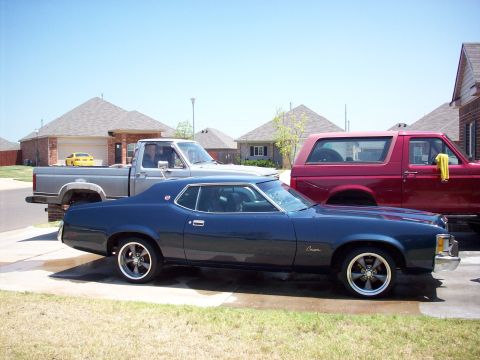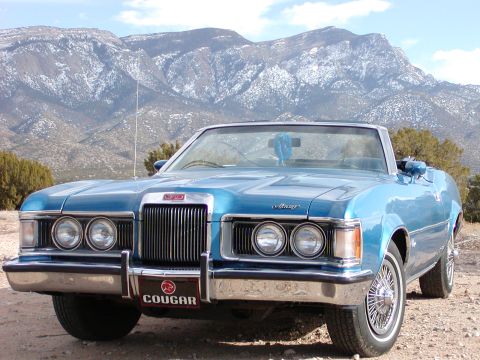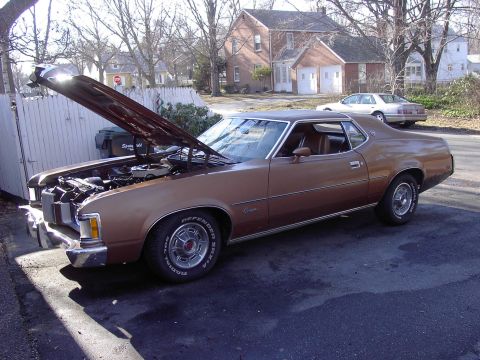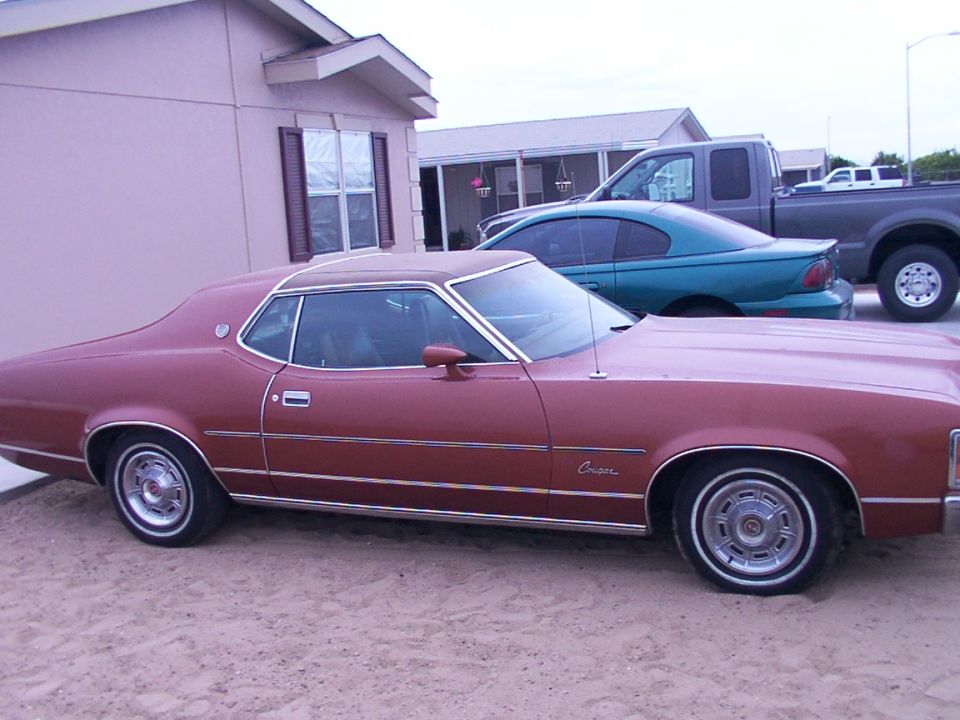
The second-generation Mercury Cougar (1971-1973) grew onto a 112.1 inch wheelbase, about three inches longer than the 1971-1973 Mustang it still shared its platform with, and roughly an inch longer than the 111 inch first-generation car. Every engine was a V8, with 351 cubic inch Cleveland variants standard across the line and the 429 Cobra Jet offered for 1971 only. Base and XR-7 trims came as a two-door hardtop or a convertible, and the 1973 convertible was the last one the Cougar ever offered. Over these three years the car moved away from pony car duty and toward the personal-luxury role the 1974 Cougar would take on full time.
Other Mercury Cougar generations
Platform and body
The 1971-1973 Mercury Cougar shared its unibody structure with the 1971-1973 Mustang but rode a 112.1 inch wheelbase, longer than the Mustang's 109 inches and about an inch up on the 111 inch 1967-1970 Cougar. Front track grew from 58.1 to 61.5 inches, partly to clear the 385-series 429 big block. Overall length ran to 196.7 inches at launch and grew about three inches for 1973 with the federally mandated 5 mph front bumper. Two body styles were offered all three years: a two-door hardtop and a convertible. The 1973 convertible was the last open Cougar, period; the nameplate never offered a factory convertible again, and the final 1973 XR-7 convertible was the last convertible Ford Motor Company assembled until the Mustang convertible returned for 1983.
Engine lineup
There were no six-cylinder second-generation Cougars. Everything ran a V8, and the 351 Cleveland family did most of the work.
- 351 2V: the standard engine all three years. Rated 240 hp gross in 1971; after the industry switch to SAE net ratings it carried figures in the low 160s net for 1972 and was retuned to 168 net for 1973.
- 351 4V: optional in 1971 at 285 hp gross. For 1972 a milder non-CJ 351 4V was also cataloged at 262 hp net, sold only with an automatic and quiet exhaust.
- 351 Cobra Jet (4V, Q-code): the top 351 for 1972 and 1973, rated 266 hp net in 1972. It used a 4-bolt-main block, open-chamber 4V heads, and a spread-bore carburetor.
- 429 Cobra Jet: 1971 only, 370 hp gross, offered with Ram Air (J-code) or without (C-code). When the 429 left after 1971, the 351 CJ became the strongest engine a Cougar buyer could order.
Compression dropped across the board for 1972 as Ford detuned for low-lead fuel, so a 1971 4V car and a 1972 4V car with the same displacement are meaningfully different engines under the valve covers.
Drivetrain and transmissions
All 1971-1973 Cougars were front-engine, rear-drive, with a live rear axle on leaf springs (Ford 9 inch behind the stronger engines). For 1971-1972 a 3-speed manual was standard with the base 351 2V; the 3-speed was dropped for 1973 and an automatic became standard. A 4-speed manual was available with the performance engines, and for 1973 only with the 351 CJ. Most cars left the line with an automatic: the FMX was standard behind the 351 2V (C6 optional), while the 4V engines, the 351 CJ, and the 429 CJ took the heavy-duty C6. Power front disc brakes became standard for 1973. Optional axle ratios and a Traction-Lok limited-slip differential were on the order sheet.
Year by year
- 1971: Full redesign on the longer wheelbase. Hidden headlights are gone; the new nose carries exposed quad headlamps flanking a vertical-bar grille. This is the only year for the 429 Cobra Jet, and the only year horsepower is quoted in gross figures.
- 1972: The 429 is dropped and the 351 CJ takes over as the top engine. Ratings switch to SAE net and compression falls. Styling changes are minor; the grille pattern is revised.
- 1973: New impact-absorbing front bumper adds about three inches of length plus weight, with a revised grille to suit. The 3-speed manual is gone and an automatic is standard. Last year for the Cougar convertible, and the last Mustang-based Cougar. The 1974 car moved to the intermediate Torino/Montego platform.
Trims and variants
The lineup was simple: base Cougar and Cougar XR-7, each as hardtop or convertible. The XR-7 carried the upgraded interior (leather-faced seating surfaces, full instrumentation with a tachometer, unique trim) and a half-vinyl roof on hardtops. A GT package was offered on 1971-1972 base hardtops with a competition suspension and performance dress-up items; it did not return for 1973. The Eliminator did not return either; it ended with the 1970 model year. Options like styled wheels and Ram Air (1971) let buyers push a car in either the sporty or the luxury direction.
Asked all the time
What engines came in the 1971-1973 Mercury Cougar?
Every 1971-1973 Mercury Cougar has a V8. The 351 Cleveland 2V was standard all three years (240 hp gross in 1971, low 160s net in 1972, 168 net in 1973). A 351 4V was optional in 1971 at 285 hp gross, and the 351 Cobra Jet was the top engine for 1972-1973 at 266 hp net in 1972. The 429 Cobra Jet, rated 370 hp gross, was offered in 1971 only.
Which year of the second-generation Cougar is the most desirable?
For performance, 1971 is the year to seek: it is the only second-generation Cougar year with the 429 Cobra Jet and the only year with higher-compression gross-rated engines. For open-air cars, the 1973 Cougar convertible matters because it was the last convertible the Cougar ever offered, and the final one was the last convertible Ford built until the 1983 Mustang. A 1972-1973 with the 351 Cobra Jet and 4-speed is the strongest of the later cars.
Was the 1971-1973 Mercury Cougar still based on the Mustang?
Yes. The 1971-1973 Cougar shares its platform with the 1971-1973 Mustang but uses a stretched 112.1 inch wheelbase versus the Mustang's 109 inches. It was the last Mustang-based Cougar; the 1974 model moved to the larger Torino/Montego intermediate platform.
What transmissions were available in the 1971-1973 Cougar?
For 1971-1972 the Mercury Cougar came standard with a 3-speed manual behind the base 351 2V; for 1973 the 3-speed was dropped and an automatic became standard. A 4-speed manual was available with the performance engines (351 CJ only in 1973). Automatics were the common choice: the FMX standard behind the 351 2V, with the heavy-duty C6 behind the 351 4V, the 351 Cobra Jet, and the 1971 429 Cobra Jet.
What changed between 1971 and 1972 on the Cougar?
For 1972 the Mercury Cougar lost the 429 Cobra Jet, leaving the 351 Cobra Jet as the top engine. Compression ratios dropped for low-lead fuel and horsepower switched from gross to SAE net ratings, which is why 1972 numbers look much lower on paper than 1971 numbers for similar engines. Styling changes were limited to grille and trim details.
Did the 1971-1973 Cougar offer an Eliminator model?
No. The Cougar Eliminator ended with the 1970 model year. For 1971-1973 the lineup was base and XR-7, each as hardtop or convertible, with a GT handling and appearance package available on 1971-1972 base hardtops.
Technical Reference
Member-uploaded diagrams & documents for this generation. AI-classified; community-verified where badged.
Data/Spec Plates (10)
- 1973 Cougar Convertible report with door tag 3F92H575077, build dates from order 05/07/73 to sold 06/25/73, and 896 built with the white power top.
- Door data plate information for 3F92H575077: built June 1973 at Dearborn, 351-2V, Bright Yellow 6E, C3 White Clarion Knit bucket seats, St. Louis DSO 42.
- Complete 1973 Cougar Convertible report page with the door data plate decode, important dates, production statistics and ordered options.
- Door data plate decode for 3F92H575077: 1973, Dearborn, 351-2V, 76D Cougar Convertible, 6E Bright Yellow, C3 trim, 2.75 axle, C-6 auto, DSO 42.
- 1973 Cougar Convertible report: door tag 3F92H575077, 76D 6E C3 U 2 42, dated 06/73, with build dates from 05/07/73 and production counts.
- Out-of-focus Ford certification label showing date, GAWR, the federal safety standards compliance statement, VIN line and passenger vehicle code row.
- Dealer 42A226, Ben Lindenbusch Linc-Merc, St Louis MO, with ordered options: white power top, C-6 automatic, E78X14 belted tires, power steering and A/C.
- Blurry photo of a Ford Motor Co. U.S.A. certification label with build date, front and rear GAWR, the FMVSS compliance statement and passenger vehicle codes.
- Full deluxe report for a 1973 Cougar Convertible showing the door data plate decode, important build dates, production statistics and ordered options.
- Out-of-focus section of a 1973 Cougar report showing the door data plate decode, dealer order details and ordered options.
The wall · registered 1971-1973 Cougars
Sorted by depth of documentation. Click any vehicle to open its permanent record.