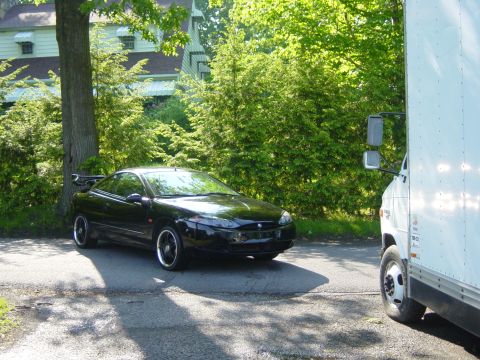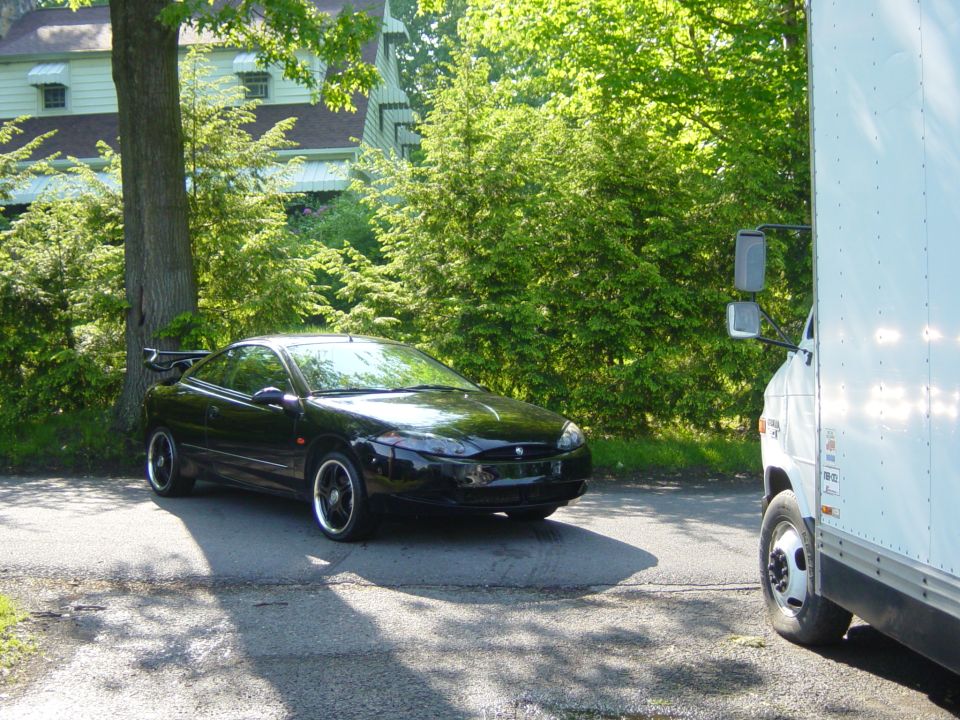
The eighth-generation Mercury Cougar (1999-2002) broke with three decades of rear-drive tradition and arrived as a front-wheel-drive, three-door hatchback coupe built on Ford's CDW27 platform, the same bones under the Contour and Mystique sedans. Two engines were offered: a 2.0 liter Zetec four rated at 125 horsepower and a 2.5 liter Duratec V6 rated at 170 horsepower. Nearly every four-cylinder car carries the MTX-75 5-speed manual; the V6 offered the manual or a CD4E 4-speed automatic. It was one of the first production cars styled in Ford's New Edge design language. The last Cougar was built in August 2002, and the nameplate died with it.
Other Mercury Cougar generations
Platform and body
The 1999-2002 Mercury Cougar sits on the CDW27 platform shared with the Ford Contour and Mercury Mystique. That means MacPherson struts up front, a fully independent multilink rear, and front-wheel drive, a first for a Cougar. The only body style is a 3-door hatchback coupe with a small rear seat and a usable cargo area under the glass hatch. Assembly was at Flat Rock, Michigan, alongside the Mazda 626. In Europe the same car sold as the Ford Cougar, badged Ford because Mercury had no presence there.
Engine lineup
- 2.0L Zetec inline four, DOHC 16-valve, rated at 125 horsepower and 130 lb-ft of torque. The base engine, and fairly rare; most buyers stepped up to the V6.
- 2.5L Duratec V6, DOHC 24-valve, rated at 170 horsepower at 6,250 rpm and 165 lb-ft at 4,250 rpm. This is the engine most eighth-gen Cougars carry, and the one worth seeking. It shares its architecture with the SVT Contour's 2.5, so intake and exhaust upgrades from that car are a common swap.
Drivetrain and transmissions
All eighth-generation Cougars are front-wheel drive. The MTX-75 5-speed manual came with both engines. The CD4E 4-speed automatic was the option on the 2.5 V6; four-cylinder automatics are a genuine oddity, with roughly 500 reportedly built, and some period references list the four as manual-only. The MTX-75 is the stronger and better-liked of the two; the CD4E has a reputation among owners for shorter service life, so a documented fluid-service history matters when shopping an automatic car.
Year-by-year
- 1999: Launch year, on sale in spring 1998 as an early 1999 model after a two-year gap in Cougar production. Four-cylinder and V6 versions from the start.
- 2000: Largely carryover. Changes were small items like a trunk emergency release.
- 2001: Mid-cycle refresh with a new front fascia, grille, and headlights, plus a new steering wheel and revised instrument faces inside. An in-dash 6-disc CD changer joined the options list. The C2 and Zn appearance packages arrived this year.
- 2002: Final year. The lineup was reorganized into Sport, Sport Premium, and Sport Ultimate trims, the XR package was offered, and a 35th Anniversary Edition was added midyear. The last Cougar was built at Flat Rock on August 30, 2002.
Trims and variants
Trim structure started simple: the four-cylinder base car and the V6, with a Sport Group on V6 cars adding 16-inch alloy wheels, four-wheel disc brakes, fog lights, a rear spoiler, and a rear wiper. Later years leaned on appearance packages. The Zn wore Zinc Yellow paint with a hood scoop and spoiler. The C2 (2001-2002) came in French Blue, Silver Frost, or Vibrant White with blue interior accents. The 2002 XR came in Black or XR Racing Red with black and red seats and 17-inch wheels, and the midyear 2002 35th Anniversary Edition, tied to the nameplate's 1967 debut, offered Laser Red, French Blue, Satin Silver, or Black with 17-inch machined wheels and leather seats with silver inserts. There was never a factory high-performance version; the Cougar S concept, shown in 1999 with all-wheel drive and an SVT Contour-derived 2.5 making about 215 horsepower, never reached production.
Asked all the time
What engines came in the 1999-2002 Mercury Cougar?
The eighth-generation Mercury Cougar (1999-2002) offered two engines: a 2.0 liter Zetec DOHC four rated at 125 horsepower and a 2.5 liter Duratec DOHC V6 rated at 170 horsepower. The MTX-75 5-speed manual came with both engines, the CD4E 4-speed automatic mainly with the V6, and all cars are front-wheel drive.
Is the 1999-2002 Cougar front-wheel drive?
Yes. The 1999-2002 Mercury Cougar is front-wheel drive, built on the CDW27 platform shared with the Ford Contour and Mercury Mystique. It was the first front-drive Cougar; every earlier generation was rear-wheel drive.
Which years of the eighth-gen Cougar should I look for?
Most buyers of a 1999-2002 Mercury Cougar want the 2.5 Duratec V6 with the MTX-75 5-speed manual. The 2001-2002 cars carry the refreshed front fascia and later trim, and 2002 adds the XR and 35th Anniversary packages. On automatic cars, check the CD4E transmission's service history closely.
What changed on the Cougar in 2001?
For 2001 the Mercury Cougar got a mid-cycle refresh with a new front fascia, grille, and headlights, plus a new steering wheel and revised gauges inside. The C2 and Zn appearance packages also arrived. Powertrains were unchanged: the 125 hp 2.0 Zetec four and 170 hp 2.5 Duratec V6 carried through to the end.
When did Mercury stop making the Cougar?
The last eighth-generation Mercury Cougar was built at Flat Rock, Michigan on August 30, 2002. The 2002 model year, which included the XR package and a midyear 35th Anniversary Edition, was the last for the Cougar nameplate.
Was there a fast version of the 1999-2002 Cougar?
No factory high-performance version of the 1999-2002 Mercury Cougar was built. The Cougar S concept, shown in 1999 with all-wheel drive and an SVT Contour-derived 2.5 V6 making about 215 horsepower, never reached production. The hottest factory setup is the 170 hp 2.5 Duratec V6 with the 5-speed manual, and many owners borrow intake and exhaust parts from the SVT Contour, which used a related 2.5 V6.
The wall · registered 1999-2002 Cougars
Sorted by depth of documentation. Click any vehicle to open its permanent record.