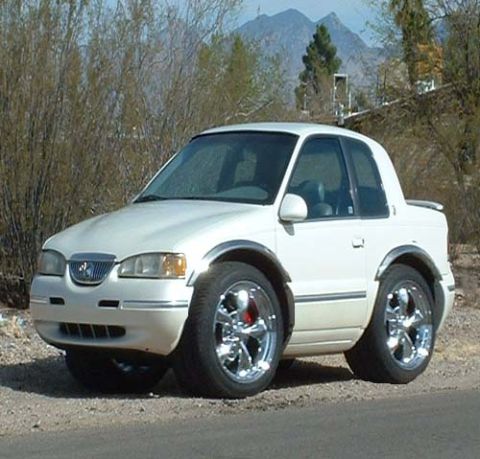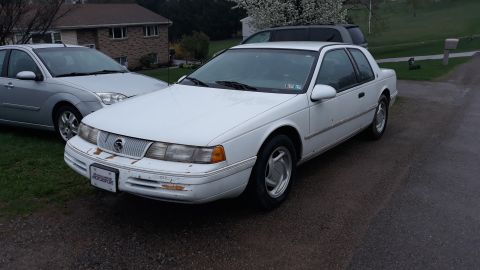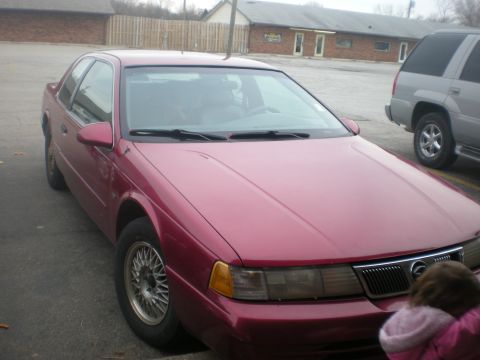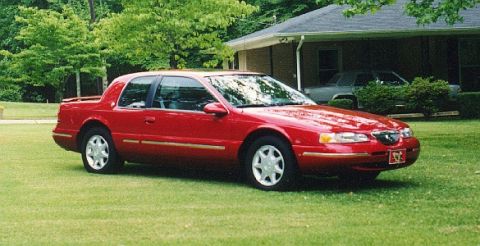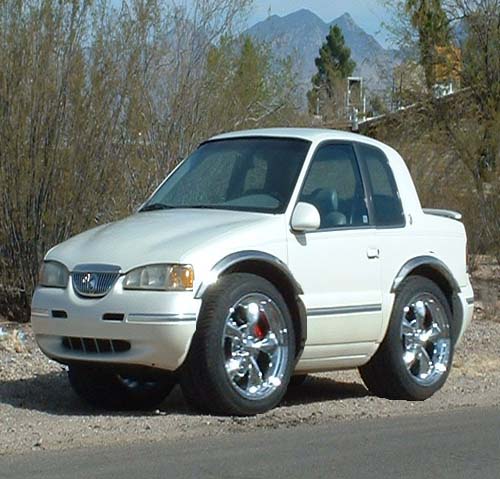
The seventh-generation Mercury Cougar (1989-1997) moved to Ford's MN12 platform, a rear-wheel-drive chassis with independent rear suspension shared with the Thunderbird. It launched with a 140 horsepower 3.8 liter V6, while the 1989-1990 XR7 carried a supercharged 3.8 rated at 210 horsepower. A 5.0 liter V8 was offered for 1991-1993, replaced by the 4.6 liter SOHC modular V8 in 1994. The last seventh-generation Cougar was built in late August 1997, and there was no 1998 model.
Other Mercury Cougar generations
Platform and Chassis
The 1989-1997 Mercury Cougar rides on the MN12 platform, developed alongside the tenth-generation Ford Thunderbird. The big news at launch was the independent rear suspension, a rarity in an American coupe at the time, with unequal-length control arms at all four corners. The car grew a 113.0 inch wheelbase, 9 inches longer than the outgoing Fox-body Cougar's 104.0, which helps ride quality but adds weight. Curb weights run in the 3,500 to 3,800 pound range depending on engine and equipment, and that mass is the first thing owners notice when they start chasing performance.
Engine Lineup
- 3.8 liter Essex V6 (1989-1997): the base engine, rated at 140 horsepower and 215 lb-ft at launch, bumped to 145 horsepower for 1996. This is the same pushrod V6 family used across Ford's lineup, and on MN12 cars the head gaskets are the known weak point. Check service history before buying.
- Supercharged 3.8 liter V6 (1989-1990 XR7 only): an Eaton M90 supercharged and intercooled version rated at 210 horsepower and 315 lb-ft of torque. Cougar got it for only two model years, while the Thunderbird Super Coupe kept it. These are the rarest MN12 Cougars.
- 5.0 liter V8 (1991-1993): the pushrod small-block, rated at 200 horsepower and 275 lb-ft in this application. The MN12's low hoodline had kept the 5.0 out at launch, the first Cougar generation to open without a V8 option. When it arrived for 1991 it came standard on the XR7 and optional on the LS.
- 4.6 liter SOHC V8 (1994-1997): the modular V8 replaced the 5.0 for 1994, rated at 205 horsepower and 265 lb-ft, with torque rising to 280 lb-ft for 1996 thanks to a new upper intake manifold. Smoother and more modern than the pushrod engine, though the two-valve modular gives up some aftermarket simplicity to the old 5.0.
Drivetrain and Transmissions
Every seventh-generation Cougar is rear-wheel drive. The 1989-1990 supercharged XR7 came standard with a Mazda-built M5R2 five-speed manual, the only manual transmission offered in this generation, with the AOD four-speed automatic optional. All other Cougars used the AOD through 1993. For 1994 the automatic gained electronic shift control as the 4R70W, which served both the 3.8 V6 and the 4.6 V8 through 1997. Base V6 cars carry a 7.5 inch rear differential; supercharged and V8 cars got the stouter 8.8 inch unit with its wide parts availability.
Year-by-Year Changes
- 1989: full redesign on the MN12 platform. LS and XR7 trims, with the XR7 running the supercharged 3.8 plus adjustable sport suspension, four-wheel disc brakes with ABS, and analog gauges in place of the LS's digital cluster.
- 1991: 5.0 liter V8 arrives, standard on the XR7 and optional on the LS. The supercharged V6 and the five-speed manual are dropped, and the XR7 repositions as the V8 luxury and performance trim.
- 1992: 25th Anniversary edition marks a quarter century of the Cougar nameplate, a midyear appearance package with Tourmaline Green paint, BBS-style wheels, and special badging, offered with either engine. Roughly 4,800 were built.
- 1993: the lineup consolidates and every Cougar wears the XR7 badge from here on.
- 1994: 4.6 liter SOHC modular V8 replaces the 5.0. The interior is redesigned with a new dashboard and standard dual airbags, and the automatic becomes the electronically controlled 4R70W.
- 1996: exterior refresh with revised front and rear fascias and a new hood. The base V6 rises to 145 horsepower and the 4.6 picks up its 280 lb-ft torque rating.
- 1997: final year, marked with a 30th Anniversary package (special paint led by Dark Toreador Red, embroidered seats, unique aluminum wheels, and commemorative badging, a $495 option) and a revised gauge cluster. The last seventh-generation Cougar was built in late August 1997, days before the final MN12 Thunderbird rolled out on September 4. There was no 1998 Cougar; the nameplate returned in 1999 on an unrelated front-wheel-drive platform.
Trims and Variants
The lineup started with the LS as the volume model and the XR7 above it. For 1989-1990 the XR7 was the performance car, with the supercharged engine, adjustable sport suspension, four-wheel disc brakes with ABS, and analog gauges where the LS ran a digital cluster. From 1991 the XR7 badge moved toward luxury, paired with the V8, and from 1993 every Cougar was an XR7. The anniversary editions of 1992 and 1997 were appearance packages rather than mechanical upgrades. For a driver's car, the 1989-1990 supercharged XR7 with the five-speed is the one to hunt. For an easy keeper, a 1994-1997 car with the 4.6 avoids both the supercharged V6's complexity and the base 3.8's head gasket reputation.
Asked all the time
What engines came in the 1989-1997 Mercury Cougar?
The seventh-generation Mercury Cougar (1989-1997) offered four engines over its run: a base 3.8 liter V6 (140 hp at launch, 145 hp from 1996), a supercharged 3.8 liter V6 in the 1989-1990 XR7 (210 hp), a 5.0 liter V8 from 1991-1993 (200 hp), and a 4.6 liter SOHC V8 from 1994-1997 (205 hp).
Which years of the MN12 Mercury Cougar had a supercharger?
Only the 1989 and 1990 Mercury Cougar XR7 came with the Eaton-supercharged 3.8 liter V6, rated at 210 horsepower and 315 lb-ft of torque. From 1991 the XR7 switched to the 5.0 liter V8, so the supercharged cars are the rarest of the generation and the only ones offered with a five-speed manual.
When did the Mercury Cougar get the 4.6 V8?
The 4.6 liter SOHC modular V8, rated at 205 horsepower, replaced the 5.0 liter pushrod V8 in the Mercury Cougar for the 1994 model year and ran through the end of production in 1997. It pairs with the 4R70W four-speed automatic, and from 1996 its torque rating rose from 265 to 280 lb-ft.
Which seventh-generation Mercury Cougar should I buy?
For performance, look for a 1989-1990 Mercury Cougar XR7 with the supercharged 3.8 and the five-speed manual, the only manual offered in this generation. For a low-fuss driver, a 1994-1997 car with the 4.6 V8 avoids the base 3.8 V6's head gasket reputation and gets the more modern engine.
Why is there no 1998 Mercury Cougar?
Ford ended production of the MN12-platform Mercury Cougar after the 1997 model year, which was marked with a 30th Anniversary edition. The last seventh-generation Cougar was built in late August 1997, just ahead of the final MN12 Thunderbird on September 4. There was no 1998 Cougar; the nameplate returned for 1999 on an unrelated front-wheel-drive platform.
Does the 1989-1997 Mercury Cougar have independent rear suspension?
Yes. Every seventh-generation Mercury Cougar (1989-1997) uses the MN12 platform's independent rear suspension, a feature shared with the Ford Thunderbird of the same era and uncommon in American rear-wheel-drive coupes of the time.
Technical Reference
Member-uploaded diagrams & documents for this generation. AI-classified; community-verified where badged.
Wiring Diagrams (25)
- 2000 Mercury Cougar Cooling Fan Wiring Diagram - Low/High Relays & PCM ControlThis document is a Ford/Mercury cooling fan wiring diagram (filed as "2000_coolingfan") showing the electric engine cooling fan circuit. Power comes from two Battery Junction Box sources that are hot at all times…
- Ford/Mercury Cooling Fan Wiring Diagram - Low/High Relays, PCM, Circuit 361 RDThis document is a factory-style wiring diagram for an electric engine cooling fan system, filed as "2000_coolingfan" in a 1997 Mercury Cougar owner's gallery. It shows two battery junction box feeds that are hot at…
- Ford Fuse 2, 6 & 15 Power Distribution Wiring Diagram - Circuits 65, 296, 640This is a Ford EVTM-style power distribution wiring diagram showing three instrument panel fuses and the circuits they feed. Fuse 2 (30A) and fuse 6 (15A) are hot in ACC or RUN; fuse 15 (10A) is hot in START or RUN…
- Ford C251 Instrument Cluster Connector Pinout - 16-Pin Wiring DiagramThis document is a connector pinout diagram for connector C251 (Natural color), the instrument cluster connector, apparently from a Ford factory wiring/EVTM reference. The upper portion shows a drawing of the 16-pin…
- C250 Instrument Cluster Connector Pinout - 16-Pin Wiring Diagram & FunctionsThis document is a connector pinout diagram and table for connector C250 (natural color), which plugs into the instrument cluster. The upper portion shows a drawing of the 16-pin connector with each cavity numbered 1…
- Wiring diagram of the C185 (gray) Powertrain Control Module connector, gasoline, with the 104-pin face and circuit numbers and functions for pins 1-40.
- 1997 Mercury Cougar PATS Transceiver Module Wiring Diagram - Fuse 12, C209This document is a wiring diagram for the Passive Anti-Theft System (PATS) Transceiver Module. Power is supplied on a circuit that is hot in START or RUN, fed through fuse 12 (15A) in the Central Junction Box…
- Ford/Mercury Instrument Cluster Wiring Diagram 63-3: SCP, PATS, Brake WarningThis is page 63-3 of a Ford factory-style wiring diagram covering the Instrument Cluster circuit. It shows the solid-state instrument cluster and its connections: PATS transceiver module TX/RX signals (circuits 1215…
- Ford Thunderbird/Cougar, Ranger, Explorer IAT & ECT Sensor Connector PinoutThis document is a Ford EEC wiring/pinout diagram covering the Intake Air Temperature (IAT) sensor and Engine Coolant Temperature (ECT) sensor vehicle harness connectors. It applies to the Thunderbird/Cougar, Ranger…
- 1996 Ford/Mercury Cooling Fan Wiring Diagram - CCRM, EDF/HEDF Relays & PCMThis document is page 33-1 of a factory-style wiring diagram covering the engine cooling fan circuit. Power comes from a 60-amp fuse (position 5) in the Power Distribution Box (referenced to page 13-2), which is hot at…
- 1994 Ford Thunderbird & Mercury Cougar Body Connector Location Diagram (17/18)This document is page 17 of 18 from the Ford Thunderbird / Mercury Cougar full-body electrical component locator set (reference FPS-12116-94). It is a cutaway illustration of the rear half of the vehicle body overlaid…
- Ford Transmission Shift Solenoid SS1/SS2 Connector Pinout Diagram D14116-BThis wiring diagram (drawing number D14116-B) illustrates the shift solenoid (SS1 and SS2) circuits at the transmission connectors. The upper illustration shows the transmission vehicle harness connector face, mapping…
- Transmission Internal Harness Connector Pinout - SS1, SS2, SS VPWR WiringThis document is a wiring diagram illustration of a transmission internal harness connector. It shows a round multi-pin connector at the top with three labeled pins: SS1, SS VPWR, and SS2 (shift solenoid 1, shift…
- Ford C255 Electronic Instrument Cluster Connector Pinout & Wire ColorsThis document is a connector pinout reference for connector C255, the electronic instrument cluster connector. It includes a diagram of the 18-pin connector showing the physical arrangement of pins (1 and 18 at the top…
- Wiring diagram of the C254 electronic instrument cluster connector showing 20 pins with circuit numbers, wire colors and functions such as VSS and tach input.
- Wiring diagram of the C251 standard instrument cluster connector showing 14 pins, circuit numbers, wire colors and functions from hi beam to water temp sender.
- C250 Standard Instrument Cluster Connector Pinout - Wire Colors & FunctionsThis document is a connector pinout reference for connector C250, the standard instrument cluster connector. It includes a diagram of the 18-pin connector face showing pin orientation (pins 1/18 at top, 9/10 at bottom)…
- 1992 Ford Thunderbird / Mercury Cougar Full Body Connector Locations (3 of 3)This document is page 18 of 18 from the Ford Thunderbird/Mercury Cougar wiring/component location manual FPS 12116-92, titled 'Full Body View (3 of 3)'. It is a cutaway illustration of the rear half of the vehicle body…
- 1992 Ford Thunderbird / Mercury Cougar Connector Locations - Full Body View 2 of 3This document is a Ford factory-style component location illustration titled "Full Body View (2 of 3)" for the Ford Thunderbird / Mercury Cougar, identified as FPS 12116-92 (page 17 of 18), indicating 1992 model year…
- 1992 Thunderbird/Cougar Full Body Connector Location Diagram (1 of 3)This document is page 1 of a 3-page "Full Body View" electrical connector location diagram for the Ford Thunderbird / Mercury Cougar, identified as FPS 12116-92 (sheet 15 of 18), indicating 1992 model coverage. The…
- 3.8L engine (4 of 4) view for Thunderbird/Cougar, FPS 12116-92, showing C101 integral alternator regulator, C130 washer pump and headlamp connectors.
- 3.8L engine (3 of 4) view for Thunderbird/Cougar, FPS 12116-92, showing starter relay, C1016 oil pressure switch, shock actuators and G121/G139 ground buses.
- 3.8L engine (2 of 4) view for Thunderbird/Cougar, FPS 12116-92, showing C117 hydraulic pump motor relay, C188 brake fluid level switch and C1012/C1013 horns.
- 3.8L engine (1 of 4) component location view for Thunderbird/Cougar, FPS 12116-92, showing C160 TFI ignition module, C140 mass air flow sensor and injectors.
- Shift Solenoid Assembly Connector Diagram - SS1 & SS2 Terminal ID (Ford/Mercury)This document is a simple line-art connector diagram labeled "SHIFT SOLENOID ASSEMBLY CONNECTOR." It shows the physical layout of a transmission shift solenoid assembly connector, with two solenoid positions…
Manual Pages (5)
- PATS Configuration Command Index covering ignition key code erase, HEC and PCM parameter resets, spare key programming switch and B&A enable.
- Exhaust system specifications: dual mufflers with 3 catalyst system, two stainless Tri-Flow mufflers and 57.2 x 1.37 branch and intermediate pipes.
- Ford chart M2840-E of normal center register discharge temperatures and high/low refrigerant pressures vs ambient temperature for the A/C orifice tube system.
- Table of engine coolant and intake air temperature sensor values in °F and °C, with voltage from .27 to 3.51 V and resistance from 1.18 to 58.75 K ohms.
- Manual page with solenoid operation chart #701 listing SS-1, SS-2 and TCC ON/OFF, EC and HD states by selector lever position and PCM commanded gear.
Exploded Parts (4)
- 1997 Mercury Cougar Standard Front Brake Caliper Exploded Diagram - 15 Inch WheelThis document is an exploded parts diagram titled "Caliper -- 15 Inch Wheel," showing the disassembled components of a front disc brake caliper assembly for vehicles equipped with 15-inch wheels. The illustration uses…
- Ford/Mercury Sport Brake Caliper Exploded Diagram - 16 Inch Wheel (AH0285-A)This document is an exploded parts diagram titled "Caliper -- 16 Inch Wheel," showing the disassembled components of a front disc brake caliper assembly for a vehicle with 16-inch wheels. Numbered callouts 1 through…
- Thunderbird/Cougar Rear Parking Brake Cable & Caliper Retaining Clip DiagramThis document is an exploded-view parts diagram showing the attachment of the rear parking brake cable to the rear disc brake caliper. It identifies four components with Ford base part numbers: the caliper assembly…
- 1994 Thunderbird Cougar Body Wiring Connector Location Diagram (Rear)This document is page 18 of 18 from Ford's FPS-12116-94 wiring/connector location illustration set for the Thunderbird-Cougar platform. It shows an exploded/cutaway line drawing of the full vehicle body (rear…
Vacuum Routing (2)
- 4.6L Vacuum Distribution Diagram - EVR, IAC, EVAP Purge & Brake Booster RoutingThis document is page 140-1, titled "Vacuum Distribution," showing the vacuum routing diagram for a 4.6L engine. It depicts vacuum distribution blocks connected to the air intake and intake manifold fittings, with…
- Ford 3.8L & 3.8L Supercharged Vacuum Routing Diagram - Thunderbird/CougarThis document is a vacuum routing diagram for the Ford 3.8L and 3.8L Supercharged V6 engines, as used in Thunderbird/Cougar applications. It illustrates the vacuum hose layout from two vacuum distribution blocks and…
Service Procedures (2)
- Shift Solenoid Failure Always On - SS-1 & SS-2 Stuck ON Gear Chart (7G484)This service reference document describes automatic transmission shift solenoid failure in the "Always On" condition, caused by powertrain control module (PCM) and/or vehicle wiring concerns, or by shift solenoid (part…
- Shift Solenoid Always Off Failure Chart - SS1/SS2 Gear Diagnosis (Ford/Mercury)This service reference document describes automatic transmission behavior when a shift solenoid fails in the "Always Off" state, which can be caused by powertrain control module (PCM) faults, vehicle wiring concerns…
The wall · registered 1989-1997 Cougars
Sorted by depth of documentation. Click any vehicle to open its permanent record.