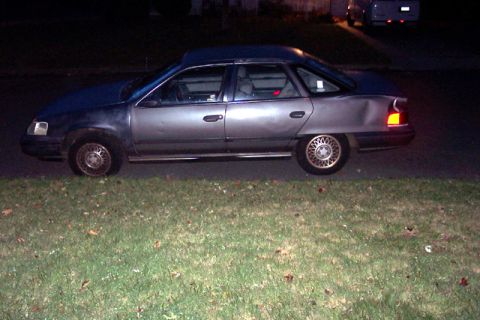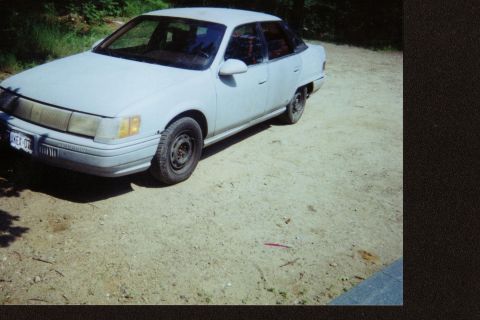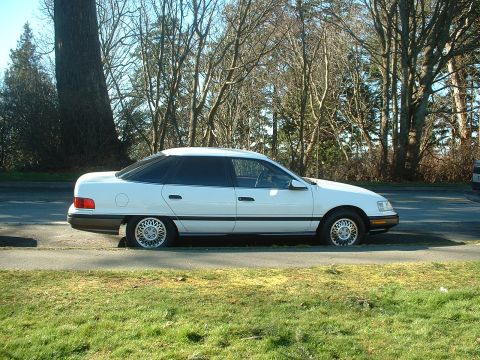
The first-generation Mercury Sable (1986-1991) was Mercury's version of the Ford Taurus, sold as a front-wheel-drive sedan and wagon in GS and LS trims. Most were built with the 140 hp 3.0L Vulcan V6, though 1986 launch cars could also be ordered with a 90 hp 2.5L four-cylinder that sold so poorly Mercury dropped it after one year. Its signature was the full-width front lightbar, an illuminated panel between the headlamps that made the car instantly recognizable at night.
Other Mercury Sable generations
Platform and body
The 1986-1991 Mercury Sable shares its front-wheel-drive unibody platform with the first-generation Ford Taurus. Two bodies were offered, a four-door sedan and a station wagon, both on the same 106 inch wheelbase. Suspension is fully independent: MacPherson struts up front, a strut-type rear with parallel links on sedans, and a coil-sprung double-wishbone rear on wagons to preserve load floor space. The Sable sedan runs 190.9 to 192.2 inches overall, about two inches longer than the Taurus, and shares only its doors and roof stamping with the Ford; everything forward and aft is Sable-specific sheetmetal.
The lightbar
The defining feature of the first-generation Sable is the front lightbar, a translucent illuminated panel running the full width of the nose between the flush composite headlamps. It is a low-wattage parking and marker lamp, not a headlight, and it stayed through the entire 1986-1991 run. Replacement lightbar assemblies are a common want-ad item for owners restoring these cars, since the plastic hazes and cracks with sun exposure.
Engines
- 2.5L HSC four-cylinder (1986 only): 90 hp, paired with a three-speed ATX automatic. It sold poorly against the V6 and was dropped from the Sable for 1987, which makes a surviving four-cylinder car a genuine oddity.
- 3.0L Vulcan V6 (1986-1991): pushrod, iron block and heads, rated at 140 hp at 4,800 rpm and 160 lb-ft of torque. This was the volume engine of the generation and the standard engine from 1987 on. The Vulcan is a simple, long-lived motor; head gaskets and the aluminum thermostat housing are the usual old-age items.
- 3.8L Essex V6 (added 1988): pushrod, iron block with aluminum heads, also rated at 140 hp but with 215 lb-ft of torque at 2,400 rpm, nearly 35 percent more than the Vulcan. It was optional on both trims and popular in the heavier wagons. The Essex of this era is known for head gasket failure, so a documented gasket job is worth real money on a survivor.
The Sable never offered the Taurus SHO's Yamaha-built DOHC V6, and after the four-cylinder's one-year run in 1986, every Sable left the factory with a V6.
Drivetrain and transmissions
All first-generation Sables are front-wheel drive. V6 cars use the AXOD four-speed automatic overdrive transaxle through 1990, replaced by the electronically controlled AXOD-E for 1991. The 1986 four-cylinder cars used the older three-speed ATX automatic instead. No manual transmission was ever offered in the Sable, a point of difference from the Taurus, which listed a five-speed with its four-cylinder. The AXOD is the car's known weak spot; fluid condition and shift quality tell you more about a used example than the odometer does.
Year by year
- 1986: Launch year (on sale December 1985), sedan and wagon, GS and LS. Engine choices are the 90 hp 2.5L four with the ATX three-speed or the 140 hp 3.0L Vulcan V6 with the AXOD.
- 1987: The four-cylinder is dropped after slow sales. The Sable is V6-only from here on.
- 1988: The 3.8L Essex V6 joins the option sheet, bringing a 55 lb-ft torque increase for wagons and loaded sedans.
- 1990: Mid-cycle update. A driver-side airbag becomes standard, the dashboard is redesigned around it, tilt steering becomes standard, and a CD player joins the options. The lightbar stays.
- 1991: The AXOD gives way to the electronically controlled AXOD-E. Final year of the first generation before the 1992 redesign.
Trims and variants
Two trim levels ran the whole 1986-1991 span. GS was the volume model with cloth seating and a shorter equipment list. LS added upgraded upholstery, more power equipment, and exterior brightwork, and a loaded LS with the Essex V6 crowded the cheaper Lincolns on price. Wagons in both trims offered a rear-facing third seat, good for seven or eight passengers depending on configuration. There was no performance variant; buyers wanting the SHO drivetrain had to go to the Ford store.
Asked all the time
What engines came in the 1986-1991 Mercury Sable?
The standard engine across the 1986-1991 Mercury Sable run was the 3.0L Vulcan V6, rated at 140 hp and 160 lb-ft. For 1986 only, a 90 hp 2.5L HSC four-cylinder was also offered; it sold poorly and was dropped for 1987. Starting in 1988, the 3.8L Essex V6 became optional, also rated at 140 hp but with 215 lb-ft of torque.
What transmission does the first-generation Mercury Sable use?
V6-powered 1986-1991 Mercury Sables use the AXOD four-speed automatic overdrive transaxle through 1990 and the electronically controlled AXOD-E for 1991. The 1986-only four-cylinder cars used a three-speed ATX automatic. No manual transmission was offered in the Sable. The AXOD is the generation's most failure-prone component, so shift quality matters more than mileage when buying.
Which years of the first-generation Sable are the best to buy?
For the 1986-1991 Mercury Sable, the 1990 and 1991 cars are the usual recommendation. They carry the mid-cycle update with a standard driver-side airbag and a redesigned dashboard, plus the accumulated running changes of the platform. If you want the torquier 3.8L Essex V6, look at 1988 and later, but budget for head gaskets on that engine.
What is the lightbar on the Mercury Sable?
The lightbar is the illuminated full-width panel between the headlamps on every 1986-1991 Mercury Sable. It functions as a low-wattage parking and marker lamp, not a headlight. It was the model's visual signature and ran unchanged in concept through the whole first generation. Good used lightbar assemblies are getting hard to find because the plastic degrades in sunlight.
How is the first-generation Mercury Sable different from the Ford Taurus?
The 1986-1991 Mercury Sable shares its platform and drivetrains with the first-generation Ford Taurus, but the sedan shares only its doors and roof stamping; the Sable runs about two inches longer with its own front and rear styling, including the lightbar. The Taurus offered a manual gearbox, kept its four-cylinder past 1986, and had the high-performance SHO; the Sable was automatic-only and dropped its four-cylinder after one year.
What are the common problems on a 1986-1991 Mercury Sable?
On the 1986-1991 Mercury Sable, the AXOD automatic transaxle is the primary failure point regardless of engine. The 3.8L Essex V6 (1988-1991) is known for head gasket failure, while the 3.0L Vulcan is the more durable engine. Age items include the sun-degraded lightbar and headlamp plastics and typical 1980s Ford electrical gremlins.
The wall · registered 1986-1991 Sables
Sorted by depth of documentation. Click any vehicle to open its permanent record.