12V 5-Pin Relay Wiring Diagram - Pins 30, 85, 86, 87, 87a Explained
Reference · 1999-2007 F-250All 1 wiring diagrams

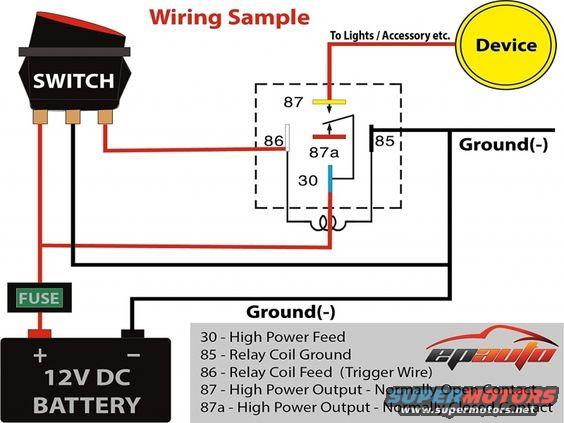
Wiring diagram showing a switch, inline fuse, 12V battery and 5-pin relay with terminals 30, 85, 86, 87 and 87a labeled to a device.
Part of 1999-2007 Ford F-250 Wiring Diagrams
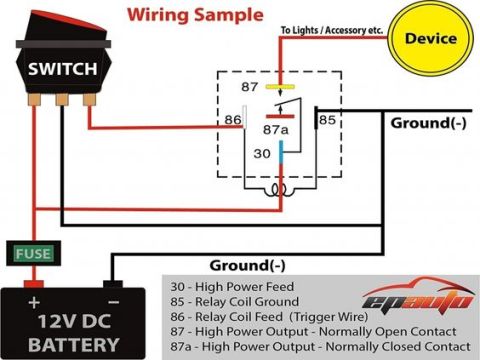
This document is a generic 12-volt automotive relay wiring sample diagram, branded by EPAuto. It illustrates how to wire a standard 5-pin relay (terminals 30, 85, 86, 87, and 87a) with a toggle/rocker switch, an inline fuse, a 12V DC battery, and a powered device (labeled 'To Lights / Accessory etc.'). The diagram shows the battery positive feeding through a fuse to relay terminal 30 (High Power Feed) and to the switch, which supplies terminal 86 (Relay Coil Feed / Trigger Wire). Terminal 85 (Relay Coil Ground) and the device's return are connected to ground (-), as is the battery negative. Terminal 87 is the normally open contact that powers the device when the relay is energized, while 87a is the normally closed contact. A legend at the bottom defines each relay terminal: 30 - High Power Feed; 85 - Relay Coil Ground; 86 - Relay Coil Feed (Trigger Wire); 87 - High Power Output - Normally Open Contact; 87a - High Power Output - Normally Closed Contact. This is a universal accessory wiring reference, not vehicle-specific, useful for anyone adding fused, relay-controlled lights or accessories to a vehicle.
Is this accurate? Sign in to help verify it.
Frequently asked questions
- What does pin 30 on a 12V relay do?
- Pin 30 is the High Power Feed, it receives fused power from the battery positive terminal.
- What is the difference between relay pins 87 and 87a?
- Pin 87 is the High Power Output on the Normally Open contact, while 87a is the High Power Output on the Normally Closed contact.
- Which relay pin is the trigger wire?
- Pin 86 is the Relay Coil Feed (Trigger Wire), fed from the switch in this diagram.
- Where does relay pin 85 connect?
- Pin 85 is the Relay Coil Ground and connects to ground (-).
- Is a fuse used in this relay wiring setup?
- Yes, the diagram shows an inline fuse between the 12V DC battery positive terminal and the rest of the circuit.





No comments yet.