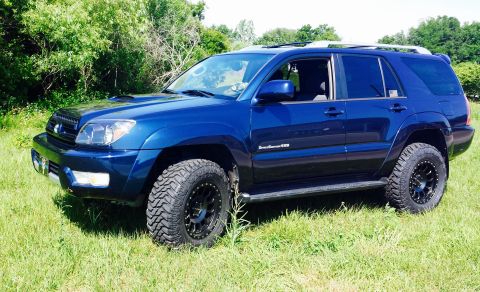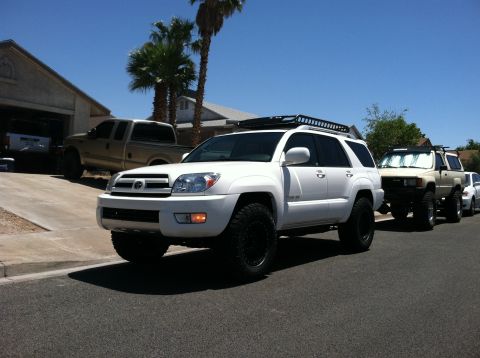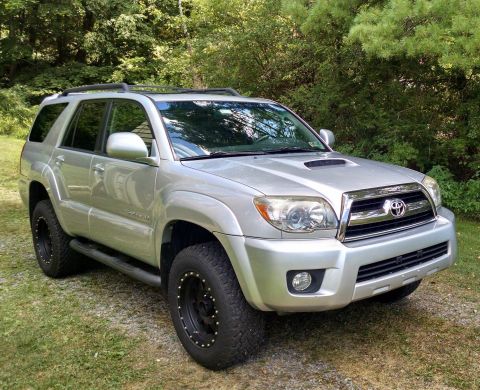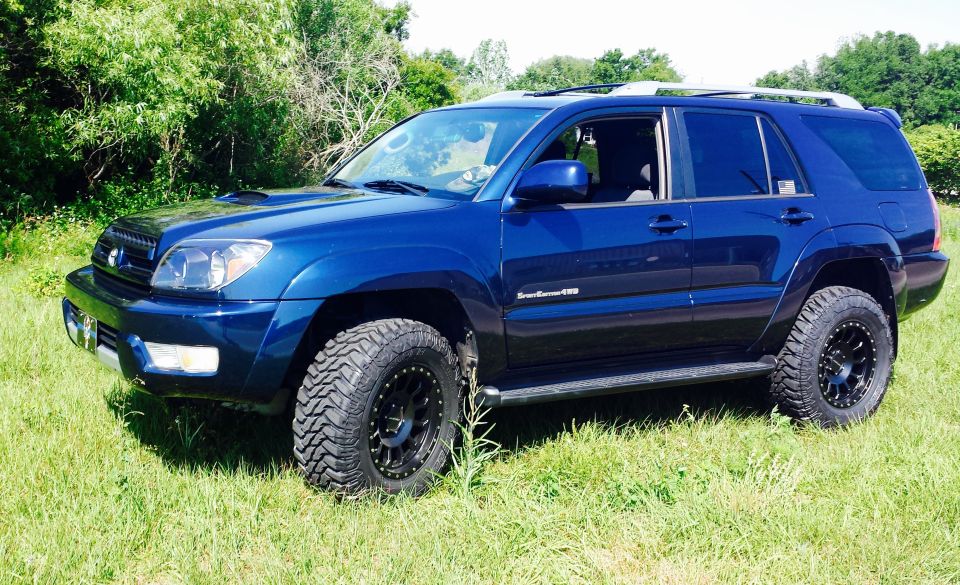
The fourth-generation Toyota 4Runner (2003-2009) is a body-on-frame midsize SUV built on Toyota's N210 platform, sharing architecture with the Lexus GX 470 and the FJ Cruiser. It was offered with a 4.0 liter 1GR-FE V6 and, uncommon for the model line, an available 4.7 liter 2UZ-FE V8. Both engines drove the rear or all four wheels through automatic transmissions, and buyers could option the X-REAS cross-linked hydraulic suspension on the Sport Edition trim.
Other Toyota 4Runner generations
Platform
The fourth-generation Toyota 4Runner (2003-2009) uses the body-on-frame N210 platform, replacing the previous N180 chassis. It shares its underpinnings with the Lexus GX 470 and later the Toyota FJ Cruiser. The 4Runner was built at Toyota's Tahara plant in Japan and by Hino Motors (Hamura), and was offered in rear-wheel-drive and four-wheel-drive configurations.
Engine lineup
- 4.0 liter 1GR-FE V6: The standard engine across 2003-2009. For 2003-2005 it was rated at 245 horsepower and 282 lb-ft of torque. For the 2006 model year, under revised SAE measurement standards, it was re-rated to 236 horsepower and 266 lb-ft. This reflected a change in measurement methodology rather than an actual reduction in output.
- 4.7 liter 2UZ-FE V8: An available option throughout 2003-2009. For 2003-2004 it produced 235 horsepower and 320 lb-ft. For 2005 the V8 gained VVT-i and was rated at 270 horsepower and 330 lb-ft. For the 2006 model year it was re-rated under revised SAE standards to 260 horsepower and 306 lb-ft.
Transmissions
The V6 used a 4-speed automatic (A340) for 2003-2004 and a 5-speed automatic (A750) from 2005 onward. The 4.7 liter V8 used a 5-speed automatic throughout its run in this generation.
Drivetrain
Rear-wheel drive was standard. V6 four-wheel-drive models used a part-time (multi-mode) system with a two-speed transfer case and a 2WD option. V8 four-wheel-drive models used a full-time system with a lockable Torsen center differential and a two-speed transfer case. A rear locking differential and Downhill Assist Control and Hill-start Assist Control were available depending on trim and drivetrain.
Suspension
The fourth-generation 4Runner used an independent front suspension and a four-link solid rear axle with coil springs. The X-REAS (Cross-Linked Relative Absorber System), a hydraulically interconnected shock arrangement that reduces body roll, was available on the Sport Edition.
Trims and variants
- SR5: The base trim.
- Sport Edition: Distinguished by a color-keyed grille and hood scoop, and offered X-REAS suspension.
- Limited: The top trim, with features such as leather seating and available full-time four-wheel drive.
Year-by-year notable changes
- 2003: Fourth generation launched on the N210 platform with the 4.0 V6 (245 hp) and 4.7 V8 (235 hp).
- 2005: The V8 received VVT-i, raising output to 270 horsepower and 330 lb-ft; the V6 adopted a 5-speed automatic while remaining rated at 245 horsepower.
- 2006: Revised front fascia and interior updates. Both engines were re-rated under revised SAE standards (a measurement change, not an actual power loss): the V6 to 236 horsepower and 266 lb-ft, and the V8 to 260 horsepower and 306 lb-ft.
- 2009: Final model year of the fourth generation, replaced by the fifth-generation (N280) 4Runner for 2010.
Asked all the time
Did the fourth-generation 4Runner come with a V8?
Yes. From 2003 through 2009 the Toyota 4Runner offered an available 4.7 liter 2UZ-FE V8 alongside the standard 4.0 liter V6. The V8 produced 235 horsepower for 2003-2004 and 270 horsepower after gaining VVT-i for 2005, then was re-rated to 260 horsepower for 2006-2009 under revised SAE measurement standards.
How much horsepower does the 4.0 V6 make?
The 4.0 liter 1GR-FE V6 was rated at 245 horsepower and 282 lb-ft for 2003-2005. For the 2006 model year it was re-rated to 236 horsepower and 266 lb-ft under revised SAE measurement standards, a change in methodology rather than an actual power reduction.
Which years have the more powerful V8?
The 4.7 liter V8 gained VVT-i for the 2005 model year, raising output from 235 horsepower to 270 horsepower with 330 lb-ft of torque. For 2006-2009 the same engine was re-rated to 260 horsepower and 306 lb-ft under revised SAE standards. Buyers seeking the stronger V8 should look at 2005-2009 models.
What is X-REAS and which trim had it?
X-REAS (Cross-Linked Relative Absorber System) is a hydraulically interconnected shock absorber system that reduces body roll during cornering. On the fourth-generation 4Runner it was available on the Sport Edition trim.
What transmissions were used?
The V6 used a 4-speed automatic for 2003-2004 and a 5-speed automatic from 2005 onward. The 4.7 liter V8 used a 5-speed automatic throughout the 2003-2009 run.
How does V6 four-wheel drive differ from V8 four-wheel drive?
V6 four-wheel-drive models used a part-time (multi-mode) system with a two-speed transfer case and a 2WD option, while V8 four-wheel-drive models used a full-time system with a lockable Torsen center differential and no 2WD mode.
The wall · registered 2003-2009 4Runners
Sorted by depth of documentation. Click any vehicle to open its permanent record.