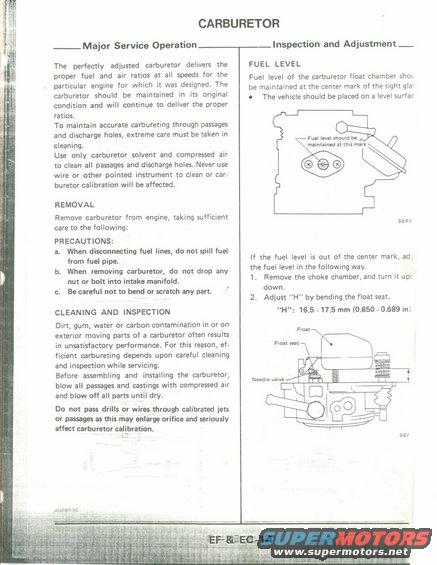
This document provides instructions for carburetor maintenance, including cleaning and fuel level adjustment procedures.
CARBURETOR Major Service Operation The perfectly adjusted carburetor delivers the proper fuel and air ratios at all speeds for the particular engine for which it was designed. The carburetor should be maintained in its original condition and will continue to deliver the proper ratiost To maintain accurate carbureting through passages and discharge holes, extreme care must be taken in cleaning. Use only carburetor solvent and compressed air to clean all passages and discharge holes. Never use wire or other pointed instrument to clean or car- buretor calibration will be affected. REMOVAL Remove carburetor from engine, taking sufficient care to the following: PRECAUTIONS: a. When disconnecting fuel lines, do not spill fuel from fuel pipe. b. When removing carburetor, do not drop any not or bolt into intake manifold. c. Be careful not to bend or scratch any part CLEANING AND INSPECTION Dirt, gum, water or carbon contamination in or on exterior moving parts of a carburetor often results in unsatisfactory performance. For this reason, ef- ficient arbureting depends upon careful cleaning and inspection while servicing. Before assembling and installing the carburetor, blow all passages and castings with compressed air and blow off all parts until dry. Do not pass drills or wires through calibrated jets or passages as this may enlarge orifice and seriously affect carburetor calibration. Inspection and Adjustment FUEL LEVEL Fuel level of the carburetor float chamber SllOl. be maintained at the center mark of the sight gla o The vehicle should be placed on a level surfar Full level should be : malntalnod at this mark If the fuel level is out of the center mark, ad the fuel level in the following way 1. Remove the choke chamber, and turn it up: down. 2 Adjust "H" by bending the float seats "H": 16.5 -17.5 mm (0.550 - 0.689 in] Float Float seat
Comments
More from this build


No comments yet.