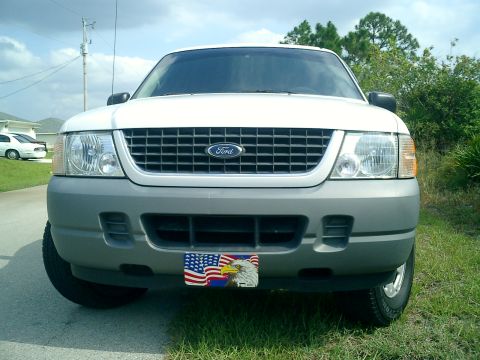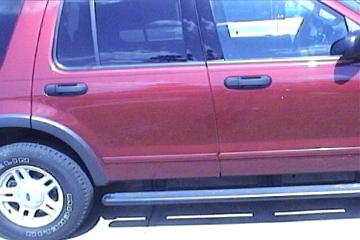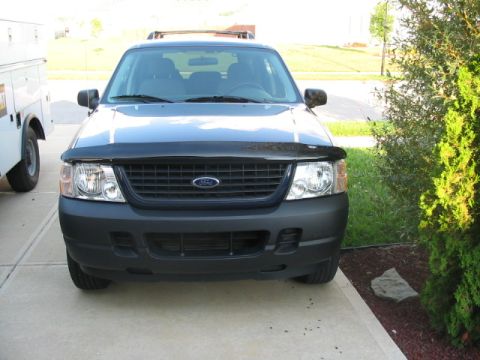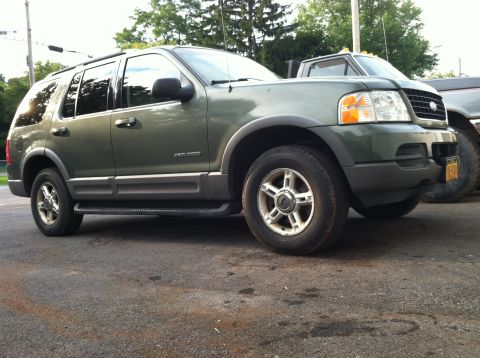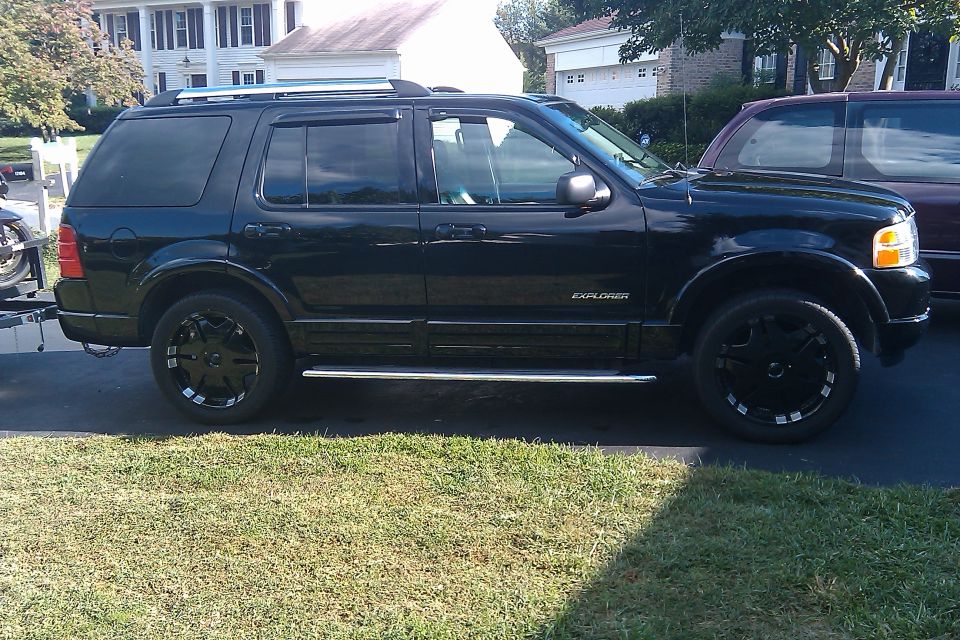
The 2002 model year brought the third-generation Ford Explorer, a redesign that introduced an independent rear suspension to the four-door Explorer for the first time. Earlier Explorers had used a live rear axle; the 2002 redesign fitted a fully independent rear suspension and a wider track, changes Ford described as improving ride and stability. The third-generation Explorer also added an available third-row seat, making it a three-row midsize SUV. The engine lineup was the single-overhead-cam (SOHC) 4.0-liter V6, rated at 210 horsepower, and a new 4.6-liter two-valve single-overhead-cam V8 rated at 239 horsepower, the latter replacing the 5.0-liter V8 used through 2001. The 2002-2005 Explorer remained a body-on-frame SUV with rear-wheel drive standard and available ControlTrac four-wheel drive, and it was offered in trims spanning XLS, XLT, Eddie Bauer, and Limited. The two-door Explorer Sport from the previous generation continued on the older body into 2003 before being discontinued, and the Explorer Sport Trac pickup derivative continued as its own model. The third-generation four-door Explorer ran through 2005 and was replaced by the fourth generation for 2006.
Other Ford Explorer generations
The 2002-2005 Ford Explorer at a glance
- Generation: third-generation Ford Explorer, redesigned for 2002
- Years: 2002 through 2005, replaced by the fourth-generation Explorer for 2006
- Key change: a new fully independent rear suspension replaced the previous live rear axle, with a wider track
- Seating: available third-row seat, making the Explorer a three-row midsize SUV
- Engines: 4.0L SOHC V6 (210 hp); 4.6L two-valve SOHC V8 (239 hp, replacing the earlier 5.0L V8)
- Chassis: body-on-frame, rear-wheel drive standard with available ControlTrac four-wheel drive
- Trims: XLS, XLT, Eddie Bauer, and Limited
- Related models: the two-door Explorer Sport continued on the older body into 2003; the Explorer Sport Trac pickup remained a separate model
Ford Explorer 2002-2005 year by year
| Year | Ford Explorer changes | Engines offered |
|---|---|---|
| 2002 | Third-generation Ford Explorer arrives with a new independent rear suspension, a wider track, and an available third-row seat; the 4.6-liter V8 replaces the 5.0-liter V8 | 4.0L SOHC V6; 4.6L V8 |
| 2003 | The 2003 Ford Explorer continued the third-generation design; the two-door Explorer Sport on the older body was in its final year | 4.0L SOHC V6; 4.6L V8 |
| 2004 | The 2004 Ford Explorer carried the 4.0-liter SOHC V6 and 4.6-liter V8 on the body-on-frame chassis | 4.0L SOHC V6; 4.6L V8 |
| 2005 | Final model year of the third-generation Ford Explorer before the 2006 redesign | 4.0L SOHC V6; 4.6L V8 |
The new independent rear suspension
The defining engineering change of the 2002-2005 Ford Explorer was its rear suspension. Earlier Explorers used a live rear axle, but the 2002 redesign fitted a fully independent rear suspension, with each rear wheel connected to the differential through a half-shaft. Ford also widened the track. These chassis changes followed the tire-safety and rollover controversy of 2000 and 2001 and were described by Ford as improving ride quality and stability. The independent rear suspension applied to the four-door Explorer; the older two-door Explorer Sport continued on the previous design.
Third-row seating and a larger body
The third-generation Ford Explorer added an available third-row seat, allowing seating for up to seven and making the four-door Explorer a three-row midsize SUV for the first time. The 2002 redesign enlarged the body and revised the interior to accommodate the extra seating, positioning the Explorer against other three-row family SUVs of the period.
The 4.0 SOHC V6 and the 4.6 V8
The 2002-2005 Ford Explorer was powered by the single-overhead-cam (SOHC) 4.0-liter V6, rated at 210 horsepower in this generation, and a new 4.6-liter single-overhead-cam V8. The 4.6-liter V8 was the two-valve-per-cylinder version, rated at 239 horsepower, and it replaced the 5.0-liter overhead-valve V8 that had been offered from 1996 through 2001. The Explorer remained a body-on-frame SUV with rear-wheel drive standard and available ControlTrac four-wheel drive, depending on configuration.
Trims and related models
The 2002-2005 Ford Explorer was offered in trims spanning the XLS, the XLT, the Eddie Bauer, and the top Limited. Two related vehicles overlapped this generation: the two-door Explorer Sport, which carried over on the older second-generation body into the 2003 model year before being discontinued, and the Explorer Sport Trac, a pickup-bodied derivative based on the body-on-frame Explorer chassis that was sold as its own model. This page covers the four-door Explorer SUV.
Frequently asked questions
What was new about the 2002 Ford Explorer?
The 2002 Ford Explorer was a third-generation redesign that introduced a fully independent rear suspension in place of the previous live rear axle, a wider track, and an available third-row seat. It also replaced the 5.0-liter V8 with a new 4.6-liter V8.
Does the 2002-2005 Ford Explorer have independent rear suspension?
Yes. The 2002-2005 Ford Explorer was the first four-door Explorer with a fully independent rear suspension, which replaced the live rear axle used by earlier Explorers. Each rear wheel connects to the differential through a half-shaft.
What engines did the 2002-2005 Ford Explorer use?
The 2002-2005 Ford Explorer used the single-overhead-cam 4.0-liter V6, rated at 210 horsepower, and a 4.6-liter two-valve single-overhead-cam V8 rated at 239 horsepower. The 4.6-liter V8 replaced the 5.0-liter V8 used from 1996 through 2001.
Did the 2002-2005 Ford Explorer have a third row?
Yes. The third-generation Ford Explorer added an available third-row seat, making it a three-row midsize SUV that could seat up to seven, depending on configuration.
Was the 2002-2005 Ford Explorer still body-on-frame?
Yes. The 2002-2005 Ford Explorer remained a body-on-frame SUV. The Explorer did not switch to a unibody crossover platform until the 2011 redesign.
Sources
- Ford factory specification sheets and brochures for the 2002-2005 Explorer
- Wikipedia, Ford Explorer (third generation)
- Alignment and suspension references for the 2002-2005 Ford Explorer independent rear suspension
Asked all the time
What was new about the 2002 Ford Explorer?
The 2002 Ford Explorer was a third-generation redesign that introduced a fully independent rear suspension in place of the previous live rear axle, a wider track, and an available third-row seat. It also replaced the 5.0-liter V8 with a new 4.6-liter V8.
Does the 2002-2005 Ford Explorer have independent rear suspension?
Yes. The 2002-2005 Ford Explorer was the first four-door Explorer with a fully independent rear suspension, which replaced the live rear axle used by earlier Explorers. Each rear wheel connects to the differential through a half-shaft.
What engines did the 2002-2005 Ford Explorer use?
The 2002-2005 Ford Explorer used the single-overhead-cam 4.0-liter V6, rated at 210 horsepower, and a 4.6-liter two-valve single-overhead-cam V8 rated at 239 horsepower. The 4.6-liter V8 replaced the 5.0-liter V8 used from 1996 through 2001.
Did the 2002-2005 Ford Explorer have a third row?
Yes. The third-generation Ford Explorer added an available third-row seat, making it a three-row midsize SUV that could seat up to seven, depending on configuration.
Was the 2002-2005 Ford Explorer still body-on-frame?
Yes. The 2002-2005 Ford Explorer remained a body-on-frame SUV. The Explorer did not switch to a unibody crossover platform until the 2011 redesign.
The wall · registered 2002-2005 Explorers
Sorted by depth of documentation. Click any vehicle to open its permanent record.