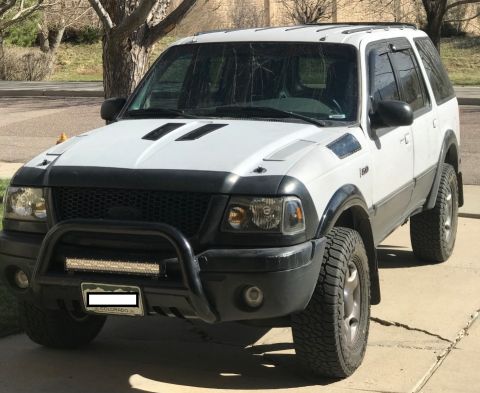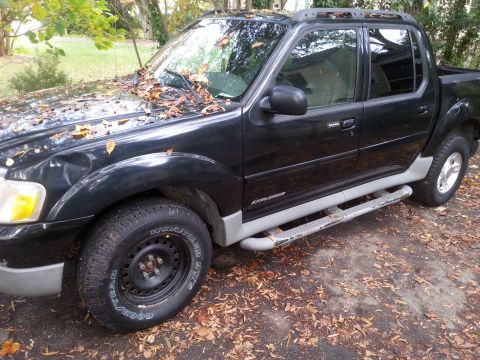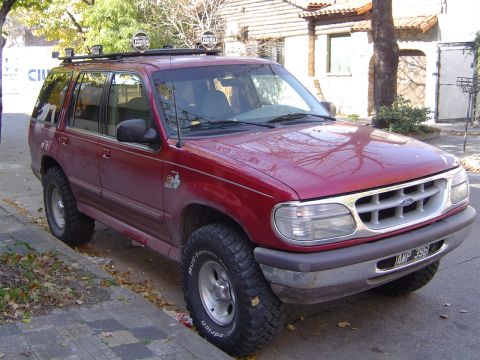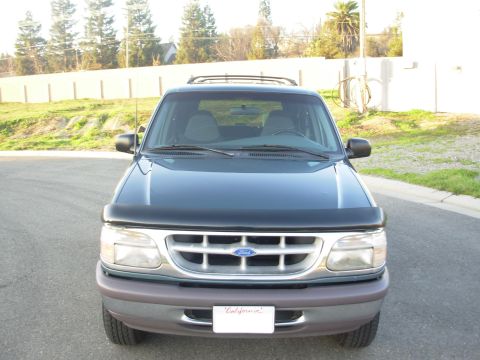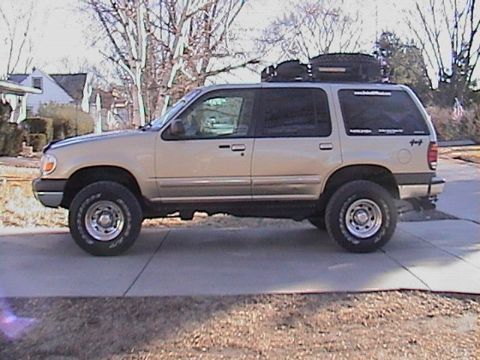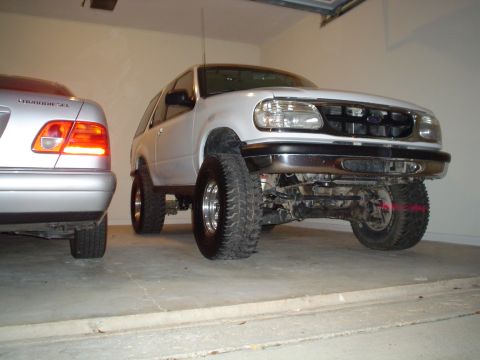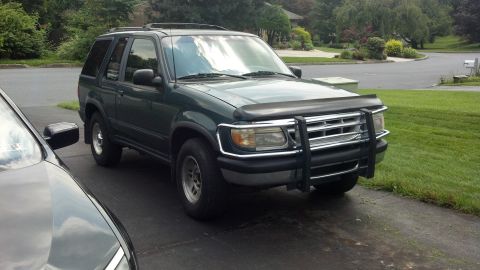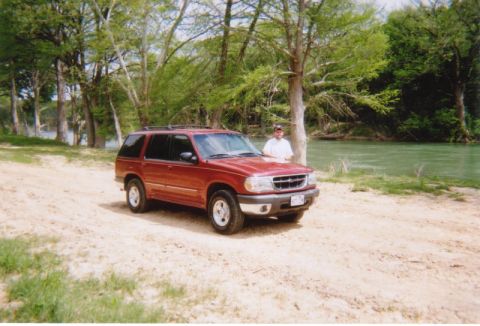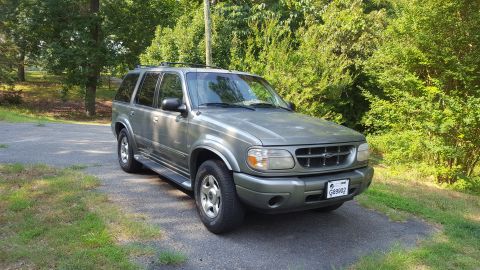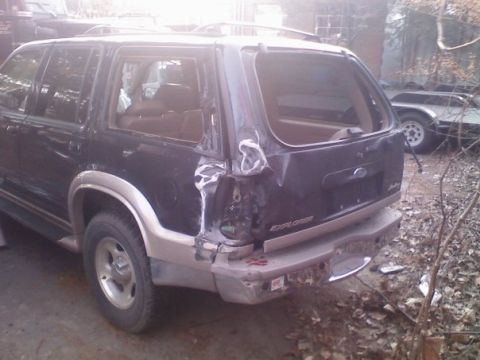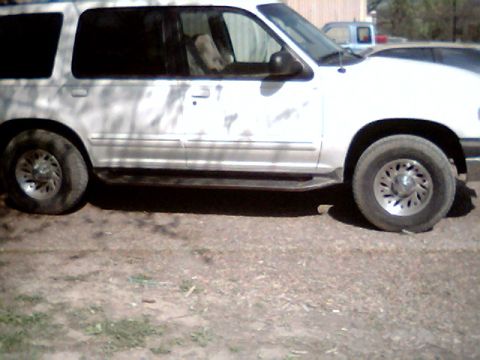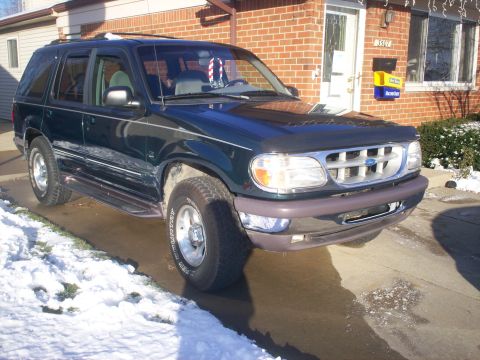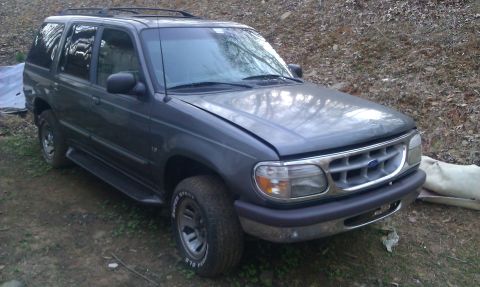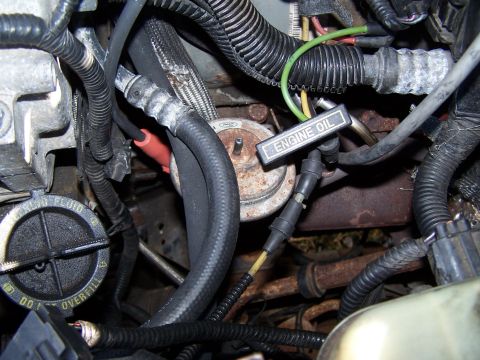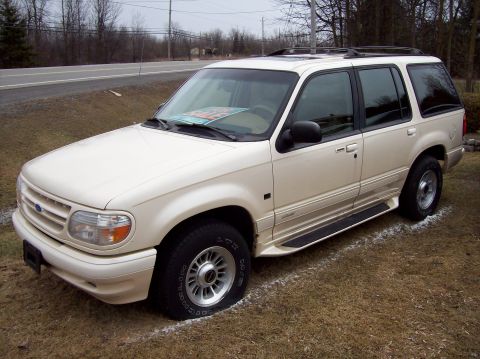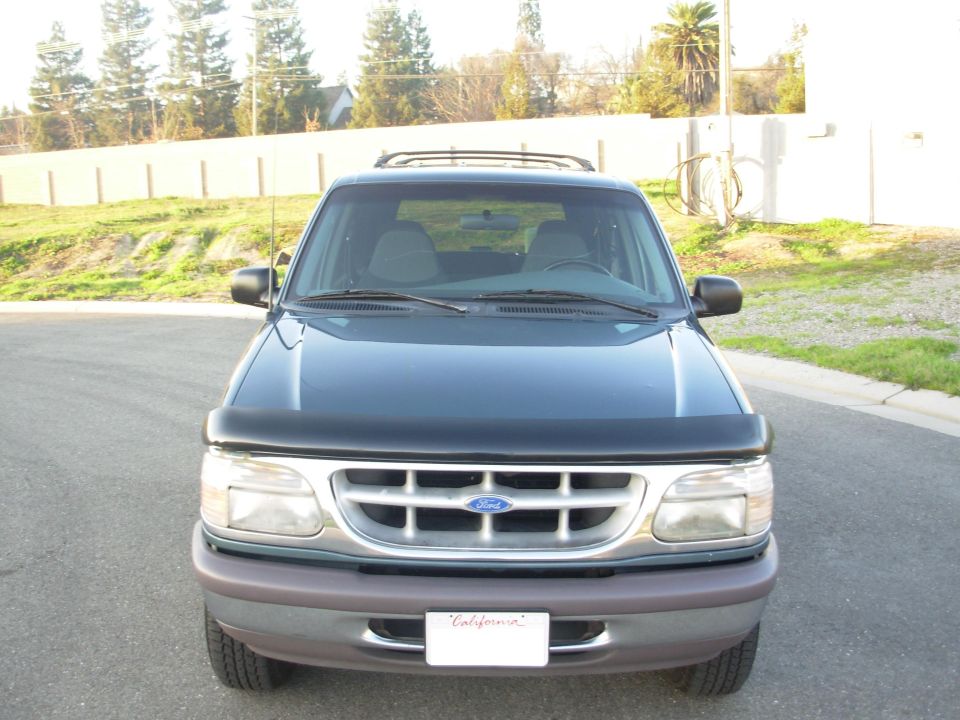
The 1995 model year brought the second-generation Ford Explorer, a restyled and re-engineered version of the midsize SUV that kept the Ranger-derived body-on-frame layout. The 1995 redesign gave the Explorer smoother, more rounded styling and a revised interior. The base engine remained the 4.0-liter overhead-valve (OHV) V6, and the four-door body continued alongside a two-door Explorer Sport. For the 1996 model year Ford added a 5.0-liter overhead-valve V8, initially in two-wheel-drive form, giving the Explorer its first V8. For 1997 Ford introduced a single-overhead-cam (SOHC) version of the 4.0-liter V6 rated at 205 horsepower, added a five-speed automatic, and made the 5.0-liter V8 available with all-wheel drive. The 5.0-liter V8 remained in the lineup through the 2001 model year, the last year of the second generation. The 1995-2001 Explorer is also closely tied to the Ford and Firestone tire controversy: in 2000 and 2001, tread separations on certain Firestone tires fitted to Explorers were linked to rollover crashes, prompting recalls of millions of tires and a public split between Ford and Firestone.
Other Ford Explorer generations
The 1995-2001 Ford Explorer at a glance
- Generation: second-generation Ford Explorer, restyled for 1995 on the Ranger-derived body-on-frame chassis
- Years: 1995 through 2001, replaced by the third-generation Explorer for 2002
- Engines: 4.0L OHV V6 (base); 4.0L SOHC V6 (from 1997, 205 hp); 5.0L OHV V8 (210 hp for 1996, 215 hp for 1997-2001)
- V8 milestone: the 5.0-liter V8 was the Explorer's first V8, offered 1996 through 2001
- 1997 updates: SOHC 4.0 V6, a five-speed automatic, and V8 availability with all-wheel drive
- Bodies: four-door, plus a two-door Explorer Sport
- Trims: XL, XLT, Eddie Bauer, and Limited
- Firestone controversy: tread separations on certain Firestone tires fitted to Explorers were linked to rollover crashes, prompting recalls in 2000 and 2001
Ford Explorer 1995-2001 year by year
| Year | Ford Explorer changes | Engines offered |
|---|---|---|
| 1995 | Second-generation Ford Explorer arrives with smoother restyling and a revised interior on the Ranger-derived body-on-frame chassis | 4.0L OHV V6 |
| 1996 | The 5.0-liter overhead-valve V8 joins the Ford Explorer lineup, initially in two-wheel-drive form, as the Explorer's first V8 | 4.0L OHV V6; 5.0L V8 |
| 1997 | A single-overhead-cam (SOHC) 4.0-liter V6 rated at 205 horsepower is added, along with a five-speed automatic; the 5.0L V8 becomes available with all-wheel drive | 4.0L OHV V6; 4.0L SOHC V6; 5.0L V8 |
| 1998 | The 1998 Ford Explorer carried the 4.0L OHV and SOHC V6 engines and the 5.0L V8 | 4.0L OHV V6; 4.0L SOHC V6; 5.0L V8 |
| 1999 | The 1999 Ford Explorer continued the four-door and two-door Sport bodies with the V6 and V8 engines | 4.0L OHV V6; 4.0L SOHC V6; 5.0L V8 |
| 2000 | The Ford and Firestone tire controversy began in 2000, when tread separations on certain Firestone tires fitted to Explorers were linked to rollover crashes and a Firestone tire recall | 4.0L OHV V6; 4.0L SOHC V6; 5.0L V8 |
| 2001 | Final model year of the second-generation four-door Ford Explorer and the last year for the 5.0-liter V8; the four-door dropped the overhead-valve 4.0-liter V6, leaving the SOHC 4.0-liter V6 and the 5.0-liter V8; Ford announced a further tire replacement program in 2001 | 4.0L SOHC V6; 5.0L V8 |
What the 1995 redesign changed
The second-generation Ford Explorer, introduced for 1995, was a restyle and re-engineering of the original that kept the Ranger-derived body-on-frame layout. Ford gave the 1995 Explorer smoother, more rounded exterior styling and a redesigned interior. The four-door body continued, and a two-door body remained available as the Explorer Sport. The base engine carried over as the 4.0-liter overhead-valve V6, with bigger powertrain changes arriving in the following two model years.
The V8 and the SOHC V6
The biggest powertrain news of the second generation was the arrival of V8 power. For the 1996 model year Ford added a 5.0-liter overhead-valve V8, rated at 210 horsepower and 280 lb-ft of torque, initially in two-wheel-drive four-door Explorers; revised cylinder heads raised output to 215 horsepower from 1997 through 2001. This was the first V8 offered in the Explorer. For 1997 Ford introduced a single-overhead-cam (SOHC) version of the 4.0-liter V6 that produced 205 horsepower, more than the 160-horsepower OHV V6, and added a five-speed automatic transmission; the 5.0-liter V8 also became available with all-wheel drive for 1997. The 5.0-liter V8 stayed in the Explorer through the 2001 model year, after which the third-generation Explorer adopted a 4.6-liter V8.
Trim levels and the two-door Explorer Sport
The 1995-2001 Ford Explorer was offered in trims spanning the base XL, the XLT, the Eddie Bauer, and the top Limited. The two-door body was sold as the Explorer Sport. When the four-door Explorer was redesigned into the third generation for 2002, the two-door Explorer Sport continued on the older body for a short time before being discontinued, which is why two-door Sport models overlap the start of the next generation.
The Ford and Firestone tire controversy
The second-generation Ford Explorer is closely associated with the tire-safety controversy of 2000 and 2001. Tread separations on certain Firestone tires fitted as original equipment to Explorers were linked to crashes, many of them rollovers. Firestone announced a recall of millions of tires in 2000, and in 2001 Ford announced a further tire replacement program; the long-standing business relationship between Ford and Firestone publicly broke down over responsibility. Among the factors discussed were tire construction and Ford's recommended tire pressure for the Explorer. The third-generation Explorer that arrived for 2002 was engineered with a wider track and a new independent rear suspension, changes Ford described as improving stability.
Frequently asked questions
What changed in the 1995 Ford Explorer redesign?
The 1995 Ford Explorer was a second-generation restyle and re-engineering that kept the Ranger-derived body-on-frame layout. It received smoother, more rounded styling and a redesigned interior, while the base engine carried over as the 4.0-liter overhead-valve V6.
When did the Ford Explorer get a V8?
The Ford Explorer got its first V8 for the 1996 model year, when Ford added a 5.0-liter overhead-valve V8 rated at 210 horsepower, initially in two-wheel-drive four-door models. Output rose to 215 horsepower for 1997, and the 5.0-liter V8 was offered through the 2001 model year.
What is the difference between the OHV and SOHC 4.0 V6 in the Ford Explorer?
The 4.0-liter overhead-valve (OHV) V6 was the original pushrod engine used from the start of the Explorer. For 1997 Ford added a single-overhead-cam (SOHC) version of the 4.0-liter V6 that produced 205 horsepower, more than the OHV engine, and it became the Explorer's main V6 going forward.
What was the Ford and Firestone tire controversy?
In 2000 and 2001, tread separations on certain Firestone tires fitted to Ford Explorers were linked to crashes, many of them rollovers. Firestone recalled millions of tires in 2000, and Ford announced a further tire replacement program in 2001, after which the two companies publicly split. The 2002 Explorer was redesigned with a wider track and a new independent rear suspension.
Was the 1995-2001 Ford Explorer still based on the Ranger?
Yes. The second-generation Ford Explorer, like the first, used a Ranger-derived body-on-frame chassis. The Explorer did not move to a unibody crossover platform until the 2011 redesign.
Sources
- Ford factory specification sheets and brochures for the 1995-2001 Explorer
- Wikipedia, Ford Explorer (second generation)
- The Ranger Station, 1996-2001 Ford Explorer 5.0L V8 specifications
- Contemporary coverage of the Ford and Firestone tire recalls (2000-2001)
Asked all the time
What changed in the 1995 Ford Explorer redesign?
The 1995 Ford Explorer was a second-generation restyle and re-engineering that kept the Ranger-derived body-on-frame layout. It received smoother, more rounded styling and a redesigned interior, while the base engine carried over as the 4.0-liter overhead-valve V6.
When did the Ford Explorer get a V8?
The Ford Explorer got its first V8 for the 1996 model year, when Ford added a 5.0-liter overhead-valve V8 rated at 210 horsepower, initially in two-wheel-drive four-door models. Output rose to 215 horsepower for 1997, and the 5.0-liter V8 was offered through the 2001 model year.
What is the difference between the OHV and SOHC 4.0 V6 in the Ford Explorer?
The 4.0-liter overhead-valve (OHV) V6 was the original pushrod engine used from the start of the Explorer. For 1997 Ford added a single-overhead-cam (SOHC) version of the 4.0-liter V6 that produced 205 horsepower, more than the OHV engine, and it became the Explorer's main V6 going forward.
What was the Ford and Firestone tire controversy?
In 2000 and 2001, tread separations on certain Firestone tires fitted to Ford Explorers were linked to crashes, many of them rollovers. Firestone recalled millions of tires in 2000, and Ford announced a further tire replacement program in 2001, after which the two companies publicly split. The 2002 Explorer was redesigned with a wider track and a new independent rear suspension.
Was the 1995-2001 Ford Explorer still based on the Ranger?
Yes. The second-generation Ford Explorer, like the first, used a Ranger-derived body-on-frame chassis. The Explorer did not move to a unibody crossover platform until the 2011 redesign.
Technical Reference
Member-uploaded diagrams & documents for this generation. AI-classified; community-verified where badged.
Brochures & Literature (3)
- Kenne Bell 5.0 Supercharger Literature - '93 Cobra Drag Test & MX2200 Dyno ChartThis is a scanned page of Kenne Bell marketing literature responding to competitor ATI's claims about "before and after" supercharger drag strip testing. Kenne Bell cites a back-to-back test conducted by Super Ford…
- Kenne Bell Blowzilla 2200 Supercharger Kit Brochure - Mustang/Lightning PricingThis is a Kenne Bell sales brochure introducing the BLOWZILLA 2200 (2.2L) twin-screw supercharger, marketed as the bigger brother to the established Kenne Bell 1500 (1.5L) Mustang kit sold since 1992. The BLOWZILLA…
- Kenne Bell 2200 & 1500 Supercharger Dyno Test Comparison Chart - Horsepower vs RPMThis document page shows a dyno test comparison chart from Kenne Bell for their 2200 (MX2200) and 1500 superchargers. The graph plots rear-wheel horsepower (50-450 HP) against engine RPM (1000-6000 RPM) for five…
Data/Spec Plates (1)
- Kenne Bell 2200 & 1500 Supercharger Dyno Torque Comparison ChartThis document is a scanned dyno test comparison chart from Kenne Bell titled "KENNE BELL 2200 and 1500 DYNO TEST COMPARISONS." It plots rear-wheel torque (150-550 ft-lbs) against engine RPM (1000-6000) for five…
The wall · registered 1995-2001 Explorers
Sorted by depth of documentation. Click any vehicle to open its permanent record.