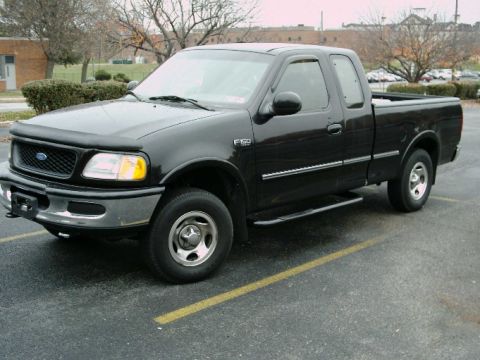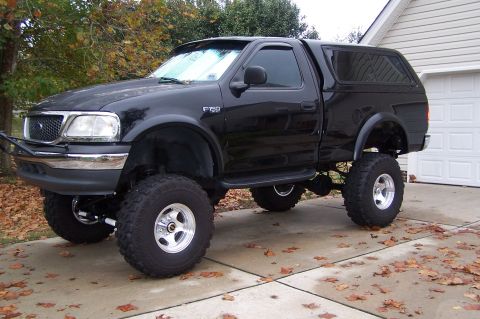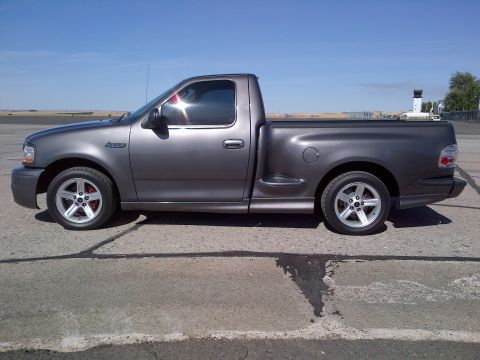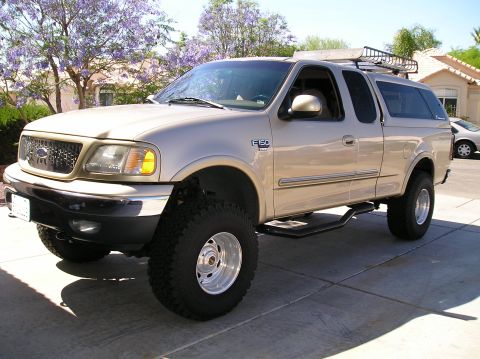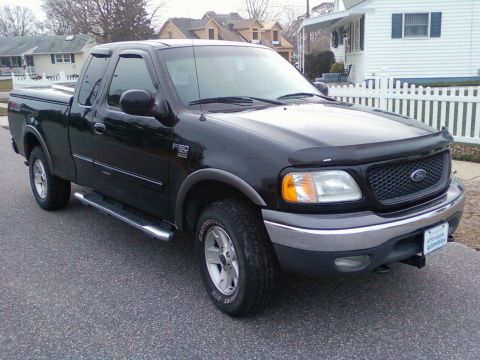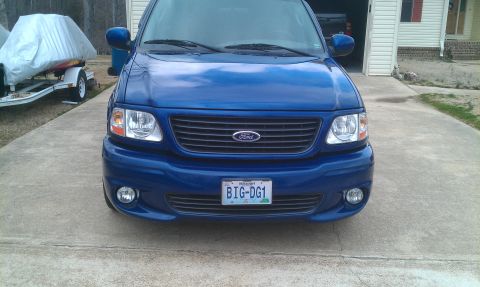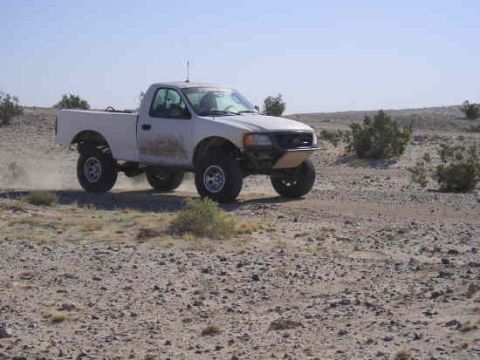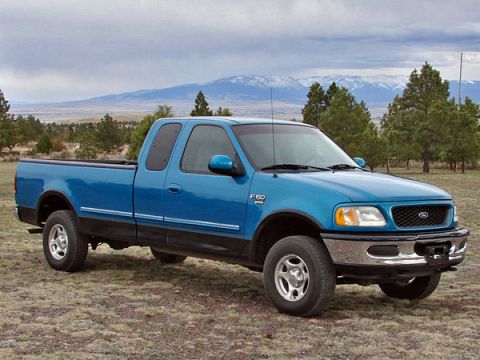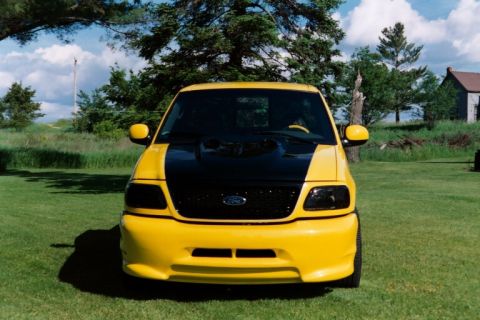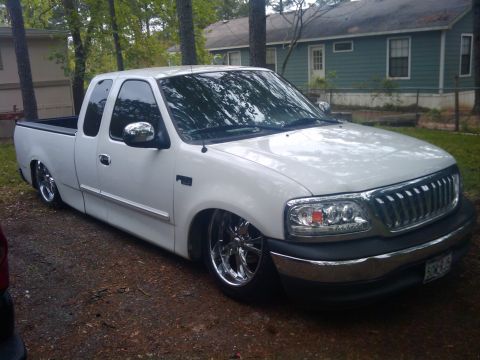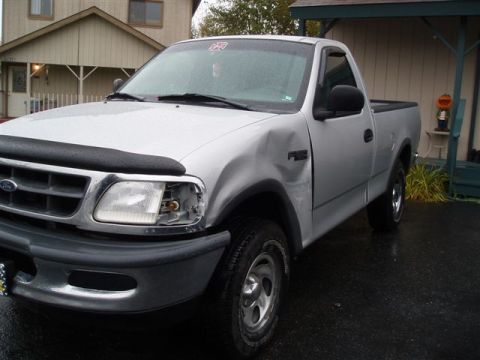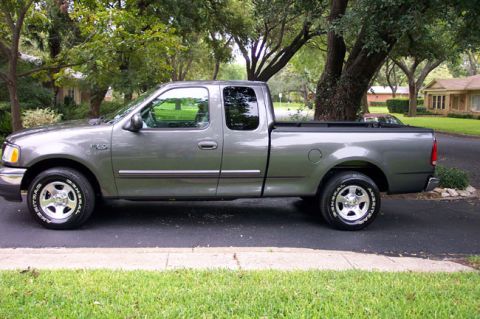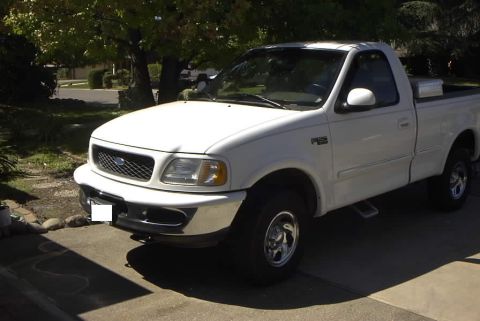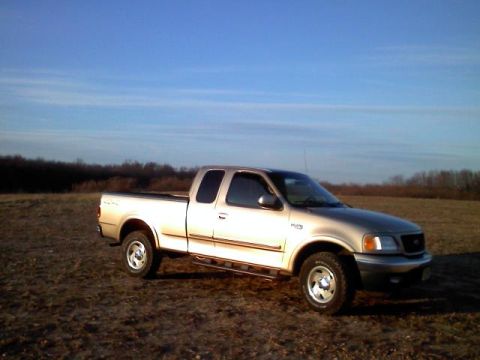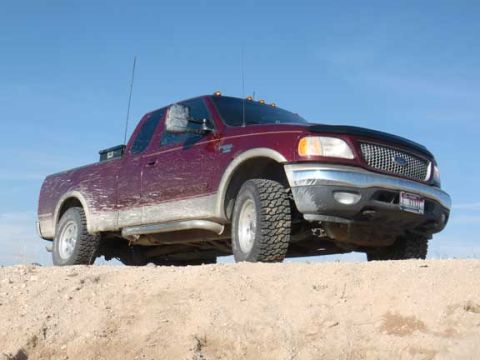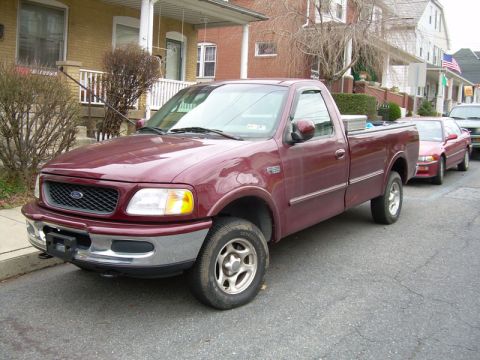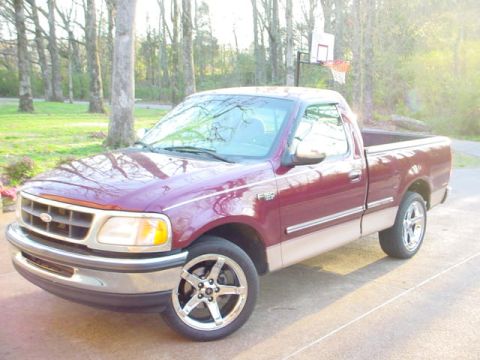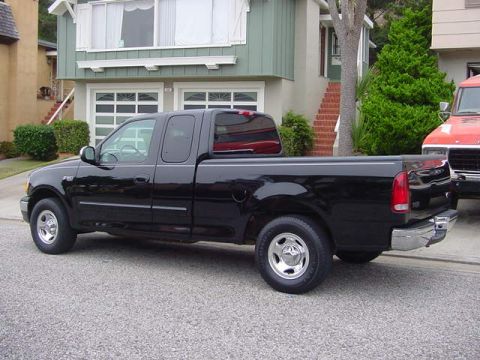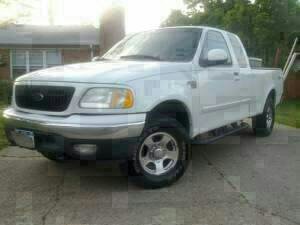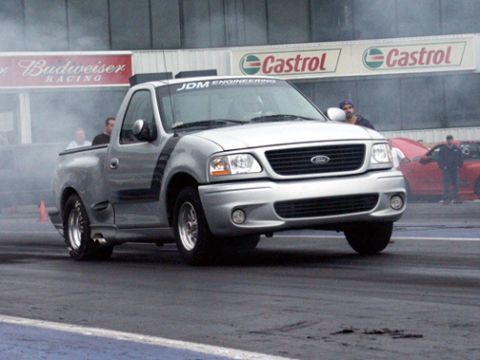
The 1997-2003 Ford F-150 is the tenth-generation truck, the model year that moved the half-ton onto a new body and a new chassis with a markedly more aerodynamic shape than the squarer OBS trucks before it. The 1997 Ford F-150 replaced the long-running pushrod engines with Ford's overhead-cam modular family: a 4.6L single-overhead-cam Triton V8 and a 5.4L single-overhead-cam Triton V8, with a 4.2L Essex V6 as the base engine in place of the 300-cubic-inch inline-six. On the chassis side, the 1997 Ford F-150 dropped the Twin-Traction Beam used since 1980 and adopted an 8.8-inch independent front suspension; the four-wheel-drive F-150 stayed independent up front rather than switching to a solid axle. For 1999, Ford spun the heavier three-quarter-ton and one-ton trucks off into the separate Super Duty line, so from the 1999 model year the F-150 name refers specifically to the half-ton. The four-door SuperCrew cab joined the lineup for 2001, and the supercharged second-generation SVT Lightning, built from 1999 through 2004, used a blown version of the 5.4L Triton V8.
Other Ford F-150 generations
1997-2003 Ford F-150 at a glance
- Generation: tenth-generation Ford F-150, model years 1997 through 2003 (the tenth-gen body continued into 2004 as the F-150 Heritage alongside the new eleventh generation).
- Major change: the 1997 Ford F-150 was an aerodynamic redesign on a new body and chassis, replacing the squarer 1992-1996 OBS truck.
- Engines: the 1997 Ford F-150 introduced the 4.2L Essex V6 and the single-overhead-cam modular Triton V8s, the 4.6L and the 5.4L, replacing the pushrod 300 inline-six and earlier V8s.
- Front suspension: the 1997 Ford F-150 replaced the Twin-Traction Beam with an 8.8-inch independent front suspension; the 4x4 stayed independent, with coil springs on two-wheel-drive trucks and torsion bars on four-wheel-drive trucks.
- Cabs: Regular Cab and SuperCab from 1997, with the four-door SuperCrew added for 2001.
- Super Duty split: the F-250 and F-350 moved to the separate Super Duty line for 1999, so the 1999-2003 Ford F-150 is specifically the half-ton.
- Performance model: the second-generation SVT Lightning (1999-2004) used a supercharged 5.4L Triton V8.
1997-2003 Ford F-150 year by year
| Year | Key changes |
|---|---|
| 1997 Ford F-150 | Tenth generation launched as an aerodynamic redesign on a new body and chassis. New engine lineup: 4.2L Essex V6 (about 202 hp), 4.6L SOHC Triton V8 (about 220 hp, 290 lb-ft), and 5.4L SOHC Triton V8 (about 235 hp, 330 lb-ft). Twin-Traction Beam replaced by an 8.8-inch independent front suspension. Regular Cab and SuperCab offered. |
| 1998 Ford F-150 | Carried the 1997 body, chassis, and engine lineup. Four-wheel ABS and revised emissions calibrations were part of running updates across the half-ton range. |
| 1999 Ford F-150 | The heavier F-250 and F-350 split into the separate Super Duty line, leaving the F-150 as the half-ton. The 4.6L Triton V8 rose to about 231 hp and the 5.4L Triton V8 to about 260 hp. The second-generation SVT Lightning arrived with a supercharged 5.4L V8 rated at about 360 hp and 440 lb-ft. |
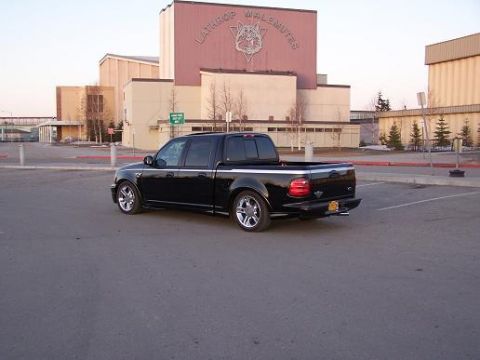
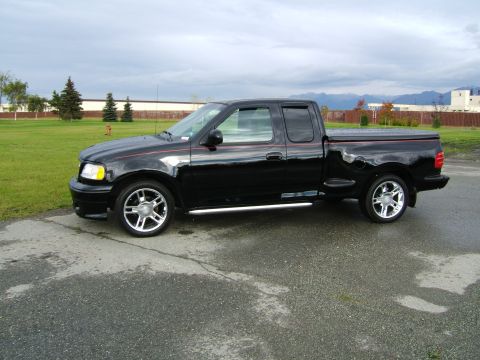
| 2000 Ford F-150 | Continued the 1999 engine ratings and the supercharged SVT Lightning. The first Harley-Davidson F-150 debuted for 2000 as a black SuperCab model. |
| 2001 Ford F-150 | The four-door SuperCrew cab was added, giving the F-150 four full-size doors with a short bed. The King Ranch trim was introduced; the Harley-Davidson F-150, first offered for 2000, continued. The supercharged SVT Lightning was uprated to about 380 hp and 450 lb-ft. |
| 2002 Ford F-150 | Carried the SuperCrew, King Ranch, and Harley-Davidson offerings. Engine lineup of 4.2L V6, 4.6L Triton V8, and 5.4L Triton V8 continued, with the supercharged 5.4L in the SVT Lightning. |
| 2003 Ford F-150 | Final full year of the tenth-generation body before the redesigned eleventh-generation 2004 F-150. The SVT Lightning continued with the supercharged 5.4L V8. The Flareside stepside bed and Styleside bed both remained available on non-SuperCrew trucks. |
The tenth-generation redesign
The 1997 Ford F-150 was an aerodynamic redesign that put the half-ton on a new body and a new chassis with smoother, more rounded sheetmetal than the 1992-1996 OBS trucks. The 1997 Ford F-150 kept the front-engine, rear-drive or four-wheel-drive layout of the trucks before it, but reworked the structure to support the new modular engines and the new front suspension. Both the Styleside flat-sided bed and the Flareside stepside bed were offered during the 1997-2003 run, with the Flareside sold only in short-bed form.
Modular Triton engines replace the pushrod V8s
The 1997 Ford F-150 retired the pushrod engines and the 300-cubic-inch inline-six and introduced Ford's overhead-cam modular family. The base 1997 Ford F-150 engine was the 4.2L Essex V6, rated at about 202 horsepower, replacing the 300 inline-six. Above it sat two single-overhead-cam Triton V8s: the 4.6L, rated at about 220 horsepower and 290 lb-ft of torque in 1997, and the 5.4L, rated at about 235 horsepower and 330 lb-ft in 1997. For the 1999 Ford F-150, the 4.6L Triton rose to about 231 horsepower and the 5.4L Triton to about 260 horsepower. The Triton V8s used a single overhead camshaft per cylinder bank, a departure from the pushrod, single-cam-in-block design they replaced.
Independent front suspension, not a solid axle
The 1997 Ford F-150 replaced the Twin-Traction Beam front suspension, used on the four-wheel-drive F-150 since 1980, with an 8.8-inch independent front suspension. A common misconception is that the 1997 Ford F-150 4x4 switched to a solid front axle; it did not. The four-wheel-drive 1997-2003 Ford F-150 kept an independent front end, using a short-and-long-arm layout with torsion bars on four-wheel-drive trucks and coil springs on two-wheel-drive trucks. This independent front suspension carried through the entire 1997-2003 generation.
The Super Duty split and the SuperCrew cab
For the 1999 model year, Ford moved the heavier F-250 and F-350 trucks into a separate Super Duty line with its own body and frame. From 1999 onward, the F-150 name refers specifically to the half-ton truck covered by this generation. For 2001, the Ford F-150 added the SuperCrew, a four-door crew cab with four full-size doors and a short bed, expanding the lineup beyond the Regular Cab and the extended SuperCab. The 2001 Ford F-150 also introduced the King Ranch trim; the Harley-Davidson F-150 had arrived a year earlier, for 2000.
The supercharged SVT Lightning
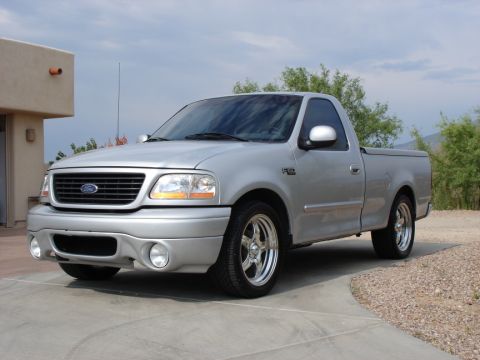
The second-generation Ford SVT Lightning was built from 1999 through 2004 on this tenth-generation F-150. The 1999 SVT Lightning used a supercharged version of the 5.4L Triton V8 rated at about 360 horsepower and 440 lb-ft of torque. For 2001, the SVT Lightning was uprated to about 380 horsepower and 450 lb-ft. The SVT Lightning was a rear-drive, single-cab performance truck and is the high-performance member of the 1997-2003 Ford F-150 family. The earlier first-generation SVT Lightning of 1993-1995 belongs to the previous OBS generation and used a pushrod 5.8L V8.
Frequently asked questions about the 1997-2003 Ford F-150
What engines did the 1997-2003 Ford F-150 use?
The 1997-2003 Ford F-150 used a 4.2L Essex V6 as the base engine and two single-overhead-cam modular Triton V8s, the 4.6L and the 5.4L. These replaced the pushrod 300 inline-six and earlier V8s used through 1996.
Did the 1997 Ford F-150 4x4 switch to a solid front axle?
No. The 1997 Ford F-150 replaced the Twin-Traction Beam with an 8.8-inch independent front suspension, and the four-wheel-drive F-150 stayed independent up front rather than adopting a solid front axle.
When did the Ford F-150 get the four-door SuperCrew?
The four-door SuperCrew cab was added to the Ford F-150 for the 2001 model year, giving the truck four full-size doors with a short bed alongside the existing Regular Cab and SuperCab.
Why is the 1999 Ford F-150 only a half-ton?
For 1999, Ford split the heavier F-250 and F-350 into the separate Super Duty line. From the 1999 model year, the F-150 name refers specifically to the half-ton truck.
What was the SVT Lightning in this generation?
The second-generation Ford SVT Lightning, built 1999 through 2004, used a supercharged 5.4L Triton V8, rated at about 360 horsepower in 1999-2000 and about 380 horsepower from 2001.
Sources
- Wikipedia, Ford F-Series (tenth generation): en.wikipedia.org/wiki/Ford_F-Series_(tenth_generation)
- Ford-Trucks.com, 1997-2003 Ford F-150 Tenth Generation: ford-trucks.com
- F-150 Hub, Ford 4.6L & 5.4L Modular V8 Specs: f150hub.com/specs/ford-modular-specs.html
- F-150 Hub, Ford 4.2L Essex V6 Specs: f150hub.com/specs/ford-4.2.html
- F-150 Hub, 1999-2004 SVT Lightning: f150hub.com/svt/lightning.html
Asked all the time
What engines did the 1997-2003 Ford F-150 use?
The 1997-2003 Ford F-150 used a 4.2L Essex V6 as the base engine and two single-overhead-cam modular Triton V8s, the 4.6L and the 5.4L. These replaced the pushrod 300 inline-six and earlier V8s used through 1996.
Did the 1997 Ford F-150 4x4 switch to a solid front axle?
No. The 1997 Ford F-150 replaced the Twin-Traction Beam with an 8.8-inch independent front suspension, and the four-wheel-drive F-150 stayed independent up front rather than adopting a solid front axle.
When did the Ford F-150 get the four-door SuperCrew?
The four-door SuperCrew cab was added to the Ford F-150 for the 2001 model year, giving the truck four full-size doors with a short bed alongside the existing Regular Cab and SuperCab.
Why is the 1999 Ford F-150 only a half-ton?
For 1999, Ford split the heavier F-250 and F-350 into the separate Super Duty line. From the 1999 model year, the F-150 name refers specifically to the half-ton truck.
What was the SVT Lightning in this generation?
The second-generation Ford SVT Lightning, built 1999 through 2004, used a supercharged 5.4L Triton V8, rated at about 360 horsepower in 1999-2000 and about 380 horsepower from 2001.
Technical Reference
Member-uploaded diagrams & documents for this generation. AI-classified; community-verified where badged.
Brochures & Literature (6)
- Ford brochure page on SuperCab features: the Third Door inside handle, the roof-mounted right shoulder belt, and the door side intrusion beam.
- Ford truck brochure page with three lifestyle photos: a toolbox stored behind the seat, three passengers on the bench seat, and a family fishing off a dock.
- Ford brochure spread titled "Flareside 4x4 for the Fun of it" showing a red F-150 Flareside 4x4 from the rear with a yellow dirt bike in the bed.
- Ford brochure spread titled "New F-250 More Capability" showing a red and silver two-tone F-250 SuperCab, with an inset of a dark truck plowing snow.
- Ford F-Series brochure spread headlined "A Tradition of Leadership" with a white regular cab pickup posed against large logs.
- Cover of the 1997 Ford F-Series sales brochure showing a teal two-tone SuperCab pickup posed in front of boulders and pine trees.
Service Procedures (2)
- Repair manual pages covering coolant temperature sending unit check, heater blower motor removal (fig. 10.5) and blower motor resistor replacement (fig. 11.4).
- Manual figure 19.7a showing how to rock a front tire to check balljoints, with the coil spring, axle jaws, upper and lower ball joints and spindle labeled.
The wall · registered 1997-2003 F-150s
Sorted by depth of documentation. Click any vehicle to open its permanent record.