This document details stall testing procedures for vehicles with accompanying diagrams.
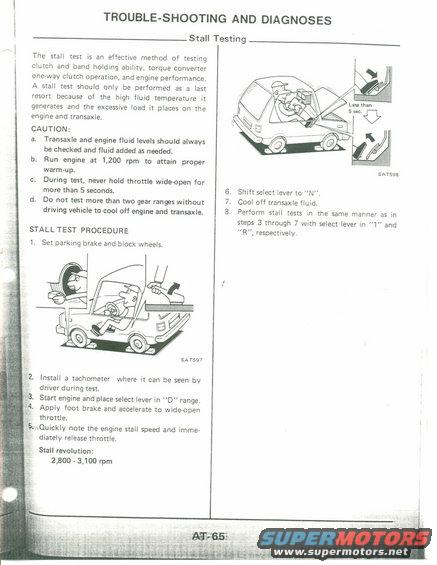
l TROUBLE-SHOOTING AND DIAGNOSES l Stall Testing The stall test is an effective method of testing clutch and band holding abllity, torque converter one-way clutch operation, and engine performance. _ _ A stall test should only be performed as a last 2 \_ resort because of the high fluid temperature it sf / generates and the excessive load it places on the .' _ y - i / engine and transaxlei , CAUTION: a. Transaxle and engine fluid levels should always be checked and fluid added as needed. I). Run engine at 1,200 rpm to attain proper LIX warmup. SATsee :1. During test, never hold throttle widerpen for more than 5 seconds. 6. Shift select lever to N. d. Do not test more than two gear ranges without 7. Cool off transaxle fluid, driving vehicle to cool off engine and transaxle, 8. Perform stall tests in the same manner as in steps 3 through 7 with select lever in "1 and STALL TEST PROCEDURE "'R, respectively. 7. 1. Set parking brake and block wheels. SAT597 7'2. Install a tachometer where it can be seen by driver du ring testt . Start engine and place select lever in D" range. . Apply foot brake and accelerate to wide-open throttle. iQuickly note the engine stall speed and imme- diately release throttle. Stall revolution: 2,800 -3,100 rpm
Comments
More from this build

No comments yet.