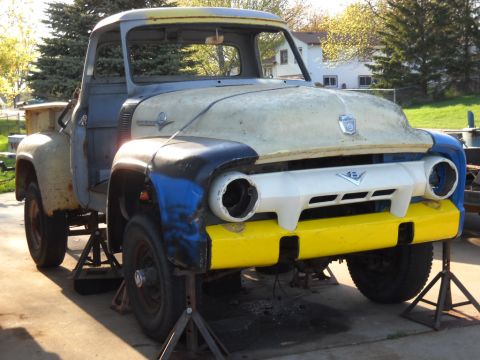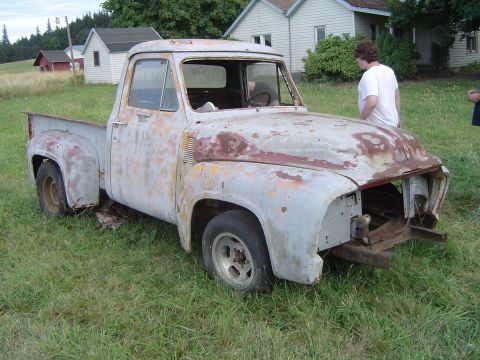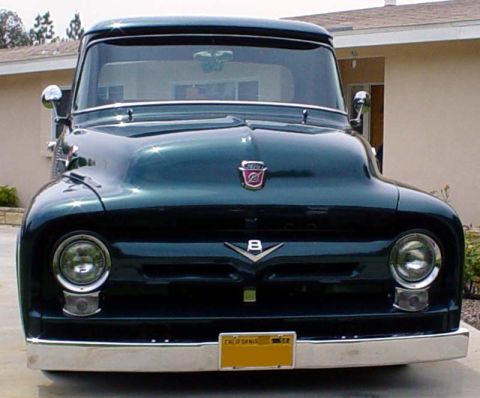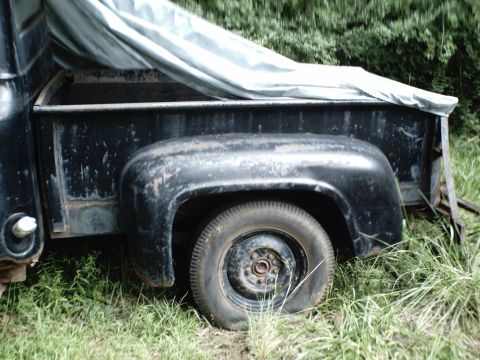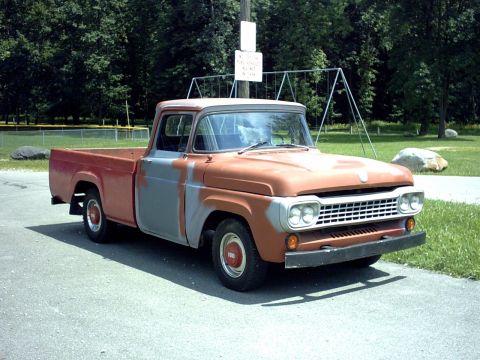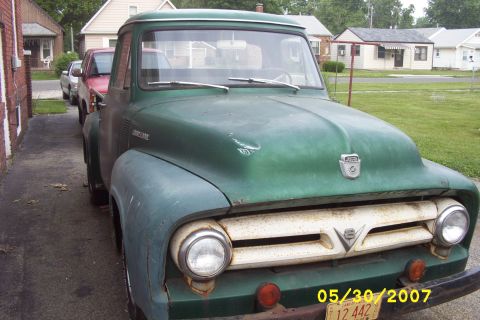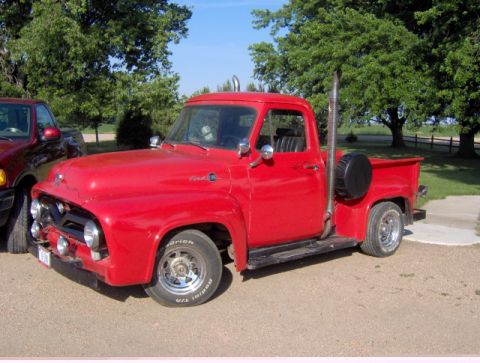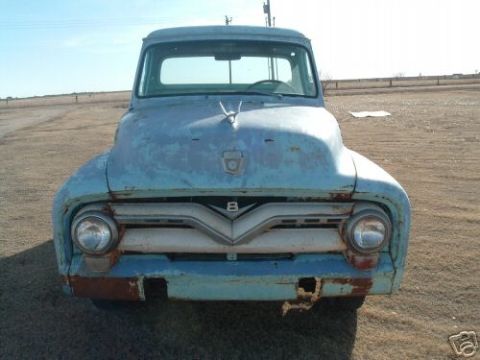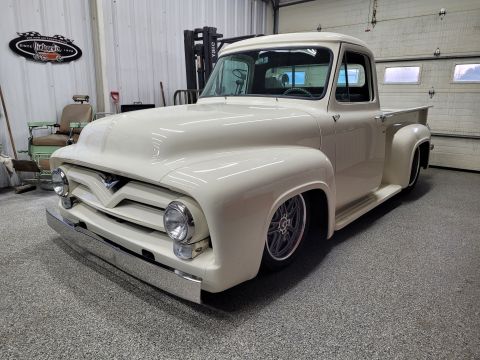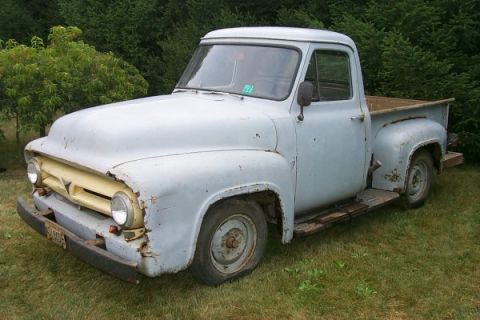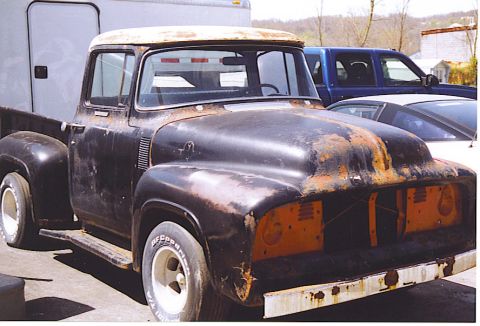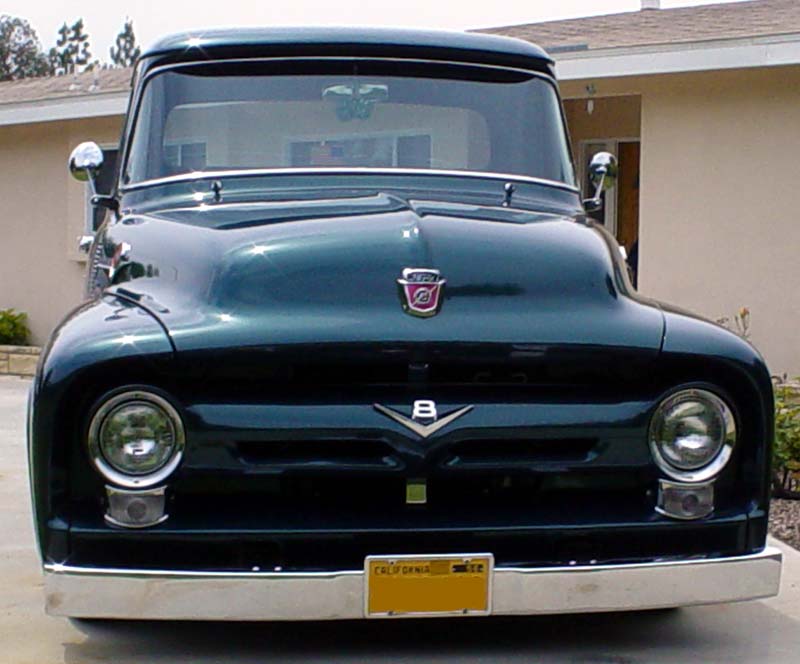
The Ford F-100 name arrived for the 1953 model year, when Ford redesigned its second-generation F-Series and replaced the half-ton F-1 with the F-100. The change was part of Ford's 50th anniversary in 1953 and introduced the three-digit naming Ford still uses, with the F-2 and F-3 becoming the F-250 and the F-4 becoming the F-350. Collectors often call these 1953-1956 trucks the "Effie." The 1953 Ford F-100 used a 215-cubic-inch overhead-valve inline-six and the last of Ford's flathead V8s, a 239-cubic-inch unit; 1953 was the final year for the flathead V8, while the six was already overhead-valve. For 1954 Ford replaced the flathead V8 with the overhead-valve 239-cubic-inch Y-block V8 and enlarged the six to 223 cubic inches, branded the Mileage Maker. The V8 grew again to 272 cubic inches for 1956. Horsepower in this period was quoted in SAE gross figures, well above the later net ratings. The 1953-1956 Ford F-100 used a body-on-frame layout with a solid front axle, before factory four-wheel drive and Twin-I-Beam suspension reached the line later in the decade and into the 1960s.
Other Ford F-100 generations
Ford F-100 1953-1956 at a glance
- Generation: Second-generation Ford F-Series, introduced for Ford's 50th anniversary, nicknamed "Effie." The F-100 name replaced the half-ton F-1 for 1953.
- Naming change: the three-digit F-100, F-250, and F-350 system began for 1953, replacing the F-1, F-2/F-3, and F-4.
- 1953 engines: 215-cubic-inch overhead-valve inline-six and 239-cubic-inch flathead V8 (the last flathead V8 year).
- 1954 change: overhead-valve 239-cubic-inch Y-block V8 replaced the flathead V8; the six grew to the 223-cubic-inch Mileage Maker.
- 1956 V8: the Y-block V8 grew to 272 cubic inches.
- Horsepower basis: SAE gross figures (pre-1972), higher than later net ratings.
- Chassis: body-on-frame with a solid front axle; factory four-wheel drive did not arrive until 1959.
Year-by-year changes
| Model year | Standard six | V8 | Key changes |
|---|---|---|---|
| 1953 Ford F-100 | 215 cu in OHV six | 239 cu in flathead V8 | F-100 name introduced, replacing the half-ton F-1; the three-digit F-100/F-250/F-350 naming began with Ford's 50th anniversary. Last flathead V8 model year for the F-100; the six was already overhead-valve. The Ford-O-Matic automatic transmission became optional during 1953. |
| 1954 Ford F-100 | 223 cu in Mileage Maker six | 239 cu in OHV Y-block V8 | The overhead-valve 239 Y-block V8 replaced the flathead V8; the six was enlarged from 215 to 223 cubic inches. |
| 1955 Ford F-100 | 223 cu in Mileage Maker six | 239 cu in Y-block V8 | Detail trim and color updates; the 223 six and 239 Y-block V8 carried over. |
| 1956 Ford F-100 | 223 cu in Mileage Maker six | 272 cu in Y-block V8 | The Y-block V8 grew to 272 cubic inches; a wraparound windshield was adopted. Final year of the second-generation body before the 1957 redesign. |
The F-100 name and the 1953 redesign
The Ford F-100 began with a complete redesign of Ford's F-Series for the 1953 model year. Ford replaced the first-generation F-1 half-ton with the F-100 and switched from one-digit to three-digit model numbers, so the F-2 and F-3 became the three-quarter-ton F-250 and the one-ton F-4 became the F-350. Ford tied the change to its 50th anniversary in 1953. The 1953-1956 Ford F-100 is the second-generation F-Series, introduced for Ford's 50th anniversary, and is commonly nicknamed the "Effie" by collectors. This second-generation body ran through the 1956 model year, after which the third-generation Ford F-100 arrived for 1957.
Flathead to Y-block: the 1953-1956 Ford F-100 engines
The 1953-1956 Ford F-100 covered Ford's switch from flathead to overhead-valve power. The 1953 Ford F-100 used a 215-cubic-inch overhead-valve inline-six and the last flathead V8, a 239-cubic-inch unit, both rated in SAE gross horsepower; 1953 was the final flathead V8 year, while the six was already overhead-valve. For 1954 Ford introduced the overhead-valve 239-cubic-inch Y-block V8, replacing the flathead V8, and enlarged the six to 223 cubic inches under the Mileage Maker name. The Y-block V8 grew to 272 cubic inches for 1956. Because these figures predate the 1972 switch to SAE net ratings, the published horsepower numbers for the 1953-1956 Ford F-100 are gross figures and are higher than net figures would be for comparable engines.
Chassis, transmissions, and body styles
The 1953-1956 Ford F-100 used a body-on-frame layout with a leaf-sprung solid rear axle and a solid front axle. Factory four-wheel drive was not yet offered on the F-100 in this generation; it arrived for the 1959 model year. Transmissions included three-speed and four-speed manuals, plus the Ford-O-Matic automatic, which became optional during the 1953 model year. The Ford F-100 was sold primarily as a two-door pickup with a separate cargo bed; the smooth-sided Styleside and the fendered Flareside bed names became prominent on the following generation. The 1956 model adopted a wraparound windshield in its final year.
Frequently asked questions
When did the Ford F-100 name first appear?
The Ford F-100 name appeared for the 1953 model year, when Ford redesigned the F-Series and replaced the half-ton F-1 with the F-100. The three-digit F-100, F-250, and F-350 naming began that year, tied to Ford's 50th anniversary.
What engine did the 1953 Ford F-100 use?
The 1953 Ford F-100 used a 215-cubic-inch overhead-valve inline-six and a 239-cubic-inch flathead V8. The 1953 model year was the last for the flathead V8 in the F-100; the six was already overhead-valve, and the overhead-valve Y-block V8 arrived for 1954.
When did the Ford F-100 get the Y-block V8?
The overhead-valve Y-block V8 reached the Ford F-100 for the 1954 model year as a 239-cubic-inch engine, replacing the flathead V8. The Y-block V8 grew to 272 cubic inches for 1956.
What is the "Effie" Ford F-100?
"Effie" is a collector nickname for the 1953-1956 second-generation Ford F-Series, introduced for Ford's 50th anniversary. The Ford F-100 versions run from the name's 1953 debut through the 1956 model year.
Did the 1953-1956 Ford F-100 offer four-wheel drive?
No. Factory four-wheel drive did not reach the Ford F-100 until the 1959 model year. The 1953-1956 Ford F-100 used a solid front axle in a two-wheel-drive configuration from the factory.
Sources
Asked all the time
When did the Ford F-100 name first appear?
The Ford F-100 name appeared for the 1953 model year, when Ford redesigned the F-Series and replaced the half-ton F-1 with the F-100. The three-digit F-100, F-250, and F-350 naming began that year, tied to Ford's 50th anniversary.
What engine did the 1953 Ford F-100 use?
The 1953 Ford F-100 used a 215-cubic-inch overhead-valve inline-six and a 239-cubic-inch flathead V8. The 1953 model year was the last for the flathead V8 in the F-100; the six was already overhead-valve, and the overhead-valve Y-block V8 arrived for 1954.
When did the Ford F-100 get the Y-block V8?
The overhead-valve Y-block V8 reached the Ford F-100 for the 1954 model year as a 239-cubic-inch engine, replacing the flathead V8. The Y-block V8 grew to 272 cubic inches for 1956.
What is the "Effie" Ford F-100?
"Effie" is a collector nickname for the 1953-1956 second-generation Ford F-Series, introduced for Ford's 50th anniversary. The Ford F-100 versions run from the name's 1953 debut through the 1956 model year.
Did the 1953-1956 Ford F-100 offer four-wheel drive?
No. Factory four-wheel drive did not reach the Ford F-100 until the 1959 model year. The 1953-1956 Ford F-100 used a solid front axle in a two-wheel-drive configuration from the factory.
The wall · registered 1953-1956 F-100s
Sorted by depth of documentation. Click any vehicle to open its permanent record.