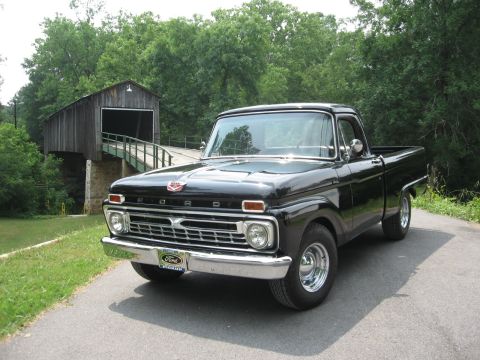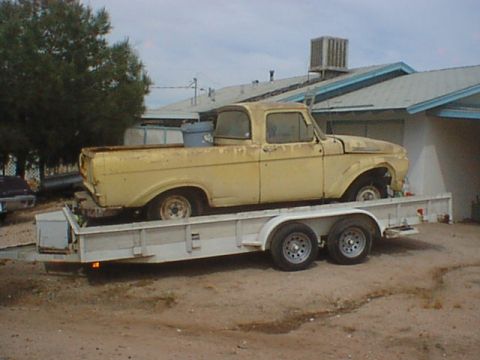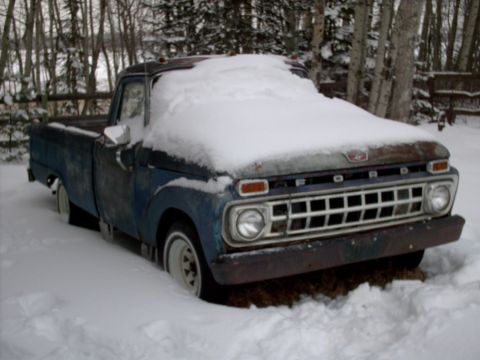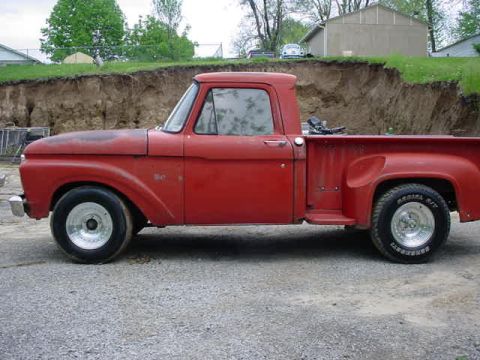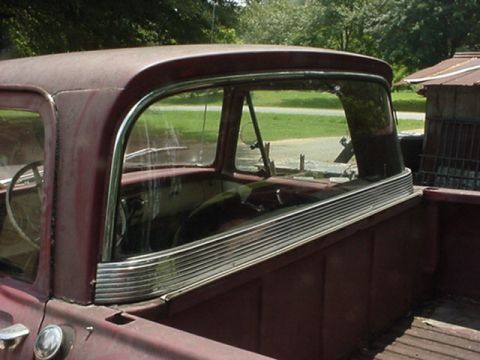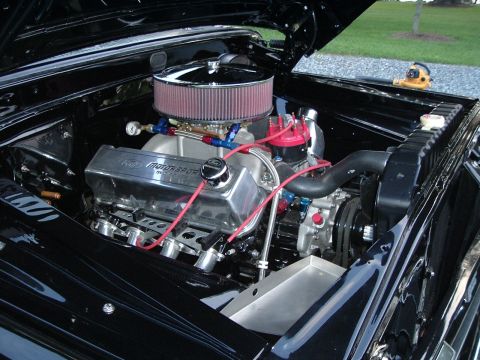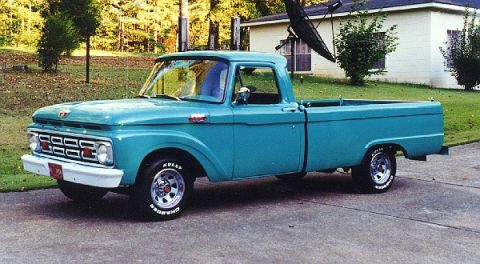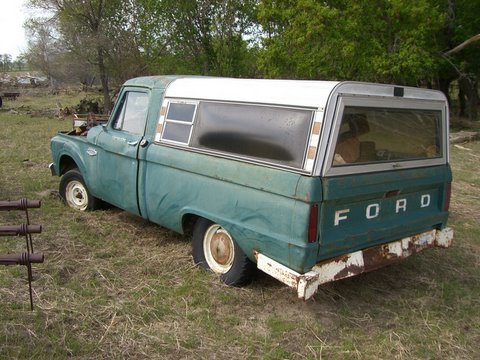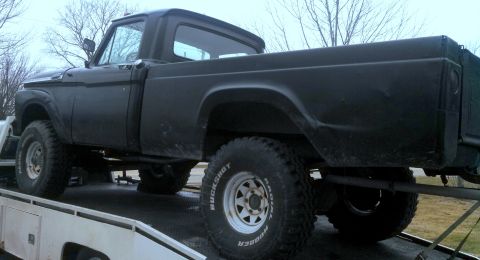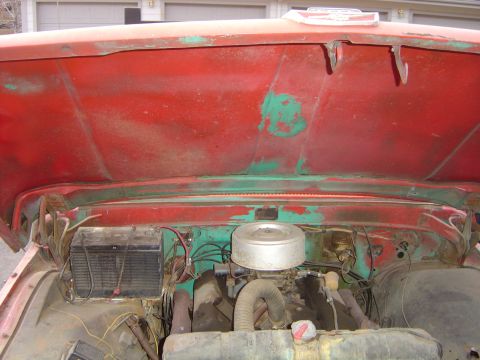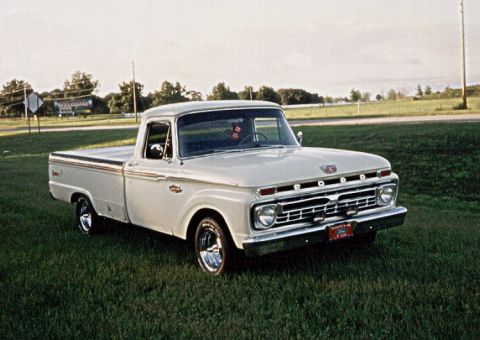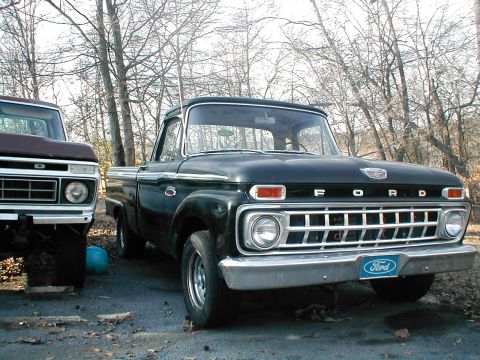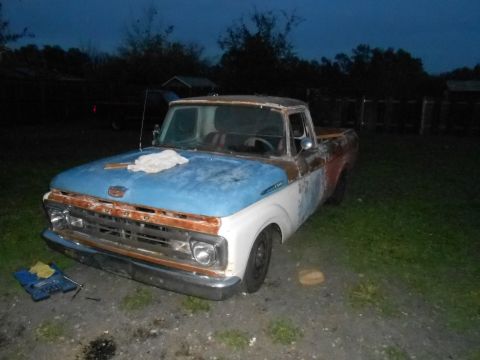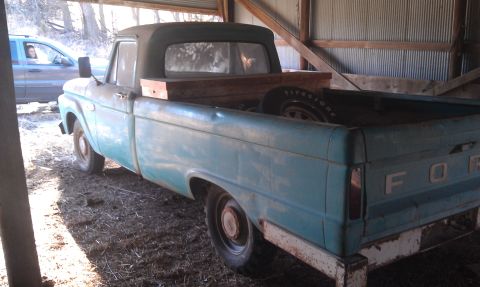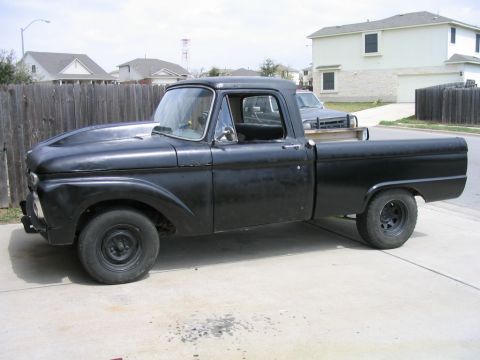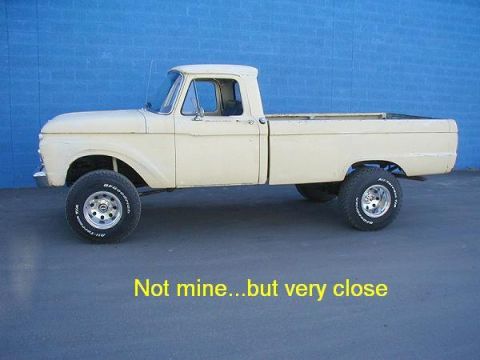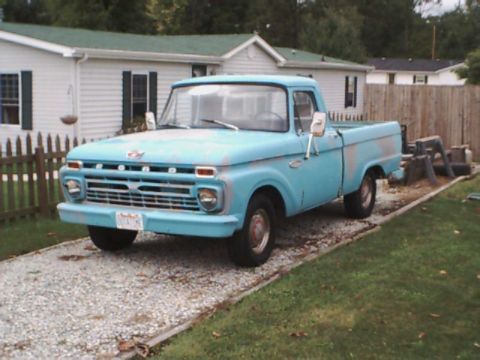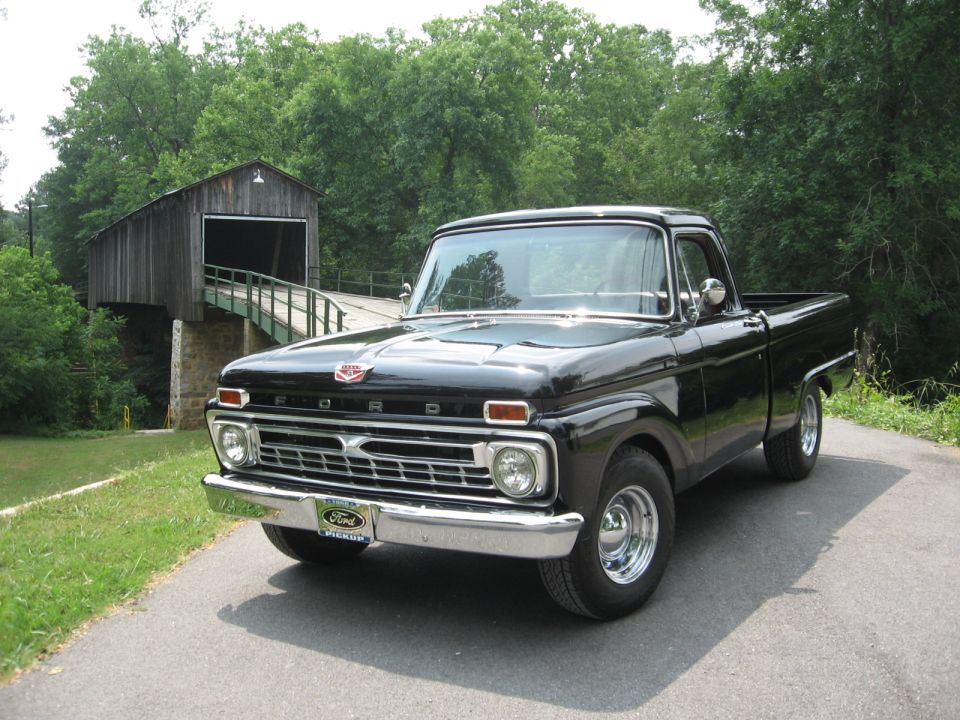
The 1961-1966 Ford F-100 was the fourth generation of Ford's F-Series and is best known for two features. The first was the integrated cab-and-bed "unibody" design offered from 1961 through 1963 on two-wheel-drive Styleside trucks, in which the cab and box were a single continuous structure rather than separate units. Ford dropped the integrated body partway through 1963, and the 1964 Ford F-100 returned to a conventional separate cab and bed. The second feature was the Twin-I-Beam front suspension, an independent front layout Ford introduced for the 1965 model year on the two-wheel-drive F-100. Engines spanned a transition: the 223-cubic-inch Mileage Maker six and 292-cubic-inch Y-block V8 carried over from the previous generation, and for 1965 Ford introduced the new 240-cubic-inch and 300-cubic-inch inline-sixes that would serve the F-100 for years, joined by the FE-family 352-cubic-inch V8, which replaced the 292 Y-block. Horsepower in this period was quoted in SAE gross figures, before the 1972 move to net ratings.
Other Ford F-100 generations
Ford F-100 1961-1966 at a glance
- Generation: Fourth-generation Ford F-Series, known for the unibody era and the arrival of Twin-I-Beam suspension.
- Integrated body: the cab-and-bed "unibody" design was offered 1961-1963 on two-wheel-drive Styleside trucks, then dropped partway through 1963.
- Twin-I-Beam: the independent Twin-I-Beam front suspension was introduced for the 1965 model year on the two-wheel-drive F-100.
- New sixes: the 240-cubic-inch and 300-cubic-inch inline-sixes were introduced for 1965, replacing the 223.
- V8 options: 292-cubic-inch Y-block through 1964; FE-family 352 V8 from 1965.
- Horsepower basis: SAE gross figures (pre-1972).
- Generation end: 1966 was the final year before the 1967 "Bumpside" fifth generation.
Year-by-year changes
| Model year | Standard six | V8 options | Key changes |
|---|---|---|---|
| 1961 Ford F-100 | 223 cu in Mileage Maker six | 292 Y-block V8 | Fourth-generation redesign; the integrated cab-and-bed "unibody" design debuts on two-wheel-drive Styleside trucks alongside the conventional separate-bed body. |
| 1962 Ford F-100 | 223 cu in Mileage Maker six | 292 Y-block V8 | The 292 Y-block remained the V8 option; the integrated cab-and-bed design continued on Styleside two-wheel-drive trucks. |
| 1963 Ford F-100 | 223 cu in Mileage Maker six | 292 Y-block V8 | Final year of the integrated cab-and-bed design, which Ford dropped partway through 1963 over market reception. |
| 1964 Ford F-100 | 223 cu in Mileage Maker six | 292 Y-block V8 | Restyled front end; the integrated body was gone and all F-100s returned to a conventional separate cab and bed. |
| 1965 Ford F-100 | 240 cu in six (300 cu in optional) | 352 FE V8 | The Twin-I-Beam independent front suspension was introduced on the two-wheel-drive F-100; the new 240-cubic-inch and 300-cubic-inch inline-sixes replaced the 223, and the FE-family 352-cubic-inch V8 replaced the 292 Y-block. |
| 1966 Ford F-100 | 240 cu in six (300 cu in optional) | 352 FE V8 | The 240 and 300 sixes and the 352 FE V8 carried over; final year of the fourth-generation body before the 1967 "Bumpside" redesign. |
The integrated cab-and-bed "unibody" (1961-1963)
The most distinctive feature of the early 1961-1966 Ford F-100 was the integrated cab-and-bed design, offered from 1961 through 1963 on two-wheel-drive Styleside trucks. In this layout, often called the "unibody," the cab and the cargo box were a single continuous body structure rather than two separate units bolted to the frame. Ford offered it alongside the conventional separate-bed F-100. The integrated design was not a commercial success, and Ford dropped it partway through the 1963 model year. The 1964 Ford F-100 returned exclusively to a conventional separate cab and bed.
Twin-I-Beam and the new sixes for 1965
For the 1965 model year Ford introduced the Twin-I-Beam front suspension on the two-wheel-drive F-100. The Twin-I-Beam was an independent front layout that used two long beam axles, each pivoting at the opposite frame rail, with radius arms to locate the wheels, combining beam-axle strength with the ride of independent suspension. The 1965 model year also brought Ford's new inline-six family to the F-100: the 240-cubic-inch six and the larger 300-cubic-inch six, replacing the older 223. The 300-cubic-inch six in particular became a durable F-100 base engine that continued in the F-Series for years.
Engines of the 1961-1966 Ford F-100
The 1961-1966 Ford F-100 spanned a clear engine transition. Early in the generation the base six was the 223-cubic-inch Mileage Maker and the V8 was the 292-cubic-inch Y-block. For 1965 Ford replaced the 223 six with the new 240-cubic-inch and 300-cubic-inch inline-sixes and replaced the 292 Y-block V8 with the FE-family 352-cubic-inch V8, which carried through 1966. All horsepower figures in this generation were quoted in SAE gross terms, before the 1972 move to net ratings, so the published numbers are higher than net figures would be for the same engines.
Body styles and four-wheel drive
The 1961-1966 Ford F-100 was sold as a two-door pickup with the smooth Styleside and the fendered Flareside beds, plus the integrated cab-and-bed Styleside in 1961-1963. Factory four-wheel drive, which Ford had added to the F-100 for 1959, continued to be available, and four-wheel-drive trucks used a solid front axle rather than the two-wheel-drive Twin-I-Beam introduced for 1965. The 1966 model year closed the fourth generation before the 1967 "Bumpside" redesign.
Frequently asked questions
What is the "unibody" Ford F-100?
The "unibody" Ford F-100 refers to the integrated cab-and-bed design Ford offered from 1961 through 1963 on two-wheel-drive Styleside trucks, in which the cab and box were a single body structure. Ford dropped it partway through 1963, and the 1964 F-100 returned to a separate cab and bed.
When did the Ford F-100 get Twin-I-Beam suspension?
Ford introduced the Twin-I-Beam independent front suspension on the two-wheel-drive Ford F-100 for the 1965 model year. Four-wheel-drive F-100 trucks continued to use a solid front axle.
When did the Ford F-100 get the 240 and 300 sixes?
Ford introduced the 240-cubic-inch and 300-cubic-inch inline-sixes on the F-100 for the 1965 model year, replacing the older 223-cubic-inch six. The 300-cubic-inch six became a long-running F-Series base engine.
What V8s did the 1961-1966 Ford F-100 use?
The 1961-1966 Ford F-100 used the 292-cubic-inch Y-block V8 through 1964; for 1965 Ford replaced it with the FE-family 352-cubic-inch V8, which continued for 1966.
Why did Ford drop the integrated body?
Ford dropped the integrated cab-and-bed Ford F-100 partway through the 1963 model year because of weak market reception. The 1964 Ford F-100 returned to a conventional separate cab and bed.
Sources
Asked all the time
What is the "unibody" Ford F-100?
The "unibody" Ford F-100 refers to the integrated cab-and-bed design Ford offered from 1961 through 1963 on two-wheel-drive Styleside trucks, in which the cab and box were a single body structure. Ford dropped it partway through 1963, and the 1964 F-100 returned to a separate cab and bed.
When did the Ford F-100 get Twin-I-Beam suspension?
Ford introduced the Twin-I-Beam independent front suspension on the two-wheel-drive Ford F-100 for the 1965 model year. Four-wheel-drive F-100 trucks continued to use a solid front axle.
When did the Ford F-100 get the 240 and 300 sixes?
Ford introduced the 240-cubic-inch and 300-cubic-inch inline-sixes on the F-100 for the 1965 model year, replacing the older 223-cubic-inch six. The 300-cubic-inch six became a long-running F-Series base engine.
What V8s did the 1961-1966 Ford F-100 use?
The 1961-1966 Ford F-100 used the 292-cubic-inch Y-block V8 through 1964; for 1965 Ford replaced it with the FE-family 352-cubic-inch V8, which continued for 1966.
Why did Ford drop the integrated body?
Ford dropped the integrated cab-and-bed Ford F-100 partway through the 1963 model year because of weak market reception. The 1964 Ford F-100 returned to a conventional separate cab and bed.
Technical Reference
Member-uploaded diagrams & documents for this generation. AI-classified; community-verified where badged.
Brochures & Literature (15)
- Ford ad, Free-Wheelin' Fords. They're TNT!, for the Free Wheeling Styleside, Bronco, Courier and Van packages with stripes and forged wheels.
- Ford Courier ad: biggest engine in its class with the optional 2.3 litre, a new 7-foot bed and sliding rear window, and the new XLT option.
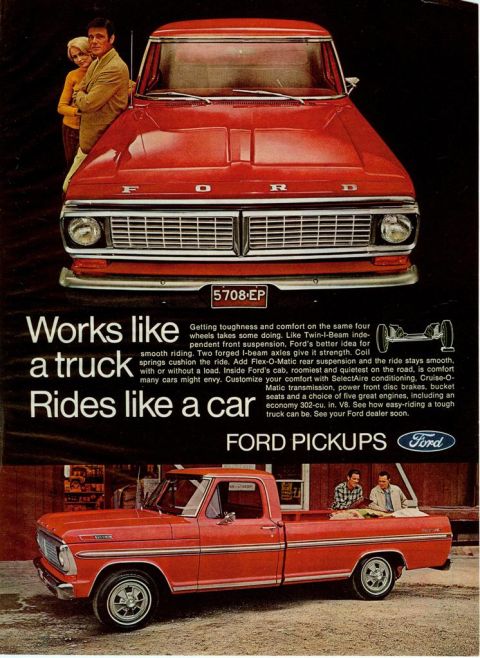
- Ford ad for limited-time Explorer Special pickups, covering Twin-I-Beam front suspension, I-beam axles and Flex-O-Matic rear suspension.
- 1977 Ford pickup ad featuring new 351 and 400 V-8 options and rust protection with over 350 sq. ft. of anti-corrosion coatings.
- 1962 Ford ad, only Ford gives you your choice of 3 lines of pickups, covering the one-piece cab-body Styleside, Econoline and Falcon Ranchero.
- Ford ad for 1973 pickups showing box cover, double-wall box sides, front disc brakes, blend-air heater and Twin-I-Beam suspension.
- Ford ad for the Free Wheeling Styleside with rainbow stripes and push bar, and the pinstriped Free Wheeling Shorty with blackout grille.
- Ford ad introducing the SuperCab pickup, showing the fold-flat rear seat, jump seats and 44-cu. ft. cargo space behind the front seat.
- Ford ad introducing the SuperCab pickup, a pickup cab roomy enough for a back seat, with 6-3/4 or 8-ft. box and GVWs to 9,300 lbs.
- Ford ad listing 12 facts about the 1974 pickup, including front disc brakes, Twin-I-Beam suspension and the F-350 Super Camper Special.
- Ford magazine ad for the 1966 Ranchero and Styleside pickup, with copy on the Ranchero's luxury interior and Styleside Twin-I-Beam suspension.
- 1966 Ford magazine ad introducing the all-new Bronco with 4-wheel drive, coil-spring ride, six-cylinder power and Roadster, Wagon and Sports-Utility models.
- 1973 Ford pickup brochure page showing Twin-I-Beam suspension, front disc brakes, slide-out tire carrier, galvanized panels and 133 in. wheelbase.
- Ditzler PPG Index No. 18 chart of 1965 commercial colors with paint chips, Ditzler codes and names for Chevrolet, Corvair 95, Ford truck, Econoline and GMC.
- Ford pickups ad touting Twin-I-Beam suspension, Flex-O-Matic rear suspension on F-250s and 390-cu. in. V-8, with Outsells every other pickup.
The wall · registered 1961-1966 F-100s
Sorted by depth of documentation. Click any vehicle to open its permanent record.