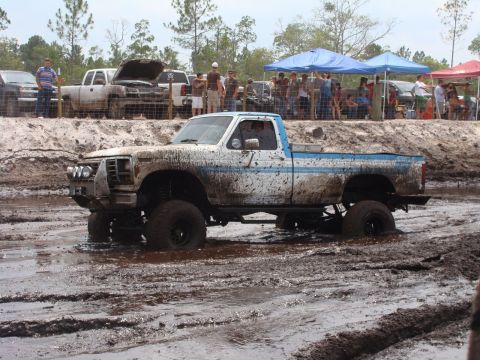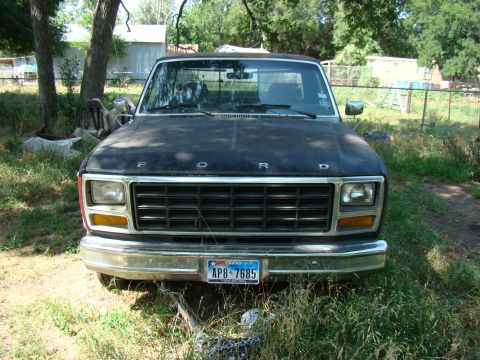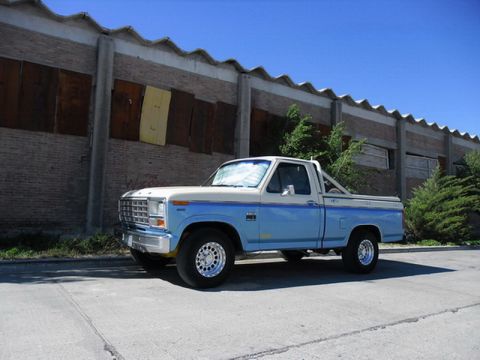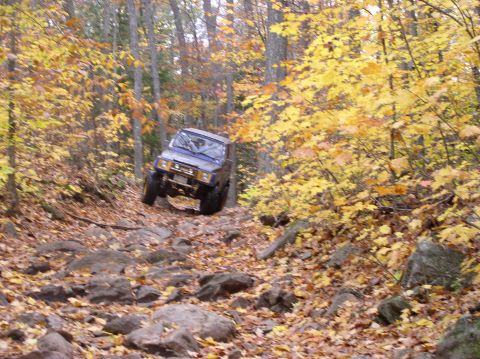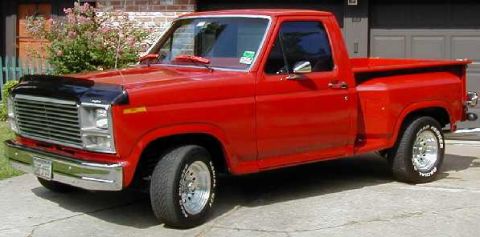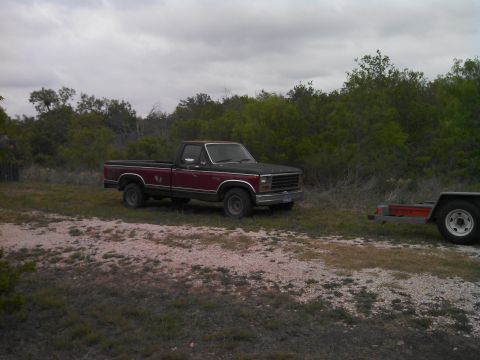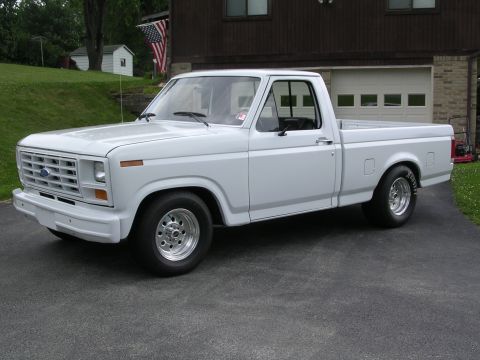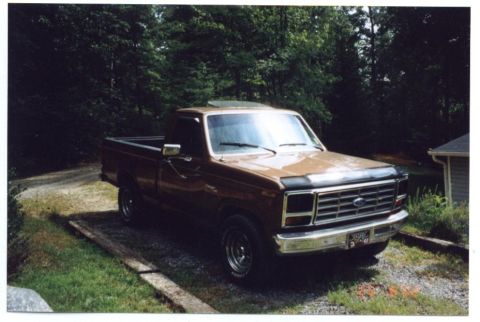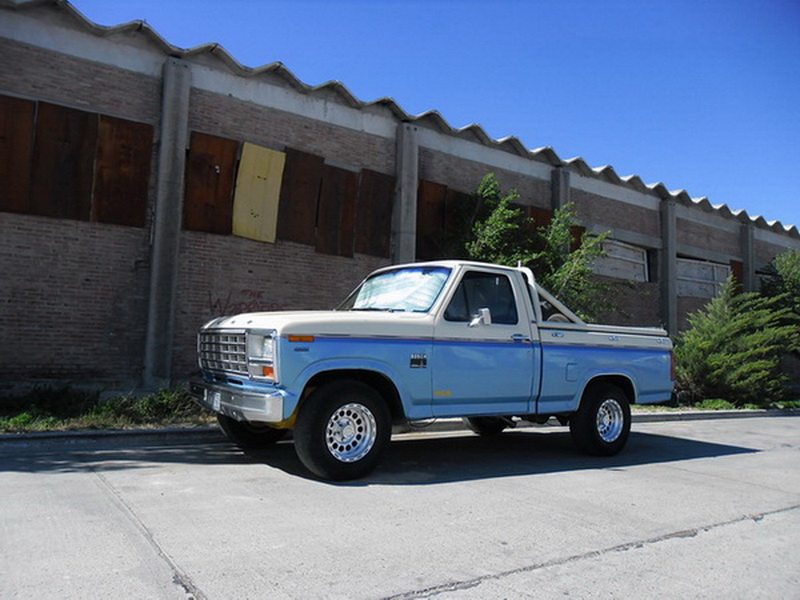
The 1980-1983 Ford F-100 was the seventh generation of Ford's F-Series and the final US-market F-100. Collectors nickname it the "Bullnose" for its squared body and aerodynamic front-end updates. This Ford F-100 was the lighter of Ford's two half-tons, positioned below the F-150 that had been introduced for 1975. Its engines were the 300-cubic-inch inline-six as the standard engine through 1981, a 3.8-liter V6 that replaced it as the base F-100 engine for 1982, and the small-block 255-cubic-inch (1981-1982) and 302-cubic-inch Windsor V8s, all reported in SAE net horsepower. The 351 V8s of this era were reserved for the F-150 and heavier trucks. The 1980 redesign emphasized weight reduction and aerodynamics in response to fuel-economy pressure. By the early 1980s the F-150 had been steadily absorbing the F-100's customer base, and the regulatory and economic case for maintaining a separate lighter half-ton had weakened. Ford retired the F-100 name in the United States after the 1983 model year, leaving the F-150 as the F-Series half-ton. The 1980-1983 Ford F-100 was sold only with two-wheel drive and used Twin-I-Beam front suspension; four-wheel drive was reserved for the F-150 and heavier F-Series trucks.
Other Ford F-100 generations
Ford F-100 1980-1983 at a glance
- Generation: Seventh-generation Ford F-Series, the "Bullnose," and the final US-market F-100.
- Standard engine: 300-cubic-inch (4.9L) inline-six through 1981; 3.8L V6 from 1982.
- V8 options: 255-cubic-inch (4.2L) Windsor V8 (1981-1982) and 302-cubic-inch (5.0L) Windsor V8; no 351 was offered in the F-100.
- Horsepower basis: SAE net figures.
- Position: the lighter half-ton, below the F-150 introduced for 1975.
- Front suspension: Twin-I-Beam independent front; the 1980-1983 F-100 was two-wheel drive only.
- Design focus: the 1980 redesign reduced weight and improved aerodynamics for fuel economy.
- End of the name: Ford retired the F-100 name in the US after the 1983 model year, leaving the F-150 as the half-ton.
Year-by-year changes
| Model year | Standard engine | V8 options | Key changes |
|---|---|---|---|
| 1980 Ford F-100 | 300 cu in (4.9L) inline-six | 302 Windsor | Seventh-generation "Bullnose" redesign with a squarer body and aerodynamic and weight-reduction updates. The F-100 continued as the lighter half-ton below the F-150. |
| 1981 Ford F-100 | 300 cu in (4.9L) inline-six | 255, 302 Windsor | The 255-cubic-inch (4.2L) V8, exclusive to the F-100, joined the 302 as an economy V8 option. |
| 1982 Ford F-100 | 3.8L V6 | 255, 302 Windsor | A 3.8-liter V6 became the standard F-100 engine; the Blue Oval Ford emblem was adopted on the grille. |
| 1983 Ford F-100 | 3.8L V6 | 302 Windsor | The 255 V8 was dropped. Final model year for the F-100 in the United States. Ford retired the F-100 name after 1983, leaving the F-150 as the F-Series half-ton. |
The "Bullnose" redesign for 1980
The 1980 Ford F-100 introduced the seventh-generation F-Series, nicknamed the "Bullnose" for its squarer body and reshaped front end. The 1980 redesign focused on reducing weight and improving aerodynamics in response to fuel-economy pressure, while keeping the body-on-frame layout and the Twin-I-Beam front suspension on two-wheel-drive trucks. The Ford F-100 remained the lighter of Ford's two half-tons, positioned below the F-150 that had arrived for 1975. This "Bullnose" body continued on the F-Series after the F-100 name was dropped.
Engines of the 1980-1983 Ford F-100
The standard engine of the 1980 and 1981 Ford F-100 was the 300-cubic-inch (4.9L) inline-six, the durable long-stroke truck six that had served the F-Series since 1965; for 1982 a 3.8-liter V6 replaced it as the base F-100 engine. The V8 options were the 302-cubic-inch (5.0L) Windsor and, for 1981 and 1982, the economy 255-cubic-inch (4.2L) Windsor. The 351 (5.8L) V8s of this era were offered on the F-150 and heavier trucks, not the F-100. All horsepower in this generation was reported in SAE net figures, the standard since 1972, so the numbers read lower than the gross figures of the pre-1972 F-100s. The larger big-blocks of the previous generation were not part of the lighter F-100 lineup by this point.
Why Ford retired the F-100
The 1983 Ford F-100 was the final F-100 in the United States. The F-150, introduced above the F-100 for 1975 as a heavier half-ton, had been steadily taking over the half-ton's customer base. By the early 1980s the F-150 had become the volume half-ton, and the case for maintaining a separate, lighter F-100 had weakened. Ford retired the F-100 name in the US after the 1983 model year, and the F-150 became the F-Series half-ton. The "Bullnose" body itself continued on the F-150 and the rest of the F-Series.
Drivetrain, body styles, and trims
The 1980-1983 Ford F-100 used a body-on-frame layout with a leaf-sprung live rear axle. All seventh-generation F-100s were two-wheel drive and used the Twin-I-Beam independent front suspension; four-wheel drive, offered on the F-150 and heavier models, used Ford's new Twin-Traction Beam independent front suspension rather than a solid axle. The Ford F-100 was sold as a regular cab and an extended cab with the Styleside and Flareside beds, and in trim levels that ranged from the base Custom up through the Ranger and XLT. Transmissions included manual and automatic options.
Frequently asked questions
What is the "Bullnose" Ford F-100?
"Bullnose" is the collector nickname for the 1980-1983 seventh-generation Ford F-Series, given for its squarer body and reshaped front end. The Ford F-100 versions of this body run from the 1980 redesign through the final 1983 model year.
When did the Ford F-100 end?
The Ford F-100 ended in the United States after the 1983 model year. Ford retired the F-100 name and left the F-150, which had been introduced above it for 1975, as the F-Series half-ton.
What engines did the 1980-1983 Ford F-100 use?
The 1980-1983 Ford F-100 used the 300-cubic-inch (4.9L) inline-six as standard through 1981 and a 3.8-liter V6 from 1982, with the 255-cubic-inch (1981-1982) and 302-cubic-inch Windsor V8s as options, all rated in SAE net horsepower. No 351 was offered in the F-100.
Why did the F-150 replace the F-100?
The F-150, introduced above the F-100 for 1975 as a heavier half-ton, gradually took over half-ton sales. By the early 1980s the F-150 had become the volume half-ton, and Ford retired the lighter F-100 after 1983, leaving the F-150 as the F-Series half-ton.
Did the 1980-1983 Ford F-100 have Twin-I-Beam suspension?
All 1980-1983 Ford F-100 trucks were two-wheel drive and used the Twin-I-Beam independent front suspension. The F-100 was not offered with four-wheel drive in this generation.
Sources
Asked all the time
What is the "Bullnose" Ford F-100?
"Bullnose" is the collector nickname for the 1980-1983 seventh-generation Ford F-Series, given for its squarer body and reshaped front end. The Ford F-100 versions of this body run from the 1980 redesign through the final 1983 model year.
When did the Ford F-100 end?
The Ford F-100 ended in the United States after the 1983 model year. Ford retired the F-100 name and left the F-150, which had been introduced above it for 1975, as the F-Series half-ton.
What engines did the 1980-1983 Ford F-100 use?
The 1980-1983 Ford F-100 used the 300-cubic-inch (4.9L) inline-six as standard through 1981 and a 3.8-liter V6 from 1982, with the 255-cubic-inch (1981-1982) and 302-cubic-inch Windsor V8s as options, all rated in SAE net horsepower. No 351 was offered in the F-100.
Why did the F-150 replace the F-100?
The F-150, introduced above the F-100 for 1975 as a heavier half-ton, gradually took over half-ton sales. By the early 1980s the F-150 had become the volume half-ton, and Ford retired the lighter F-100 after 1983, leaving the F-150 as the F-Series half-ton.
Did the 1980-1983 Ford F-100 have Twin-I-Beam suspension?
All 1980-1983 Ford F-100 trucks were two-wheel drive and used the Twin-I-Beam independent front suspension. The F-100 was not offered with four-wheel drive in this generation.
Technical Reference
Member-uploaded diagrams & documents for this generation. AI-classified; community-verified where badged.
Exploded Parts (2)
- Ford F-250 NP205 Transfer Case Installation Diagram - Linkage & Torque SpecsThis is a scanned page (16-84-5) from a Ford factory service manual covering the New Process 205 transfer case. It presents Figure 4, "Model 205 Transfer Case Installation, F-250," showing multiple exploded/detail…
- Ford NP205 Transfer Case Installation Diagram F-250 - Linkage Adjustment & TorqueThis is a scanned page (section 16-84-4) from a Ford factory shop manual covering the New Process 205 transfer case. The page presents Figure 3, an exploded/installation illustration of the Model 205 transfer case as…
Service Procedures (1)
- Ford F-250 4x4 Transfer Case Removal & Installation Procedure (06-07-02)This is a scanned page (section 06-07-02) from a Ford factory shop manual covering the four-wheel drive transfer case on the F-250 4x4. Section 2, 'Removal and Installation,' provides step-by-step procedures. The…
The wall · registered 1980-1983 F-100s
Sorted by depth of documentation. Click any vehicle to open its permanent record.